
In-House Videographer vs Production Company: The Real Cost Maths
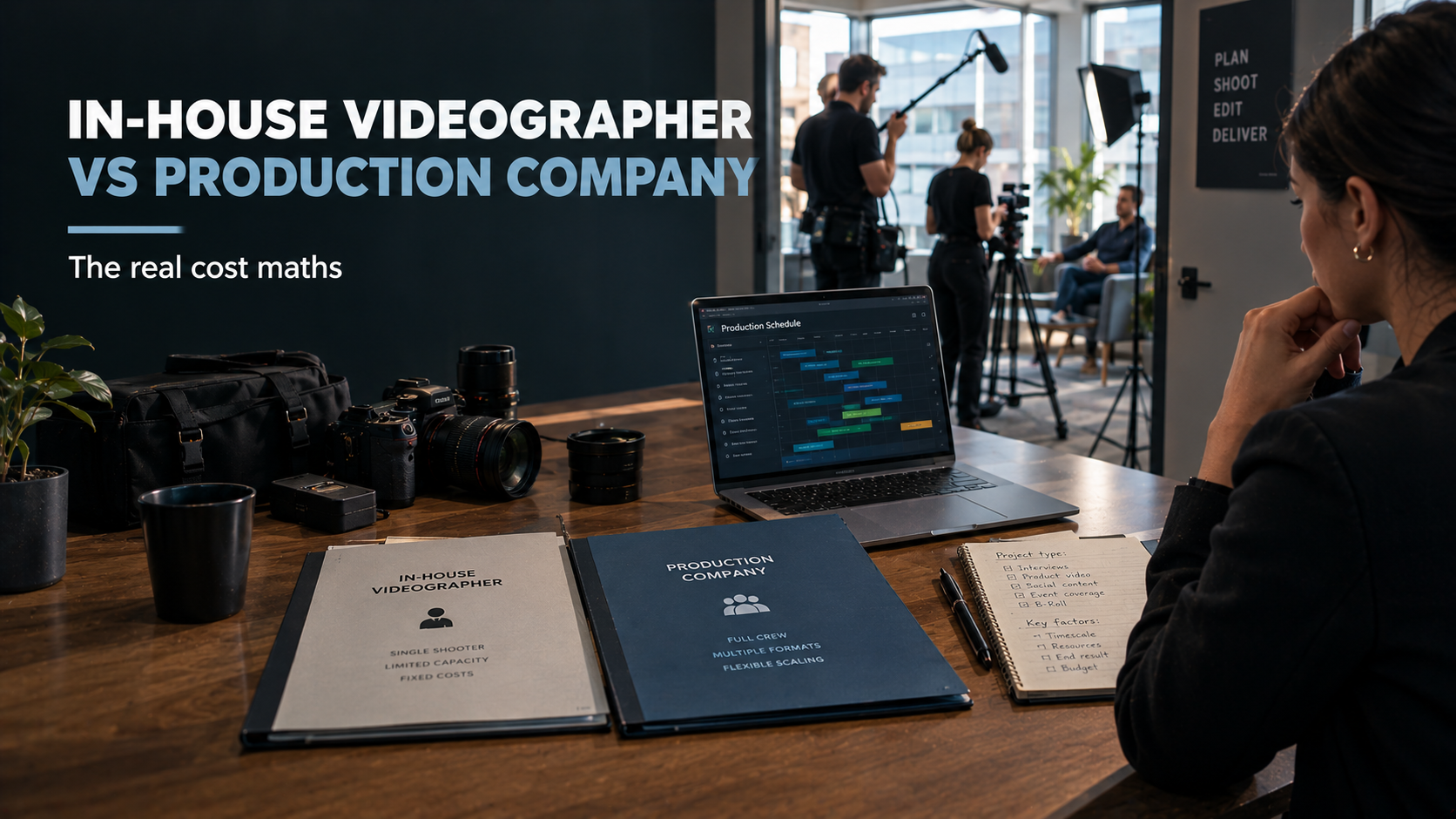
In-House Videographer vs Production Company
Hiring an in-house videographer can seem like the obvious next step when your business needs more video content. You have someone on the team, the cameras are available, and there is no need to arrange an external crew every time marketing needs a new video.
But there is a question worth asking before creating the job advert: how much finished content will that person actually deliver for the money you spend?
A salary is only one part of the cost. Equipment, software, employment overheads, editing time and the volume of work the business expects all affect the real investment. There is also the question of whether one person can cover every skill your content requires.
For some businesses, hiring internally is absolutely the right decision. For others, working with a production company or agreeing a regular production retainer can deliver greater flexibility without the same fixed commitment.
The difference comes down to the numbers, the workload and what your marketing team needs video to achieve.
What does an in-house videographer really cost?
A capable shooter-editor in the North West might command a salary of approximately £28,000–£40,000 a year, depending on experience, responsibilities and technical skills.
At first glance, that may appear more economical than regularly commissioning a production company. However, the salary does not represent the full cost of employing someone to manage video production.
Salary and employment costs
The advertised salary is the starting point. Employers also need to account for relevant National Insurance contributions, pension contributions, paid leave, recruitment costs and the management time required to support the role.
There may also be costs associated with training, professional development and covering work when the employee is unavailable.
The precise total depends on the employment package and the employer's circumstances, so these costs should be calculated using the actual figures rather than a generic estimate.
Cameras, lighting and audio equipment
An in-house videographer needs access to equipment suitable for the work they are expected to produce.
That could include cameras, lenses, lighting, microphones, audio recording equipment, tripods, stabilisation equipment, batteries and storage media.
A practical kit can cost several thousand pounds, while a more comprehensive setup may require an initial investment of £10,000–£20,000 or more.
Equipment is not a one-off expense that disappears after purchase. It needs maintenance, occasional replacement and upgrades as the business's requirements change.
The company also needs somewhere secure to store it and a process for managing equipment between shoots.
Software, storage and post-production
Video production requires more than a camera and an editing application.
Depending on the workflow, the business may need editing software, graphics tools, cloud services, backup storage, asset management and sufficient computer hardware to handle demanding projects.
A planning allowance of £1,000–£2,000 a year for software and storage may be reasonable for some setups, but it will not cover every business's requirements. Workstations, additional storage and specialist software can add considerably more.
The cost of employing one person
Taking salary, equipment, software and employment overheads together, an annual budget of approximately £45,000–£60,000 can be a useful planning estimate for an in-house videographer in this scenario.
It is not a universal market rate. The actual cost could fall below or exceed that range depending on the salary, employer contributions, equipment requirements and the level of support the role needs.
There is another consideration: that investment buys one employee's available time and skill set.
A strong shooter-editor may be capable of handling interviews, filming, editing and basic graphics. More demanding projects may require additional expertise in sound recording, animation, motion graphics, colour grading or creative direction.
If the business expects one person to handle all of these tasks, the role can quickly become a bottleneck.
What can the same budget buy from a production company?
An external production company offers a different model. Instead of paying for a permanent employee and maintaining an internal equipment setup, the business commissions the production capacity it needs.
With an annual budget of £45,000–£60,000, a company could potentially fund a regular production schedule, with planned filming days, a defined collection of finished assets and access to different specialists.
For example, a monthly production arrangement could include a filming day, employee or customer interviews, supporting footage and an agreed package of edited videos. The exact output would depend on the scope and pricing of the contract.
A team with the right workflow might produce a main film, several short videos and vertical social clips from one session. Additional stills or written content could be included where agreed.
This approach offers several advantages.
Access to different skills. A production company can bring together camera operators, sound specialists, editors and motion graphics professionals according to the project.
Flexible capacity. The business can increase production for a campaign or reduce activity when fewer assets are required, subject to the agreement in place.
Defined deliverables. A clear scope establishes what the company should receive, how much editing is included and when the work will be delivered.
Less equipment management. The business does not need to purchase and maintain an entire production setup for work commissioned externally.
However, external production is not automatically cheaper. A high-volume business that requires filming every day may spend more on repeated commissions than it would on an effective internal team. The comparison only works when the expected workload and deliverables are clearly defined.
The hidden cost of an in-house videographer: Internal requests
There is a practical challenge that rarely appears in a salary comparison.
Once someone is hired to handle video, other departments discover that they can request video-related work too.
Marketing needs a social clip. HR wants staff headshots. Sales needs a presentation edited. Someone asks for a screen recording, an event recap or a quick video for an internal meeting.
Individually, these requests may be reasonable. Together, they can consume a surprising amount of the employee's working week.
The role gradually becomes the company's general-purpose visual support desk, while the strategic content that justified the hire gets pushed further down the schedule.
This is not necessarily a problem with the employee. It is a workload and management problem.
If you hire internally, establish the purpose of the role before the first request arrives. Decide how much time should be spent on planned marketing content, what counts as urgent work and which tasks need to be handled by other departments or external suppliers.
Without that structure, a business can pay for a full-time videographer without getting the volume of marketing content it expected.
When does hiring in-house make sense?
An in-house videographer can be a strong investment when video is a daily operational requirement rather than an occasional marketing activity.
Your business needs filming most days
Businesses built around frequent video publishing may need a person available to capture developments as they happen.
This can apply to content-led brands, media businesses, large social media operations and organisations with a continuous stream of products, events or activities to document.
When there is enough consistent work, an internal role can reduce scheduling friction and give the business greater control over day-to-day production.
Speed matters more than a large production setup
Some content needs to be captured and published quickly. A team might need a same-day update, a short product demonstration or footage of an event that cannot be recreated later.
Having someone on site can make that easier, particularly when the content is relatively simple and the business has an established workflow.
You can protect the role's priorities
An internal videographer needs clear objectives and realistic expectations.
If the business wants regular marketing content, the employee should have dedicated time to plan, film and edit it. A manager should also be able to distinguish between strategic content requirements and requests that can be handled another way.
Hiring internally works best when the company can provide enough work, suitable equipment, appropriate management and a realistic scope for one person's capabilities.
When is a production company the better choice?
External production can make more sense when the business needs planned, professional content rather than a camera operator available every day.
You need consistency, not permanent availability
If the business can plan its video requirements in advance, a monthly or quarterly production schedule may cover its needs without requiring a full-time employee.
A planned filming day can capture interviews, supporting footage and several pieces of content in one visit. The finished assets can then be scheduled across the following weeks.
The work requires specialist production skills
Customer-facing campaigns, brand films, complex interviews and high-stakes corporate productions may need a combination of creative planning, filming, sound, editing and graphics.
A production company can assemble the appropriate team for the project rather than expecting one employee to master every discipline.
That does not mean an in-house videographer cannot produce excellent work. It means the business should match the complexity of the project to the skills and resources available.
You want to control fixed costs
External production lets a business commission work according to its needs and available budget.
A smaller company might begin with a defined monthly retainer of around £1,500–£3,000, depending on the scope, or commission individual projects when required.
These are illustrative budget ranges rather than guaranteed prices. The number of filming days, editing requirements, asset count and level of creative development will determine what is achievable.
The advantage is that the business can define its requirements before committing to the work.
A third option: Combine in-house speed with external expertise
The decision does not always have to be one or the other.
For some businesses, a hybrid arrangement provides the best balance. A junior in-house content creator or videographer can handle everyday filming, simple updates and quick-turnaround requests, while a production company manages larger campaigns and planned content days.
The internal person understands the business, can capture activity as it happens and helps keep routine content moving. The external team provides additional capacity, specialist skills and a structured production process when the work demands more.
For example, the internal employee might capture a quick update from a team meeting, while the production company handles a customer case study, a series of service explainers or a planned batch of marketing content.
The responsibilities need to be clear. Otherwise, the company risks paying twice for the same work or creating confusion over who owns the content plan.
A well-designed hybrid arrangement separates daily capture from more demanding production requirements and gives each resource a defined purpose.
How to compare the costs properly

Production Planning in the Creative Studio
Before deciding which model to use, compare the total annual investment against the content the business actually needs.
Start by estimating the number of filming days required each month, the number of finished assets you expect to publish and the complexity of those assets.
Then calculate the full internal cost, including employment expenses, equipment, software, storage, management and any external specialists you may still need.
For an external arrangement, include production fees, editing, travel where applicable, revisions, additional deliverables and any costs associated with distribution.
Next, examine the practical capacity. How quickly can each option respond to a request? How much content can it realistically deliver? What happens when several projects need attention at once? Who covers the work when the main person is unavailable?
Finally, look beyond the number of files delivered. A collection of videos that nobody uses is not better value simply because the cost per asset looks low.
The useful comparison is the cost of producing the right content to the standard required, at a pace the business can sustain.
The real question is how much content your business needs
An in-house videographer can be the right choice when the business has enough regular work to justify a permanent role, needs daily access to filming and can protect the employee's time for the tasks that matter.
A production company can be more suitable when the business needs a regular supply of professionally produced content, access to different specialists and the flexibility to scale production up or down.
A hybrid approach may be best when daily capture is important but larger campaigns still require a broader production team.
At Title Productions, we help businesses plan video production around the content they need and how they intend to use it. That includes looking beyond the main film to consider interviews, shorter edits, supporting footage and the wider marketing requirements. You can explore our video production work to see examples of our approach.
The best decision is not automatically the option with the lowest headline price. It is the model that gives your business the right production capacity, quality and consistency without paying for resources it does not use.
If you are weighing up an internal hire against external production, contact Title Productions to discuss the volume of content you need and the production model that could suit your business.