
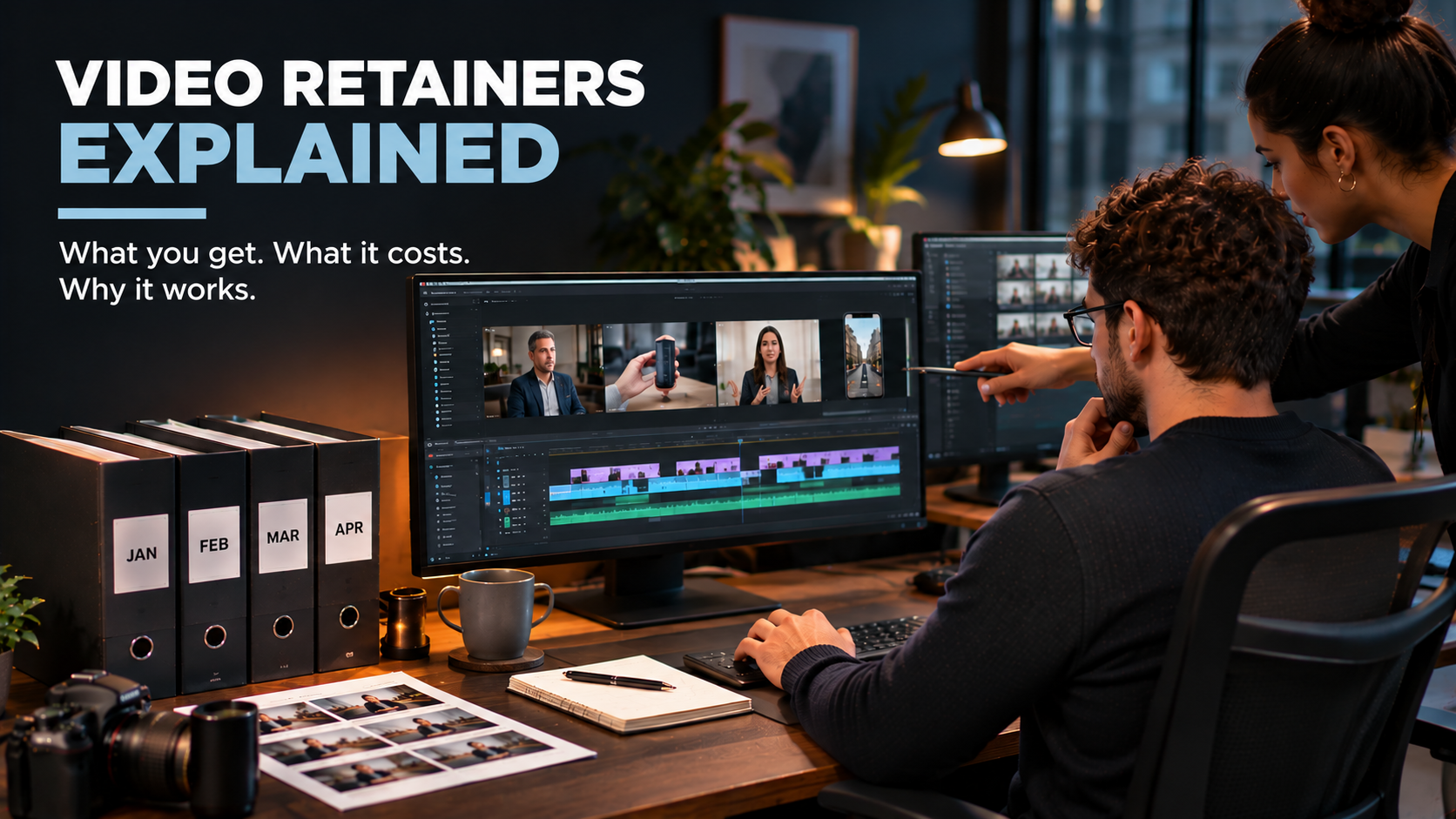
Video Retainers Explained_ Editing Workspace
Your business needs a video for LinkedIn. A few weeks later, the sales team requests a customer testimonial. Then there's a product launch, a recruitment campaign and another request for short-form content.
Each project starts the same way: a new brief, another quote, scheduling discussions, filming arrangements and an editing process.
Before long, your marketing team is spending almost as much time organising video production as it is using the finished content.
This is a common problem for businesses investing in video marketing. They need content regularly, but they're still buying production as though it's an occasional requirement.
A video production retainer offers a different approach.
Instead of commissioning individual videos whenever the need arises, a business pays an agreed monthly fee for recurring production services, usually including scheduled filming, editing, planning and a defined package of content.
In the UK, video production retainers can typically range from £1,500 to £5,000 per month, depending on the filming requirements, production team, editing workload and number of deliverables.
The real advantage isn't simply a lower production cost. It's having a dependable system that turns business knowledge, customer stories and marketing ideas into a consistent supply of usable content.
Here's what a video production retainer should include, how pricing works and how to decide whether it's the right investment for your business.
What Is a Video Production Retainer?
A video production retainer is an ongoing agreement between a business and a production company to deliver video content on a recurring basis.
Rather than paying separately for every filming session or editing project, the business agrees to a regular fee in exchange for a defined scope of work.
For many SMEs and B2B businesses, that means one planned filming day each month, followed by the production of several videos for different marketing purposes.
The arrangement might include corporate interviews, social media clips, customer testimonials, product demonstrations, recruitment content and campaign assets.
The exact deliverables depend on the agreement.
A simple retainer could provide a monthly filming session and a handful of edited videos. A larger package might include creative planning, multiple locations, specialist production requirements and a wider range of content formats.
What makes it different from a one-off video project is the recurring workflow.
The production team becomes familiar with your business, understands your marketing priorities and develops content according to an agreed schedule.
Instead of beginning with a new supplier conversation every time you need a video, production becomes part of your normal marketing operation.
Why Businesses Are Moving Towards Recurring Video Production
The way businesses use video has changed.
A corporate video that sits on a homepage for several years may still have value, but it rarely covers everything a modern marketing team needs.
Businesses also use video to explain services, support sales conversations, recruit employees, demonstrate products, share customer experiences and maintain a presence across social platforms.
Those requirements don't appear once a year.
They develop throughout the year, often across several departments.
The difficulty is that traditional project-based production doesn't always match that demand.
If every video requires a separate quote, brief and production schedule, the process can become slow and fragmented.
A recurring agreement helps address that problem by creating a regular opportunity to capture and produce content.
For example, a monthly filming day could include a leadership interview, a technical demonstration and several answers to frequently asked customer questions.
That footage can then be developed into different formats and distributed over the following weeks.
The business gains a predictable production rhythm, while the marketing team has a clearer understanding of what content will be available and when.
A retainer works best when video is an ongoing business requirement rather than an occasional creative project.
What Should a Video Production Retainer Include?
Not all video retainers offer the same level of service.
Some focus primarily on filming and editing. Others include planning, creative direction, distribution support and performance reviews.
Before agreeing to a monthly fee, it's important to understand exactly what the production company is responsible for delivering.
1. A Recurring Filming Schedule
For many businesses, the foundation of a video retainer is a monthly filming day.
This provides a dedicated opportunity to capture interviews, demonstrations, workplace footage, customer stories and other material needed for upcoming content.
The schedule should be agreed in advance so the business can arrange suitable locations, prepare contributors and organise any products or equipment required.
Some retainers include a full filming day, while others provide half-day sessions or multiple shorter visits.
The right arrangement depends on how much content the business needs and how complicated it is to capture.
A company filming interviews in one office may require a different setup from a manufacturer recording processes across several facilities.
The important point is that filming becomes predictable rather than something organised at the last minute.
2. A Defined Monthly Deliverable Package
A good video production retainer should clearly explain what the business receives each month.
For example, a package might include:
One main corporate, educational or campaign video.
Three shorter videos focused on specific messages.
Ten vertical clips for LinkedIn, Instagram Reels or YouTube Shorts.
Selected stills or supporting visual assets.
Captions and platform-appropriate versions of the agreed videos.
This is an illustrative package, not a standard inclusion at every price point. The final output will depend on the footage, editing complexity and agreed budget.
The important distinction is between purchasing production time and purchasing finished content.
A filming day is an input.
The edited videos, approved formats and usable marketing assets are the outputs.
If a supplier promises a monthly filming day but leaves the number of edited videos undefined, it's difficult to know what you're actually buying.
A proper agreement should identify the deliverables, expected lengths, aspect ratios, revision allowances and delivery dates.
That gives both parties a clear understanding of the work involved.
3. Content Planning and Creative Preparation
Filming is more productive when everyone knows what needs to be captured.
That's why planning should be part of a strong retainer.
Before each session, the production company and marketing team should agree on the subjects, intended audience and purpose of the content.
Preparation might include interview questions, shot lists, location requirements, production schedules and recommendations for adapting footage into different formats.
This doesn't mean the production company should make every marketing decision on your behalf.
Your internal team still understands your customers, commercial priorities and upcoming campaigns.
But the production partner should help translate that knowledge into a practical filming and editing plan.
If your team is expected to arrive with fully developed scripts, shot lists and editing instructions every month, the agreement may provide less strategic support than the word retainer suggests.
4. A Consistent Production Team
One of the less obvious benefits of recurring production is familiarity.
When the same production team works with your business regularly, they begin to understand your services, working environment, brand preferences and communication style.
They learn which locations work well for filming and how to get the best from the people appearing on camera.
Your employees also become more comfortable with the process.
Someone who feels nervous during their first interview may be considerably more confident after several sessions with a familiar crew.
This can make filming more efficient and improve the natural quality of the content.
The production team also develops a stronger understanding of what your business wants to communicate.
That knowledge is valuable because it doesn't need to be rebuilt with every project.
5. Reliable Scheduling and Clear Turnaround Times
Recurring production should make planning easier.
A good retainer agreement will explain when filming takes place, how editing is scheduled and when the finished content is expected.
It should also clarify how urgent requests are handled.
For example, a business might need a short video to support an unexpected announcement or upcoming event.
An established production relationship may make it easier to discuss that requirement without starting a completely new procurement process.
However, priority scheduling shouldn't be assumed to mean unlimited availability.
The agreement should specify what flexibility exists, whether additional work attracts extra charges and how changes affect existing deadlines.
How Much Does a Video Production Retainer Cost in the UK?
For many UK SMEs, a practical planning range is £1,500 to £5,000 per month.
These are indicative budget ranges rather than fixed industry prices. Actual quotes vary according to location, crew size, filming duration, editing requirements and the scope of the agreement.
£1,500–£3,000 Per Month: A Focused Content Retainer
This range may suit businesses looking to establish a consistent video presence without commissioning major campaigns every month.
Depending on the supplier and scope, it could include a regular filming session, editing and a defined selection of short-form content.
It is particularly relevant for businesses that need expert interviews, social media clips, straightforward demonstrations or regular corporate updates.
At this level, efficiency matters.
Filming in one location, planning several topics in advance and using a repeatable editing approach can help make the budget go further.
However, don't assume every package in this range includes a full filming day and a large number of edited assets. Always check the actual deliverables.
£3,000–£5,000 Per Month: A Broader Production Programme
A larger monthly budget may allow for more extensive content planning, additional filming requirements or a wider range of deliverables.
This could include multiple contributors, more complex editing, several locations or content supporting different departments and campaigns.
For example, a business might use its monthly production capacity to create a substantial customer story alongside recruitment videos and short social media content.
The extra investment should translate into a clearly defined increase in production scope, creative support or usable output.
Above £5,000 Per Month: More Complex Production Requirements
Businesses running substantial campaigns or requiring frequent filming may need a larger arrangement.
This can involve specialist crew, additional shoot days, animation, advanced post-production, travel or more demanding production schedules.
At this level, the agreement should be tailored closely to the business's actual requirements.
The monthly fee alone doesn't tell you whether a retainer offers good value.
What matters is the quality, quantity and usefulness of the content delivered for that investment.
Is a Video Retainer Cheaper Than One-Off Production?
It can be, particularly when a business needs a consistent volume of similar content.
One-off projects often involve repeated setup work.
The supplier needs to understand the brief, organise the production, schedule the crew, prepare equipment and establish the editing requirements.
When the next project begins, parts of that process happen again.
A retainer can reduce some of that repetition.
The production team already knows the business. Filming sessions can be grouped together. Editing formats can be standardised, and planning can happen around a recurring schedule.
Those efficiencies may reduce the average cost of each finished asset.
For illustration, consider a business paying £2,500 per month for a package that delivers 15 usable content assets.
That works out at approximately £167 per asset.
The calculation is a simple average, not a claim that every asset costs the same amount to produce. A substantial video requires different resources from a short clip or still image.
The comparison becomes useful when you assess the cost of commissioning the same deliverables separately.
Some recurring arrangements may offer savings of 20–40% per asset compared with equivalent one-off work, but that is not a guaranteed market discount. The actual saving depends on the quotes, scope and production efficiency.
A retainer only offers better value when the business consistently uses the capacity and receives content it genuinely needs.
Unused filming time and unnecessary deliverables can quickly eliminate any apparent saving.
Video Retainer vs Hiring an In-House Videographer
Businesses considering regular video production often face another decision: should they hire someone internally instead?
An in-house videographer can be valuable, particularly when a business needs filming almost every day.
They are available within the organisation, can respond to routine requests and may develop a detailed understanding of internal operations.
However, the cost extends beyond salary.
For a UK business, a videographer earning £30,000–£40,000 annually may also require equipment, software, storage, employer contributions, training and management support.
Depending on those costs, the overall annual investment can reach approximately £45,000–£60,000 or more.
A £2,500 monthly production retainer, by comparison, represents £30,000 annually.
That doesn't automatically make outsourcing the better choice.
The two arrangements provide different kinds of capacity.
An internal employee may be able to capture spontaneous events, support daily production and respond quickly to requests.
An external production company may provide access to a broader combination of filming, lighting, sound, editing and creative expertise without requiring the business to employ each specialist.
For businesses with frequent but planned content requirements, a retainer can be an attractive alternative.
For those producing video every day, an in-house role or a combination of internal and external support may be more appropriate.
The right decision depends on the amount of work, its complexity and how quickly content needs to be produced.
The Compounding Benefit of Working With the Same Production Team
One of the strongest arguments for a recurring production relationship has little to do with the monthly fee.
It's what happens as the relationship develops.
During the first filming session, the production team is still learning about your business.
They need to understand the environment, meet contributors, establish visual preferences and become familiar with the subject matter.
By the third or fourth session, much of that groundwork has already been completed.
The crew knows which rooms work well for interviews, which employees are comfortable on camera and how the business prefers its content to look.
Your marketing team becomes better at preparing topics and identifying useful material.
Employees become more familiar with filming, making conversations feel less formal.
The production company also develops a growing library of footage that may be useful for future edits, subject to the agreed storage and usage arrangements.
A new video might benefit from relevant footage captured during an earlier session, reducing the need to record every supporting shot again.
Over time, performance data can improve the process further.
If customer demonstrations consistently attract useful enquiries, the next filming session can include more of them.
If a particular style of interview performs poorly, the team can adjust the format.
This creates a feedback loop between production and marketing performance.
The value of a good retainer should improve as both teams learn what works.
That improvement isn't automatic, though. It depends on regular communication, useful performance reviews and a willingness to refine the content plan.
How to Spot a Retainer That's Really Just a Rebadged Day Rate
Not every monthly production agreement offers a complete content system.
Some suppliers use the word retainer to describe a discounted filming day, with little planning or post-production support included.
There's nothing inherently wrong with purchasing recurring filming time if that's what your business needs.
The problem arises when you expect an ongoing content service but receive little more than access to a camera operator.
Before signing an agreement, ask four important questions.
What Exactly Will Be Delivered Each Month?
A good retainer should define the finished outputs.
Ask how many videos are included, what formats will be supplied, whether captions are part of the service and how many revision rounds are allowed.
You should also understand whether photography, animation, additional edits or platform-specific versions are included.
Vague promises of regular content aren't enough.
Who Is Responsible for Planning the Content?
Find out how the production company helps identify topics and prepare filming sessions.
Will they contribute ideas, develop interview questions and recommend useful formats?
Or will your marketing team need to supply everything before filming begins?
Neither model is necessarily wrong, but they offer different levels of service.
Make sure you're paying for the one you actually need.
What Happens If We Don't Use Our Filming Time?
Business schedules change.
A senior employee might become unavailable, a location may be inaccessible or an important project could be postponed.
Ask whether unused filming time can be moved to another date, exchanged for editing work or carried into a future month.
Some retainers provide flexibility; others operate on a strict use-it-or-lose-it basis.
There is no universal rule that unused time must roll over. The important thing is to understand the policy before committing.
How Does Performance Influence Future Production?
A recurring production agreement should provide opportunities to improve the content.
Ask whether the team reviews previous videos, discusses audience response and adjusts future filming plans.
If the same assets are produced every month regardless of results, the arrangement may be missing an important strategic benefit.
A good production partner should be interested in whether the content is useful, not simply whether it has been delivered.
What Else Should You Check Before Signing?
Beyond the monthly deliverables, review the practical terms of the agreement.
Pay particular attention to the contract length, notice period, cancellation conditions and arrangements for rescheduling filming.
Check who owns the finished videos and what rights your business has to use them across websites, social media, advertising and other channels.
Ask whether raw footage is included, available for an additional fee or retained by the production company.
You should also understand how long project files are stored and whether additional edits can be requested later.
Travel, location hire, specialist equipment, music licensing and extra crew may create additional costs, so confirm what the monthly fee covers.
Finally, establish who approves the content and how long each approval stage should take.
Even the best production schedule can fall apart when finished videos spend several weeks waiting for feedback.
Clear responsibilities on both sides help keep the arrangement productive.
Who Shouldn't Buy a Video Production Retainer?

Thoughtful Workspace with Camera and Plants
A retainer isn't the right choice for every business.
If you only need one corporate video each year, a project-based agreement will probably make more sense.
The same applies if your requirements are unpredictable or you need a highly specialised production that doesn't fit a recurring monthly format.
A retainer may also be unsuitable if your business can't regularly provide the people, locations or approvals required to produce content.
For example, if your managing director is the main contributor but is rarely available for filming, a monthly commitment could become difficult to fulfil.
Similarly, if nobody has responsibility for reviewing and approving the finished videos, content may accumulate without being published.
In those circumstances, committing to a monthly fee doesn't automatically solve the underlying problem.
It may be better to begin with one well-planned project, test the production process and establish whether there is enough ongoing demand to justify a retainer.
A retainer is most valuable when the business can commit to the rhythm as well as the budget.
How to Get the Most From a Video Production Retainer
Once you've chosen a production partner, the next step is to make the arrangement work.
Start by agreeing on your main marketing objectives.
Are you trying to generate enquiries, improve recruitment, educate customers, support sales conversations or maintain a more consistent social media presence?
Those priorities should guide the content plan.
Next, identify the people within your business who can contribute useful knowledge.
Your sales team understands customer objections. Your technical specialists can explain complicated services. Your customers can provide evidence of the work you've delivered.
Bring those voices into the production process.
Plan filming sessions around related topics so that each recording creates opportunities for multiple assets.
For example, a single conversation about a common customer challenge could become a substantial educational video, several short clips and a supporting article.
Give the production team access to relevant campaign plans, brand guidelines and performance information.
Then review the results regularly.
Look at which videos are being used, which subjects generate meaningful engagement and whether the monthly package still reflects your business's needs.
A retainer shouldn't remain unchanged simply because the original agreement specified a particular content mix.
As your business develops, the production plan should be reviewed and adjusted where the contract allows.
Is a Video Production Retainer Worth It?
For businesses that need video regularly, a well-structured retainer can make production more predictable, efficient and easier to manage.
It replaces repeated project setup with a recurring schedule.
It gives the marketing team a clearer supply of content and allows the production partner to build a stronger understanding of the business over time.
But the value depends on what the agreement actually delivers.
A good video production retainer should provide more than a discounted filming day. It should combine planning, production, editing and an agreed set of usable assets into a process that supports your marketing objectives.
At Title Productions, we work with businesses across corporate video production, branded content, social media video and wider creative campaigns.
Our approach to content production is built around understanding what each business needs to communicate and creating assets that can serve multiple purposes.
You can explore examples of our previous work to see the range of projects we produce.
If your business is regularly commissioning videos and wants to explore a more consistent production approach, contact our team to discuss your content requirements and budget.
The best video retainer doesn't simply guarantee another filming day. It gives your business a reliable way to keep producing content worth publishing.