

One Filming Day, Weeks of Content.
You know your business should be posting more content. There are services to promote, customer questions to answer, projects to showcase and expertise worth sharing.
But running a business doesn't leave much room for creating content every week.
A client needs something urgently. Meetings take over the day. Your team has deadlines to meet, and filming another social media video keeps getting pushed to next week.
Before long, you've gone several weeks without posting anything meaningful.
The problem isn't necessarily that you lack ideas. It's that creating content from scratch every time is difficult to sustain when you're already running a business.
The solution is to stop treating every post as a separate production task and start planning content in batches.
Why posting consistently is so difficult
For many businesses, content creation happens whenever someone finds spare time. Unfortunately, spare time is rarely predictable.
There are three common problems.
Every post starts from scratch. You need a new idea, someone to appear on camera, a recording session, editing and a caption. Repeating that process several times a week quickly becomes exhausting.
The right people are too busy. Business owners, directors and employees have their own responsibilities. Organising them for separate filming sessions every few days is rarely practical.
There's no organised content plan. Without a clear schedule, businesses often post several times in one week and then disappear for the next two. Content becomes reactive rather than consistent.
Posting more frequently won't solve these problems if the production process remains disorganised.
What is batch filming?
Batch filming means recording several videos during one planned production session instead of arranging a separate shoot for every piece of content.
For example, rather than filming one video every Monday, a business could organise one filming day at the beginning of the month.
During that session, the team could record educational videos, founder insights, employee interviews, product demonstrations and customer stories.
The footage is then edited into individual videos and scheduled across the following weeks.
This approach reduces repeated preparation, makes better use of everyone's time and gives the marketing team a supply of content to work with.
The key is to plan what you need before filming begins.
What should your business batch during a filming day?
The best content depends on your industry, but most businesses can build a useful content library around a few recurring themes.
Educational videos
Start with questions customers regularly ask.
What does your service include? What mistakes should people avoid? How does your process work? What should customers consider before making a decision?
Record short answers from the people who understand the subject. Each question can become an individual video.
Founder and employee insights
People want to understand the people behind a business.
Record your founder discussing industry developments, lessons from experience or common customer challenges. Employees can also share their roles, expertise and experiences.
These videos help communicate personality and make the business feel more approachable.
Customer stories and testimonials
If customers are willing to participate, use a filming day to capture their experiences.
A longer interview can be edited into a customer case study and several shorter clips focusing on the original challenge, their experience and the outcome.
Always agree how the footage will be used and obtain the necessary permissions.
Behind-the-scenes footage
Show what happens beyond the finished product or service.
Capture your team preparing for a project, manufacturing a product, delivering a service or collaborating on a task.
These moments provide useful material for social media and help audiences understand how the business operates.
Product and service demonstrations
If your products or services are difficult to explain, demonstrate them.
Record several short videos showing different features, benefits or common uses. This gives your team useful content for social media, customer enquiries and sales conversations.
How one filming day can create weeks of content
A successful batch-filming session starts with a plan.
Begin by identifying what the business needs to communicate over the next four weeks. Choose topics that answer customer questions, demonstrate expertise, showcase people and promote relevant services.
Next, group similar videos together. Record founder interviews in one block, employee contributions in another and product demonstrations afterwards. This reduces time spent changing locations and preparing equipment.
Prepare simple questions or prompts rather than asking everyone to memorise lengthy scripts. People generally communicate more naturally when they understand the subject instead of trying to remember every word.
Finally, capture additional footage of the workplace, team and products. This supporting footage can be used across multiple edits, making the finished videos more varied.
One filming day might produce a main company video, several educational clips, employee features, customer stories and behind-the-scenes content. Depending on the scope and production plan, that could provide enough material for several weeks of publishing.
The important thing is to focus on useful, individual pieces of content rather than chasing a particular number of videos.
You still need a posting schedule
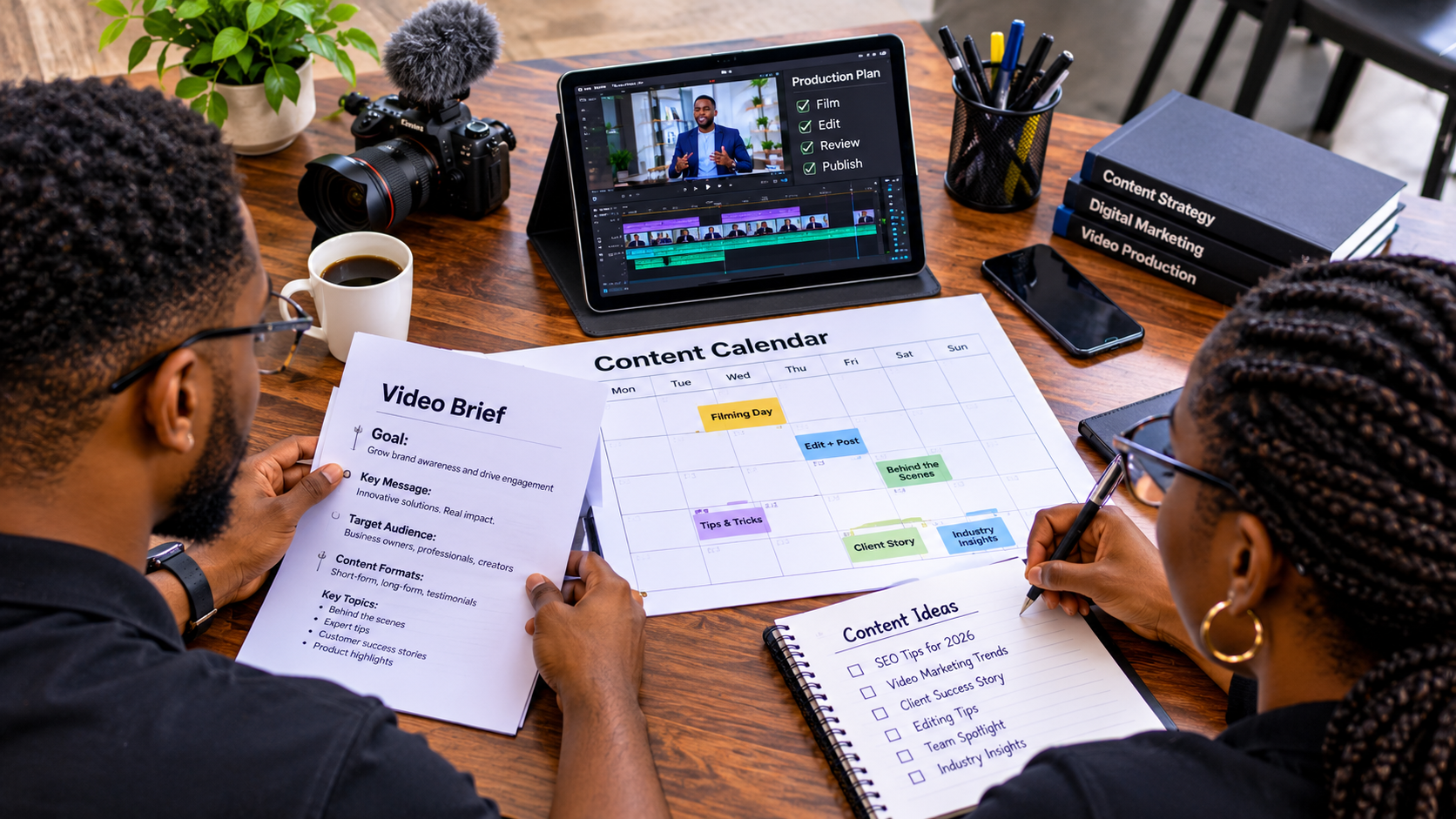
Collaborative Content Planning Workspace.
Batch filming solves the problem of repeatedly creating content, but you still need a plan for publishing it.
For many businesses, two or three short-form videos each week is a reasonable starting point.
For example, Monday could feature an educational video, Wednesday could highlight a founder or employee insight, and Friday could share a customer story or project update.
The schedule should reflect your audience, available content and marketing objectives. You don't need to publish every day simply because another business does.
Keep some flexibility for timely updates, company news and unexpected opportunities. Your batch-filmed content provides a reliable foundation, while spontaneous posts keep your channels connected to what's happening in the business.
Review performance regularly and identify which topics generate meaningful engagement, enquiries or conversations.
Make content production part of the business plan
Consistency becomes easier when content is treated as planned business activity rather than something squeezed into an already busy week.
You don't need your director recording a new video every few days or your marketing team constantly searching for something to publish.
You need a process that brings the right people together, captures useful material and turns it into content that can be used over time.
At Title Productions, we approach filming days with that wider purpose in mind. The aim isn't simply to produce one finished video. It's to capture the material a business needs across its website, social media, sales activity and wider marketing.
One well-planned filming day can take weeks of content pressure off your team. The difference is having a system before the cameras start rolling.