
Why Nobody Trusts Your New Business Yet—and the 3-Minute Fix
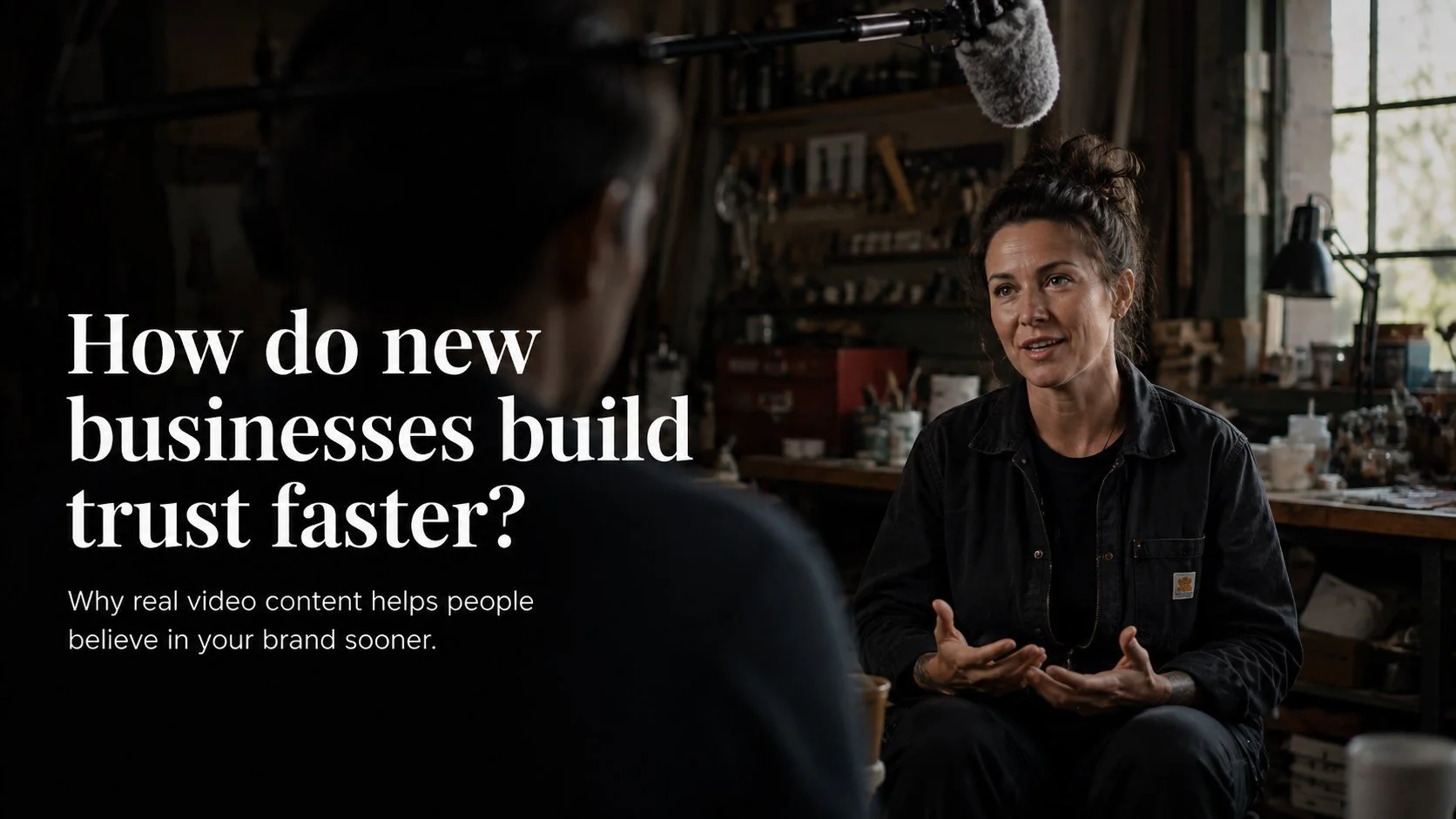
Why Nobody Trusts Your New Business Yet
You can have a brilliant product, a great website, and a genuinely good service—and still have people hesitate before buying from you.
That is one of the hardest parts of launching a new business.
Nobody knows you yet human,
There are no years of reviews. No long list of recognisable clients. No case studies stacked across your website. No familiar faces appearing every time someone searches your company name.
And when a potential customer is comparing you with an established competitor, they are not necessarily asking:
“Which company has the better product?”
They are often asking something much simpler:
“Can I trust these people?”
That is the real problem new businesses have.
It is not always an awareness problem. It is a trust problem.
And while building trust traditionally takes months or even years, there is one surprisingly effective way to accelerate that process: a well-made brand film.
Not a two-minute corporate video full of stock footage, corporate buzzwords, and people shaking hands in slow motion.
A real film.
Real people. Real work. Real environment. Real personality.
Done properly, around three minutes of video can give a new business something its website alone often struggles to create: a sense that there are genuine people behind the company.
The problem isn't that people haven't heard of you
When a new business struggles to generate enquiries, the obvious conclusion is usually that more people simply need to see it.
So the response is often more advertising.
More social posts.
More Google Ads.
More LinkedIn activity.
More content.
And visibility certainly matters. But there is a difference between someone knowing you exist and someone feeling comfortable doing business with you.
Imagine two companies appear in front of a potential customer.
Company A has been operating for years. Its website contains customer testimonials, photographs of its team, case studies and videos showing its work.
Company B has a polished website, a logo, a few carefully written paragraphs and a contact form.
Both may provide an excellent service.
But Company A has already answered several of the questions that naturally appear in a buyer's mind:
Who are these people?
What do they actually do?
Do they look professional?
Have they worked with people like me?
What happens after I contact them?
Can I imagine working with them?
Company B leaves many of those questions unanswered.
That is the trust gap.
And for a new business, closing that gap can be more important than simply generating another few thousand impressions.
Awareness gets you noticed. Trust gets you considered.
This distinction is worth understanding because it changes the way you approach marketing.
Awareness gets your business into someone's field of view.
Trust gives them a reason to stay.
You can have an excellent social media campaign that reaches 100,000 people. You can run paid advertising across multiple platforms. You can rank for your target keywords.
But if somebody clicks through to your website and still has no idea who is behind the business, what the company is really like or whether they can rely on you, those views may not translate into enquiries.
This is where video becomes particularly powerful.
A written About page can tell somebody that your team is experienced.
A photograph can show them who your team are.
But video can show them how you communicate, how you work, and what the business actually feels like.
That difference is significant.
People trust people—not just logos.
One of the biggest mistakes new businesses make is hiding behind their branding.
The logo is everywhere.
The company name is everywhere.
The products are everywhere.
But the people are nowhere.
That creates distance.
Think about the businesses you naturally feel more comfortable buying from. There is usually something human about them. You have seen the founder. You have met the team. You have watched someone explain the product. You have seen the workplace. You have heard a customer talk about their experience.
None of these things guarantee that a company is good.
But they make the business feel real.
That is exactly what a strong brand film should achieve.
Rather than simply telling potential customers that your company is trustworthy, the video gives them evidence they can experience for themselves.
The three-minute fix: make your business feel real.
So what is the three-minute fix?
It is surprisingly simple.
Show people the business instead of simply describing it.
A strong brand film can introduce your founder, your team, your workplace, your process, and the reason the business exists—all within a few minutes.
The important part is that it should not feel like a sales presentation.
Nobody wants to watch a founder spend three minutes explaining how their company is “committed to delivering innovative, market-leading solutions through a customer-centric approach."
That sounds like every other company on the internet.
Instead, let people see the business.
Show the founder speaking naturally.
Show the team doing their actual jobs.
Show the environment customers will be dealing with.
Show the product being made, delivered or used.
Show the details that make the company different.
And, if possible, let an existing customer explain why they chose you.
Suddenly, the company becomes much easier to understand.
More importantly, it becomes much easier to believe in.
What should a new-business brand film actually include?
There is no universal formula because every business has a different story.
A technology company should not look like a construction company. A professional services firm should not look like a manufacturer. A healthcare organisation should not communicate in exactly the same way as a creative agency.
But the strongest brand films tend to answer the same fundamental questions.
Who are you?
Give people a reason to understand the humans behind the business.
That could be the founder explaining why they started the company, a member of the team explaining what they do or a combination of different voices.
The objective is not to make everyone sound perfect.
It is to make them sound genuine.
A founder who speaks naturally and occasionally laughs or pauses can often create more trust than somebody delivering a perfectly memorised corporate script.
What do you actually do?
This sounds obvious, but many business videos make the mistake of assuming the viewer already understands the service.
Show it.
If you manufacture something, film the manufacturing process.
If you provide professional services, show the people delivering them.
If you work with customers on-site, show what that experience looks like.
Your audience should finish the film understanding your business without needing to read another page.
Why should people care?
This is where storytelling becomes important.
Your brand film should not simply explain what you sell.
It should explain why the business exists and what problem you are trying to solve.
That gives the audience something to connect with beyond the product itself.
Can you prove it?
This is where testimonials, customers, projects, and real-world results become valuable.
If someone else is willing to talk about their experience with your business, the message becomes much more credible.
You are no longer saying:
“We're brilliant.”
Someone else is saying it for you.
That is a much stronger position.
What if your new business doesn't have any customers yet?
This is one of the most common objections.
“What if we haven't built up enough customers to have testimonials?”
That does not mean you cannot make an effective brand film.
In fact, a new business can use video to establish credibility around the things it can demonstrate.
Show the expertise behind the company.
Show the people.
Show the process.
Show the facilities.
Show the technology.
Show the preparation.
Show the founder's experience.
Show why the company was created.
You are not trying to pretend that the business has been operating for twenty years.
You are showing potential customers why the business is worth taking seriously today.
Authenticity is important here.
A new company pretending to be an established multinational is unlikely to inspire confidence.
A new company confidently showing the expertise, people, and thinking behind its launch can be much more compelling.
Secure24: using video to establish trust from the start
This is something we saw particularly clearly with Secure24.
As a newer business, one of the challenges was not simply explaining what the company offered. It was helping potential customers understand who they were and why they should take the business seriously.
Rather than relying entirely on written website copy, the approach was to build that trust visually.
The brand film introduced the business, its people, and its offering in a way that made the company easier to understand and, importantly, easier to remember.
That film then became more than a single piece of content.
It could support the website.
It could be used across social media.
It could be incorporated into marketing campaigns.
It could give potential customers something tangible to watch before making contact.
That is one of the biggest advantages of professional brand video production.
You are not simply buying three minutes of footage.
You are creating a trust asset that can continue working across your marketing.
You can explore more examples of this approach through Title Productions' case studies and our wider production work.
Your brand film shouldn't be an advert disguised as a documentary
There is another trap worth avoiding.
Some businesses hear “brand film” and immediately think:
“Let's tell people how amazing we are.”
That usually produces a video that feels more like an extended sales pitch.
And viewers can sense it.
The strongest brand films are not necessarily the ones that talk the most about the company.
They are the ones that help the audience understand the company.
That means giving the viewer context.
Show the problem.
Introduce the people.
Show the work.
Explain the thinking.
Let customers or team members tell parts of the story.
Give the viewer enough information to form their own impression.
The best marketing does not always shout:
“Trust us.”
Sometimes it simply gives people enough evidence to reach that conclusion themselves.
Why a brand film can work better before paid advertising
This is particularly important if you are investing money into paid media.
Imagine spending £2,000 promoting an advert to a carefully targeted audience.
The advert does its job.
People click.
They arrive on your website.
And then they discover a business they have never heard of, with very little evidence that the company is legitimate, experienced, or worth contacting.
You have paid to get the person through the door before properly introducing yourself.
A brand film can help solve that problem.
Instead of making the customer do all the research themselves, you can give them a concise introduction to the company immediately.
That does not mean every new business needs a three-minute film before running an advert.
It means your trust infrastructure should support your visibility strategy.
Paid advertising creates attention.
Your website, case studies, testimonials, content, and video help convert that attention into confidence.
Brand film vs social media video: they're not the same thing.
It is also important not to confuse a brand film with a collection of social media videos.
Short-form content is excellent for grabbing attention.
Reels, TikToks, LinkedIn videos, and YouTube Shorts can help businesses stay visible, demonstrate expertise, and repeatedly appear in front of potential customers.
But they serve a slightly different purpose.
Short-form social content often answers:
“Why should I stop scrolling?”
A brand film can answer:
“Who are these people, and why should I trust them?”
You need both when the strategy calls for it.
That is why a good production plan should consider how one shoot can create multiple pieces of content rather than treating every video as an isolated project.
You can explore how different production services fit together through Title Productions' video production services.
Where should you put your three-minute brand film?
Creating the film is only half the job.
You also need to put it somewhere people will actually see it.
Your website homepage is usually one of the most valuable locations because visitors are already trying to understand who you are.
Your About page can also benefit from it because people who are researching your business are often looking for exactly this kind of information.
But don't stop there.
The same film can potentially be cut into shorter versions for LinkedIn, Instagram, YouTube, and other channels.
A 90-second section might work as a social video.
A particularly strong founder statement could become a short clip.
A customer quote could become a testimonial asset.
A behind-the-scenes moment could become another piece of content.
This is where professional video production becomes much more valuable than simply “getting a video made."
The objective is to create content that has a life beyond its launch day.
The biggest mistake? Making the video about you
Ironically, a video intended to build trust can destroy interest if it becomes too self-centred.
Your customer does not wake up thinking:
“I wonder what this new company's five-year mission statement is today.”
They are thinking about their own problem.
Can you solve it?
Can they trust you?
Will you understand what they need?
Will you deliver?
Will working with you be straightforward?
Your brand film should therefore connect your story to their reason for caring.
Instead of:
“We were founded in 2026 with a mission to revolutionise…"
Try:
“We started the company after seeing how difficult it was for…”
That small shift changes the entire story.
The business is still the subject.
But the customer becomes part of the reason the story matters.
How much does a three-minute brand film cost?
There is no single price because production requirements vary considerably.
A simple founder-led film filmed in one location is obviously different from a cinematic campaign involving multiple locations, actors, lighting setups, drone footage, interviews, and extensive post-production.
The cost can be influenced by:
number of filming days
crew size
locations
lighting and sound requirements
interviews
scripting and story development
motion graphics
colour grading
music and sound design
number of final versions
social media cutdowns
turnaround time
The important thing is not simply asking:
“How much does a three-minute video cost?”
A better question is:
“What do we need this video to achieve?”
Once the objective is clear, the production can be designed around it.
That is the approach we take at Title Productions: starting with the story and objective before deciding what needs to be filmed. You can see how that process works through our production services.
You don't need a perfect business. You need a believable one.
This may be the most important point of all.
New businesses often wait until everything is perfect before showing themselves.
The website needs to be perfect.
The office needs to look perfect.
The team needs to be perfect.
The founder needs to become comfortable on camera.
The brand needs to be completely established.
Then, eventually, the business will start producing content.
But by that point, competitors may already have spent months building familiarity.
Your audience does not necessarily expect a new company to look like a 50-year-old corporation.
They simply need to understand who you are and why you are worth considering.
That means your video does not need to hide the fact that you are growing.
It needs to show the strength behind the growth.
A confident founder.
A capable team.
A real process.
A clear purpose.
A genuine reason for customers to choose you.
That is far more convincing than pretending everything is bigger, older or more established than it really is.
Three minutes can change the first impression.
A brand film is not a magic button.
It will not automatically turn every viewer into a customer.
But it can dramatically improve the first impression your business makes.
Instead of a stranger discovering a logo and a few paragraphs of copy, they can meet the people behind the company.
They can see the environment.
They can hear the story.
They can understand what you do.
They can see evidence of how you work.
And they can decide whether the business feels right for them.
For a new business, that is incredibly valuable.
Because before people buy from you, they need a reason to believe you are worth buying from.
And sometimes, the fastest way to create that belief is simply to show them who you are.
Frequently asked questions
Do new businesses really need a brand film?
Not every new business needs one immediately. But if your service involves trust, expertise, relationships, or a significant purchase decision, professional brand video can be particularly useful because it allows potential customers to see and hear the people behind the company.
How long should a new-business brand film be?
Around two to three minutes is often enough to tell a focused brand story without asking too much of the viewer. The final length should depend on the story rather than an arbitrary time limit.
What if the founder hates being on camera?
That is extremely common. A good production team should not simply put a camera in front of someone and expect a perfect performance. Interviews, natural conversation, B-roll, and careful direction can make the process much more comfortable.
Should we make a brand film or social media videos first?
They serve different purposes. A brand film can establish credibility and explain the wider business story, while short-form social content can help you build ongoing visibility. Ideally, your production strategy should allow one project to create assets for both.
Can a brand film help with paid advertising?
Yes. A strong brand film can give people additional context after they discover your business through advertising. It can also be repurposed into shorter campaign assets designed for different platforms.
What if we have no customer testimonials?
You can still create a strong film. Focus on the people, expertise, process, product, environment, and reason the business exists. As your customer base grows, testimonials and case studies can strengthen the trust layer further.
Ready to turn your first impression into something people remember?
If your business is new, your biggest challenge may not be getting people to notice you.
It may be giving them enough confidence to take the next step.
A story-led brand film can help bridge that gap.
At Title Productions, we create story-led video, photography and campaign content for businesses, organisations and brands — from the initial story and treatment through to filming, editing, grading, and distribution.
If you are building a new brand and want your first impression to feel credible, human and worth remembering, talk to Title Productions about your next project.