
Your company just turned 50. Now what? Milestone Films That Aren’t Cringe
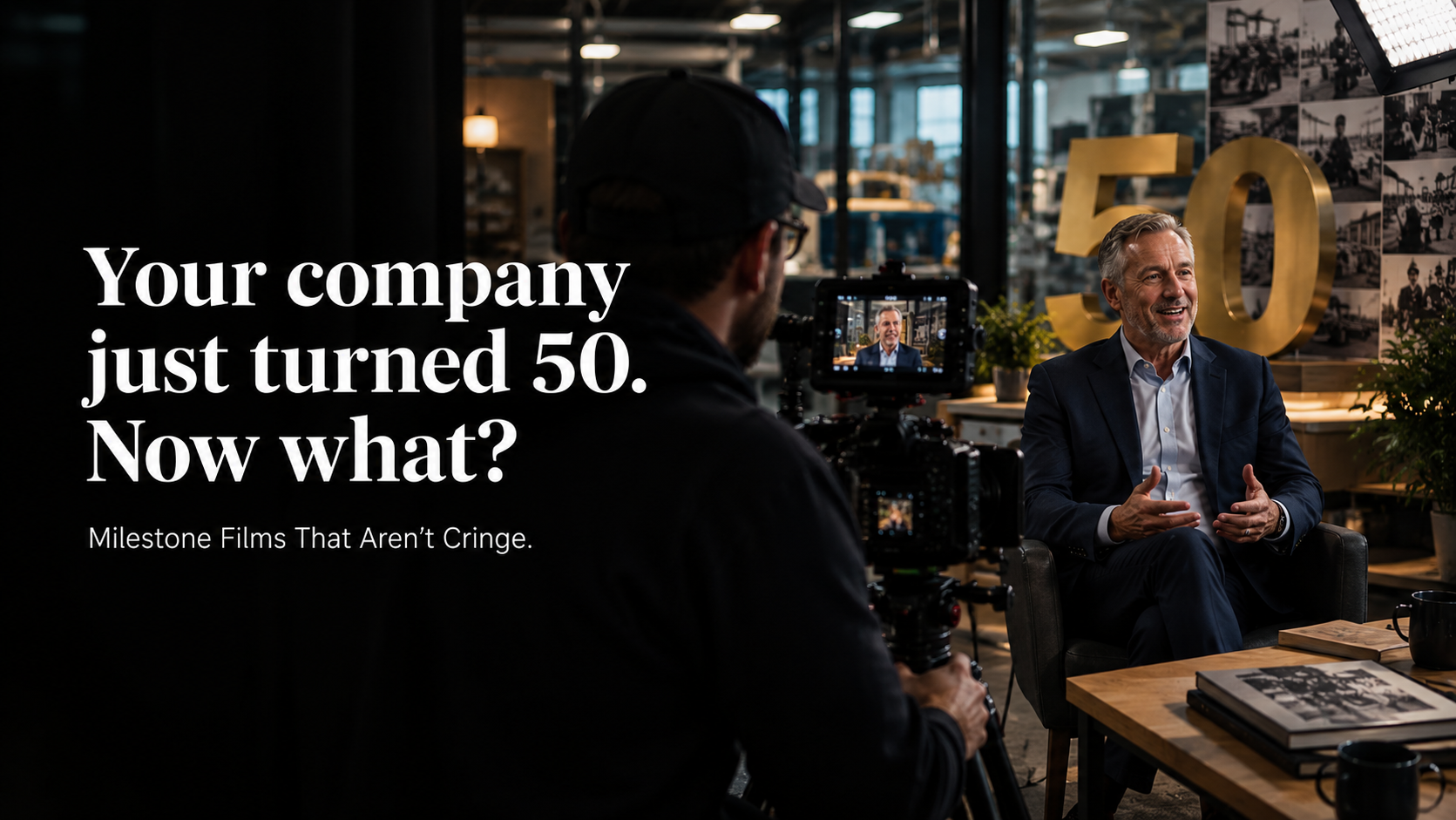
50th Anniversary Video: How to Tell Your Story
machinery,
And somewhere, inevitably, there is a piano track waiting to happen.
Please don't.
There are two kinds of company anniversary video.
The first opens with:
“Founded in 1974…”
Then comes the sepia photograph.
Then another.
Then a timeline.
Then the CEO talking about “the journey”.
Everyone watches it once at the anniversary event while quietly wondering when the buffet opens.
The second type makes a customer think:
“They've been doing this for 50 years. There must be a reason people keep trusting them.”
Same milestone.
Very different outcome.
The difference is storytelling.
A great company anniversary video shouldn't simply prove that your business is old.
It should show what those years have actually earned you.
Why make a company anniversary video at all?
Because longevity is one of the few trust signals a competitor can't manufacture overnight.
A new company can launch a beautiful website.
It can hire a talented designer.
It can create an impressive brand identity.
It can produce polished marketing.
But it can't suddenly claim 50 years of experience if it hasn't lived them.
Fifty years means customers have come and gone.
Employees have built careers.
Markets have changed.
Technology has changed.
Competitors have appeared and disappeared.
Businesses have had to adapt.
And somehow, your company is still here.
That's not just a birthday.
That's a story.
An anniversary film gives you a way to turn that history into something people can actually experience.
Instead of telling a prospect:
“We have five decades of experience.”
You can show them the people, customers, decisions, challenges and achievements that make those five decades meaningful.
That's a much more powerful proposition.
Your anniversary isn't really about the number
This is the mistake companies make.
They become obsessed with the number.
25 years.
50 years.
75 years.
100 years.
But the number itself isn't particularly interesting.
What the number proves is interesting.
If you've been manufacturing something for 50 years, what has kept customers coming back?
If you've been providing professional services for 25 years, what has changed — and what hasn't?
If you've operated in the same community for decades, how many generations of customers have you served?
If your company has survived major changes in technology, regulation or consumer behaviour, how did you adapt?
Those are stories.
The anniversary simply gives you a reason to tell them.
The birthday is the excuse. The trust is the product.
What makes an anniversary video not cringe?
People.
Not plaques.
Not certificates.
Not a 90-second montage of the reception desk.
People.
Find the employee who has been there for 30 years and remembers when the business was operating from half its current space.
Find the customer who has worked with you for decades.
Find someone who joined the company as an apprentice and is now running a department.
Find the person who remembers the biggest mistake the company ever made.
Find the employee who can tell you what the business was like before email, smartphones or whatever technology completely changed the industry.
Those people are your archive.
Their memories are your history.
And their personalities are what make the film worth watching.
The best stories are usually hiding in ordinary people
Ask someone in management to describe the company's history and you might get:
“We've always been committed to delivering excellence for our customers.”
Ask an employee who has been there for 30 years and you might get:
“When I started, there were six of us in the workshop and we all knew exactly what everyone else was doing.”
Much better.
Ask a long-standing customer what the relationship means to them and you might hear about the first project they worked on together.
Ask an employee what has changed and what hasn't.
Ask someone what they remember about the company's biggest turning point.
Ask them what nearly went wrong.
Ask them what makes them proud.
That's where the film starts to breathe.
Because audiences don't connect with corporate timelines.
They connect with people who remember things.
Don't airbrush the history
This is another reason anniversary films can become painfully corporate.
Everything was apparently perfect.
Every year was a success.
Every decision was strategic.
Every challenge was an “exciting opportunity”.
Nobody believes that.
A company that has survived 50 or 100 years has almost certainly experienced difficult periods.
Recessions.
Market changes.
Failed ideas.
Pivots.
Leadership changes.
Technology disrupting the industry.
Projects that didn't go according to plan.
Maybe even the occasional questionable haircut in the company photographs.
That's what makes the story believable.
You don't need to turn an anniversary film into a catalogue of problems.
But acknowledging that the business had to adapt makes its longevity more impressive, not less.
A company that survived because it never changed isn't particularly interesting.
A company that survived because it knew when to change?
Now you've got a story.
Amitek's 50 years: turning longevity into a story
We took this approach with Amitek's 50-year celebration film.
The objective wasn't simply to announce:
“Amitek has been around for 50 years.”
Everyone attending the celebration already knew that.
The more interesting question was:
What does 50 years actually mean?
It means people.
Experience.
Relationships.
Changes in the industry.
Customers who have stayed.
Employees who have grown with the business.
Knowledge that has accumulated over decades.
The anniversary became a framework for telling that bigger story.
And that's the key distinction between documenting a milestone and using a milestone to tell a meaningful brand story.
Greater Manchester University had an even bigger number
The same principle applies when the milestone gets much larger.
We also produced a 100-year anniversary film for Greater Manchester University.
A century gives you plenty of history.
But history on its own isn't enough.
A good anniversary film needs to connect where an organisation came from with where it is going.
Otherwise, you're simply producing a very expensive history lesson.
The audience needs to understand:
What did those 100 years build?
And:
What happens next?
That second question is particularly important.
Because your customers aren't buying your history.
They're buying what you can do for them now.
The anniversary film should look forward as well as backwards
Your history is proof.
Your future is the reason to care.
That's why the strongest milestone films use the past to establish credibility and then turn towards what's next.
Fifty years behind you tells me you've survived.
Fifty years behind you and a clear vision for the next chapter tells me you're still relevant.
That could mean new technology.
New markets.
New products.
A new generation of employees.
A new approach to sustainability.
International expansion.
Investment.
Innovation.
Whatever the next chapter looks like, put it in the film.
You don't want viewers finishing the video thinking:
“That was nice. Shame they're probably retiring.”
You want:
“They've been doing this for 50 years — and they're only getting started.”
Your customers should be part of the story
This is one of the easiest ways to make an anniversary film more credible.
Don't let the company talk about itself for three minutes.
Let customers explain what the company has meant to them.
A customer saying:
“We've worked with them for 20 years because…”
is inherently more interesting than the company saying:
“We pride ourselves on long-term relationships.”
One is a claim.
The other is evidence.
You can also show the relationship visually.
Old photographs.
Historic projects.
Current work.
People who have worked together for years.
Products that have evolved.
Locations that have changed.
The contrast between then and now can tell an enormous amount of the story without needing a narrator to explain every detail.
What about employees?
Absolutely.
In fact, your employees may be the most important part of the film.
A milestone is a perfect opportunity to celebrate the people who actually built the business.
And that creates another benefit.
An anniversary film can become a recruitment asset.
Imagine a potential employee watching someone who has spent 25 years at your company talking about why they stayed.
That's very different from a careers page saying:
“We are a great place to work.”
Again, you're replacing the claim with evidence.
The film can show the culture rather than simply describing it.
One anniversary film can become a year's worth of content
Here's where the commercial value becomes even more interesting.
Don't plan the production around one three-minute film.
Plan it around the entire content ecosystem.
The main film can premiere at your anniversary celebration and live on your website.
Then create shorter versions.
A 30-second social clip featuring a long-serving employee.
A customer story.
A “then vs now” piece.
A recruitment-focused edit.
A sales version.
A founder story.
A behind-the-scenes piece.
A historical photograph paired with a current interview.
Short clips about major milestones.
You can even create individual pieces around the people featured in the main film.
One production can therefore generate content for months rather than disappearing after the anniversary event.
One shoot. One milestone. A much bigger content library.
EDU Lettings shows why the milestone doesn't have to be huge
Not every company needs to wait 50 years.
We also created a three-year milestone film for EDU Lettings.
Three years might sound tiny next to a centenary.
But that's the wrong way to look at it.
The question isn't whether the number sounds impressive.
The question is whether it means something to your audience.
In a market where businesses come and go, being able to say:
“We've built something that is still here, still growing and still serving customers”
can be valuable.
A milestone is meaningful when it proves something your audience cares about.
For one company, that might be 100 years of heritage.
For another, it might be three years of rapid growth.
For another, it might be the tenth year of serving a particular industry.
The number isn't the story. What the number proves is the story.
When should you start producing an anniversary film?
Don't start two weeks before the party.
Ideally, give the production around four to six months of planning time.
That gives you room to find the stories rather than simply collecting whatever material happens to be easiest to access.
You may need to:
Find old photographs and archive material
Locate former employees
Identify long-standing customers
Schedule interviews
Film different departments
Capture current operations
Record the leadership's vision for the future
Film across different locations
Capture seasonal activity where relevant
The earlier you begin, the more options you have.
And if the anniversary event is the premiere, you want the finished film ready before everyone sits down with a drink and waits for the lights to go down.
The film should arrive at the celebration.
Not three months afterwards with:
“Sorry, editing took longer than expected.”
What if you don't have any archive footage?
That's not a disaster.
Old photographs are useful, but they're not the only way to tell history.
Your people are walking archives.
Your buildings are archives.
Your products are archives.
Your customers are archives.
Your documents, signage, machinery and old materials can all provide visual context.
You can also use interviews to reconstruct moments from the company's history.
Someone saying:
“I remember when we first moved into this building…”
while standing in that same building today can be more powerful than a collection of old photographs.
And if your archive really is thin?
Start building one now.
Because your 75th or 100th anniversary film will be much easier if somebody has been saving the good stuff.
Don't turn the CEO into a newsreader
The CEO should probably appear.
But they shouldn't have to carry the entire film.
One of the easiest ways to make an anniversary video feel corporate is to put the managing director in front of a camera and ask them to read the entire company history.
Suddenly you're watching an annual report with background music.
Instead, use leadership to provide perspective.
Why did the company survive?
What changed?
What are they proud of?
Where is the company going?
Then let employees and customers provide the human stories.
The film becomes a conversation rather than a corporate announcement.
What should the anniversary film actually look like?
That depends on the company.
But the production style should serve the story.
A manufacturer might need detailed footage of its facilities, machinery and people at work.
A university might need students, alumni, academics, historic material and the campus itself.
A professional services firm might need client relationships, employees, projects and the evolution of the business.
A family-run company might have decades of personal stories that become the backbone of the film.
There isn't one “anniversary video style”.
The common thread is simple:
Show the real people and real evidence behind the milestone.
Beautiful cinematography can help.
Great sound can help.
Archive footage can help.
Music can help.
But none of those things can rescue a boring story.
The film should outlive the anniversary party
This is perhaps the most important test.
Imagine the anniversary event never happened.
Would the film still be useful?
If the answer is no, you've probably made an event video rather than a business asset.
A good milestone film should continue working long after the cake has been eaten.
Put it on your website.
Use it in sales conversations.
Share clips on LinkedIn.
Use employee stories for recruitment.
Include it in presentations.
Show it to potential partners.
Use shorter edits in campaigns.
Give your sales team relevant versions.
The anniversary is the reason you made the film.
It shouldn't be the reason you stop using it.
Your 50-year story is also your sales story
This is where milestone films become particularly valuable for established companies.
You've spent decades building credibility.
Your customers know it.
Your employees know it.
Your industry might know it.
But a new prospect visiting your website doesn't automatically know any of that.
They only see what you choose to show them.
An anniversary film turns years of invisible credibility into visible proof.
Instead of:
“Trusted since 1974.”
They can see the people who made that trust possible.
Instead of:
“Serving customers for generations.”
They can hear customers explain why they stayed.
Instead of:
“50 years of expertise.”
They can see 50 years of experience sitting behind the people doing the work today.
That's a much stronger use of history.
The best anniversary films don't feel like anniversary films.

Showing How Your Company Has Changed
That's the secret.
Don't make a film about a birthday.
Make a film about why the business has earned the right to celebrate the birthday.
Tell the stories.
Show the people.
Show the customers.
Show the changes.
Show the difficult moments.
Show the achievements.
Show what the business looks like now.
And then show where it's going.
Do that, and the film becomes more than a three-minute celebration piece.
It becomes a brand asset.
A recruitment asset.
A sales asset.
A piece of company history.
And something your employees might actually want to share.
Frequently Asked Questions
Is 50 years the right time to make a company anniversary video?
Fifty years is certainly a major milestone, but there isn't a magic number.
A 10th, 25th, 40th or 75th anniversary can all provide a compelling reason to tell your company's story.
What matters is what the milestone represents to your customers, employees and wider audience.
How long should a company anniversary video be?
Around two to four minutes can work well for a flagship anniversary film.
Long enough to tell a meaningful story, but short enough to keep the audience engaged.
The bigger opportunity is to create shorter cutdowns at the same time.
A 30-second employee story, customer clip or recruitment edit can often be more useful on social media than simply posting the full film everywhere.
What if our company history is boring?
If you've survived decades of changing markets, technology, competitors and economic conditions, the history probably isn't boring.
It may simply not have been told well.
The key is to stop thinking in terms of dates and start looking for stories.
Who stayed?
Who changed?
What nearly went wrong?
What changed the business?
Which customer relationship has lasted the longest?
What did the company look like then?
What does it look like now?
That's where the interesting material usually appears.
Should an anniversary film focus on the past or the future?
Both.
Use the past to establish credibility and the future to create relevance.
Your history explains why people should trust you.
Your future explains why they should continue paying attention.
A strong milestone film should leave the audience thinking about what comes next, not simply what happened decades ago.
What if we don't have old photos or archive footage?
You can still make a compelling film.
Interviews with long-serving employees and customers can provide historical context, while your current workplace, products and people provide the visual story.
And if your archive is currently thin, your anniversary is a good reason to start documenting the business properly for future milestones.
Can an anniversary film be used for recruitment?
Yes.
Employee stories can become powerful recruitment content because they show potential candidates what staying and growing with the company can actually look like.
A dedicated recruitment cut can focus specifically on career development, culture, and the people behind the business.
Can we use the film for sales?
Absolutely.
Your anniversary film can sit on your website, appear in proposals, support presentations, and give sales teams another way to demonstrate your experience.
The key is to plan those uses before filming rather than discovering six months later that you have one beautiful three-minute video and nothing else.
Big birthday coming up?
Don't make a film that everyone watches once at the anniversary party and forgets before dessert.
Make the film that keeps working after the balloons come down.
At Title Productions, we can turn your milestone into a story built around the people, customers, history and future that make your business worth remembering.
Start a conversation about your anniversary film.
Because 50 years is a big deal.
It deserves more than sepia photos and a piano.