
How a Town Changed Its Reputation: The Visit Bolton Playbook
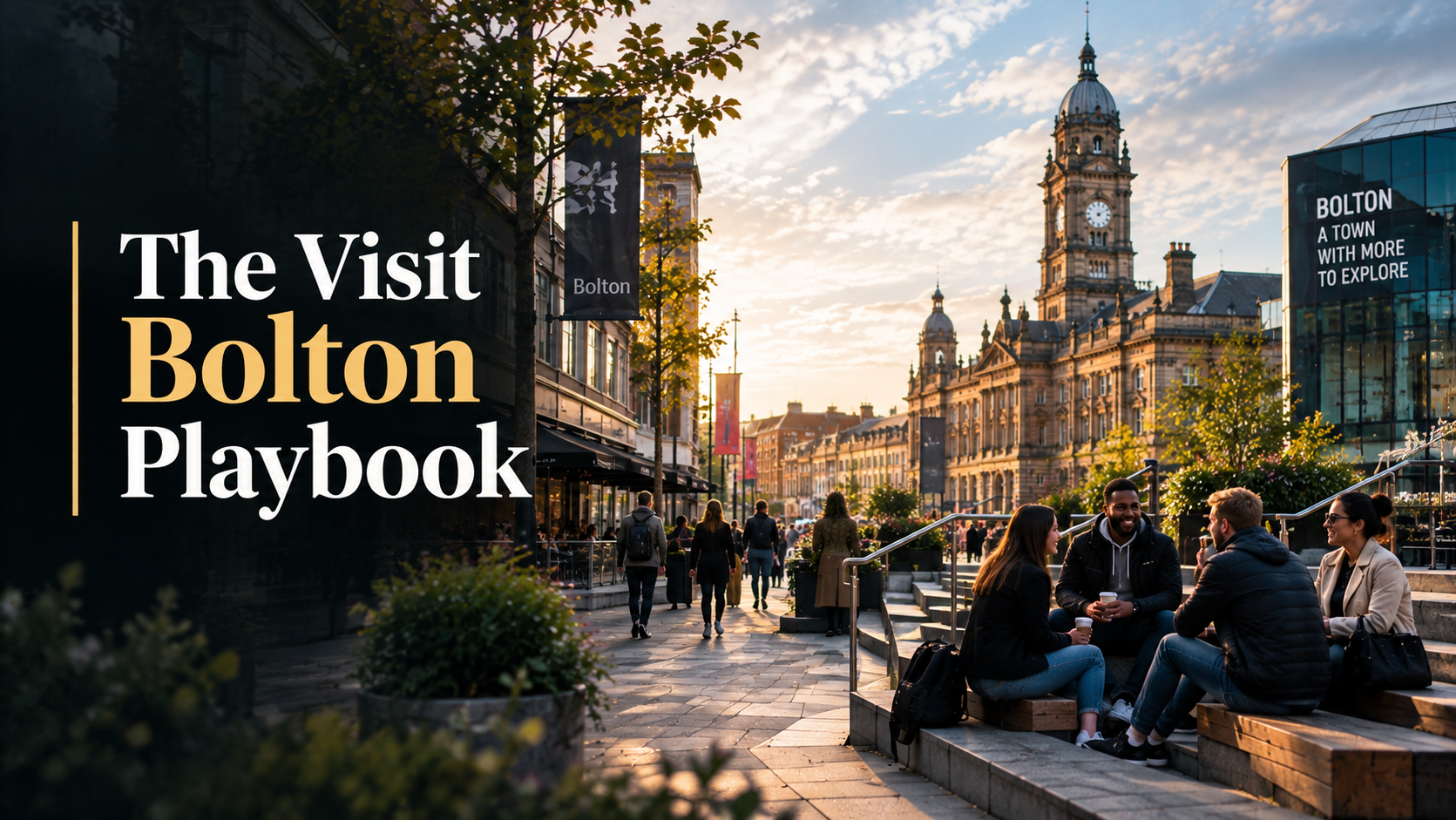
Cinematic but believable
Every town has a reputation.
The annoying part is that the reputation is usually about 15 years out of date.
Ask someone who hasn't visited Bolton for a while what they think of it, and you might hear the familiar jokes. The old stereotypes. The same assumptions that have been doing the rounds for years.
Meanwhile, the actual Bolton has been getting on with things.
Food festivals.
Live music.
Historic buildings.
Independent businesses.
Cultural events.
Busy town-centre venues.
People doing interesting things in places that rarely make it into the old version of the story.
That creates a fascinating problem for places trying to attract visitors, businesses, students, residents and investment.
What happens when the reality has changed, but the reputation hasn't?
You don't solve it by arguing with people.
You solve it by showing them.
And that is the central lesson behind the Visit Bolton approach to place marketing.
The gap between reality and reputation is a content problem
Imagine someone says:
“There's nothing happening in Bolton.”
You could respond with a paragraph explaining why they're wrong.
You could publish statistics.
You could commission a beautifully written report.
You could tell them that Bolton has a thriving cultural scene.
Or you could show them a packed event.
A busy market.
A live performance.
A restaurant full of people.
A historic venue being used.
A festival attracting hundreds of thousands of visitors.
Suddenly, you don't have an argument anymore.
You have evidence.
That distinction is incredibly important.
People can debate a claim. It's much harder to debate something they've just watched happening.
This is why video can be so powerful in place branding.
It doesn't simply tell people what a place is supposed to be.
It gives them a window into what is actually happening there.
You can't talk people out of an old reputation.
This is where many place-marketing campaigns go wrong.
They try to correct the old story directly.
“Actually, we're vibrant.”
“Actually, we're innovative.”
“Actually, we're a great place to visit.”
“Actually, there's loads to do here.”
The problem?
You've put the old perception and your new claim in a boxing ring.
And now you're asking people to decide which one they believe.
There is another approach.
Don't argue.
Show.
Show the event.
Show the people.
Show the venue.
Show the food.
Show the businesses.
Show the evening atmosphere.
Show what has changed.
Show what people are doing.
Eventually, the old story starts becoming difficult to maintain.
Not because you've shouted louder.
Because it no longer matches what people are seeing.
This is where the Visit Bolton playbook comes in
The Visit Bolton work followed a relatively simple principle:
Keep showing the place as it actually is.
Not once.
Not with one enormous campaign film and then silence for six months.
Repeatedly.
Events.
Venues.
Businesses.
People.
Culture.
Seasonal activity.
Things happening across the town.
The camera becomes a running record of the reality that people might otherwise miss.
And that matters because perception doesn't change after watching one video.
If someone's mental picture of a place has been built over 10 or 15 years, one 60-second advert isn't going to magically delete it.
You need repetition.
You need consistency.
You need enough evidence for the new version of the story to become familiar.
Drip. Drip. Drip.
Eventually, the drip becomes the story.
Bolton's cultural recognition didn't happen in a vacuum
In 2024, Bolton was named Greater Manchester Town of Culture.
That recognition provides an important marker in the wider story of Bolton's cultural positioning.
But it also illustrates a useful point for place marketers.
You don't create a new reputation simply by announcing that you've changed.
The underlying activity has to exist.
And then people need to see it.
That is where content becomes important.
A town can have brilliant venues, events, businesses and communities.
But if those things aren't being documented and distributed effectively, people outside those immediate circles may never know they exist.
A fantastic event that nobody sees online has limited value as a perception-changing marketing asset.
A fantastic event that produces photographs, short-form videos, interviews, event films and stories can keep working long after the last person has gone home.
The event happens once.
The content can keep telling the story.
Why one glossy campaign isn't enough
Here's the uncomfortable bit.
Imagine spending a substantial budget on one spectacular destination film.
It looks fantastic.
Drone shots.
Beautiful music.
Slow-motion footage.
Perfect weather.
A stunning voiceover.
Then you publish it.
And go quiet.
Meanwhile, the old perception continues receiving reinforcement every week.
People visit.
Events happen.
New businesses open.
Venues change.
Communities create things.
But none of it gets consistently captured.
So the public's mental picture doesn't move very far.
That's why place branding requires continuity.
You don't need every piece of content to look like a £100,000 tourism advert.
You need a steady stream of evidence.
A new restaurant opening.
A festival happening.
A concert selling out.
A local business doing something interesting.
A resident explaining why they love living there.
A historic building being used in a new way.
A seasonal event bringing people into the town.
These individual stories may seem small.
Together, they create a completely different picture.
The real power is in specificity
“Bolton is a vibrant cultural destination.”
That's a claim.
“Here's what happened in Bolton on Friday night.”
That's content.
There's a massive difference.
Generic place-branding language could describe almost anywhere.
Vibrant.
Dynamic.
Welcoming.
Innovative.
Culturally rich.
You can put those words on hundreds of council and tourism websites.
They don't tell me much.
Specificity does.
Show me the venue.
Show me the people.
Show me the event.
Show me what they're eating.
Show me what's happening this weekend.
Show me the thing I didn't know existed.
That's when place marketing starts feeling less like advertising and more like discovery.
And discovery is powerful.
What content does a town actually need?
A successful place-marketing strategy needs more than one type of video.
Event coverage that creates FOMO
Event coverage shouldn't simply document what happened.
It should make someone watching think:
“How did I miss that?”
That's a completely different objective.
Instead of filming an event like a security camera, look for the moments that communicate atmosphere.
The crowd arriving.
The performers.
The food.
The conversations.
The reactions.
The unexpected moments.
The energy.
The little details that make someone want to experience it themselves.
Then the content becomes more than an archive.
It becomes an invitation to the next event.
Venue and business stories that give the place a face
Places aren't destinations because of buildings alone.
They're destinations because people do things inside them.
That means local businesses, venues, restaurants, cultural organisations and community groups become part of the story.
Film them.
Introduce the people behind them.
Show what they make.
Show what happens there.
Give the audience reasons to recognise individual places rather than presenting the town as one giant anonymous location.
A town becomes more memorable when people can attach stories and faces to it.
Resident voices that feel believable
There's a big difference between a council saying:
“Residents love living here.”
And an actual resident explaining why they do.
The second feels human.
It doesn't have to be scripted into corporate perfection either.
A resident talking honestly about their favourite venue, event or part of town can be far more persuasive than another polished promotional statement.
People trust people who sound like people.
That's why resident-led content can play such an important role in place branding.
Seasonal content that keeps the story moving
A town doesn't stop existing after summer.
So your content shouldn't either.
Winter events.
Christmas markets.
Spring openings.
Summer festivals.
Autumn culture.
Indoor venues.
Food.
Sport.
Business.
Arts.
Community.
Different seasons create different reasons to visit.
And they also give the audience repeated opportunities to encounter the new version of the place.
That's important.
Reputation needs repetition.
This isn't just about towns
The Visit Bolton playbook works because the underlying problem isn't exclusive to destinations.
It applies to almost any organisation whose reputation is lagging behind reality.
Think about a business that has grown significantly but is still perceived as a small local company.
Or a venue that has been completely refurbished but everyone remembers what it looked like 10 years ago.
Or a manufacturer that has invested heavily in automation and technology while the public still imagines an old-fashioned factory.
Or an industry that has transformed but hasn't told anyone.
Or a university that has developed new facilities and programmes but is still being judged on an outdated reputation.
The problem is the same.
**Reality moved.
Perception didn't.**
And the solution is remarkably consistent.
Show the change.
Trafford Active Travel offers another version of the same lesson
The same principle can be seen outside traditional destination marketing.
Trafford's Active Travel campaign had to communicate something many people might not have immediately associated with the area: the availability and use of walking and cycling routes.
Instead of simply telling people that active travel infrastructure existed, the campaign could show real residents using real routes in the real borough.
That's important because infrastructure can be difficult to communicate through abstract language.
“Borough-wide active travel connectivity” doesn't exactly make you want to lace up your trainers.
Seeing someone actually using a route is different.
You can picture yourself doing it.
That's the same fundamental mechanism as Visit Bolton.
Don't just announce the reality. Make the reality visible.
The best place marketing doesn't pretend everything is perfect
This is another important lesson.
Authenticity doesn't mean making everything look flawless.
If every video shows perfect weather, perfectly happy people and impossibly beautiful streets, audiences eventually recognise the pattern.
Real places are messy.
They're diverse.
They're busy.
They're quiet.
They have old buildings and new developments.
They have brilliant days and ordinary Tuesday afternoons.
That's okay.
In fact, showing reality can make the positive stories more believable.
The goal isn't to convince people that a place is some sort of theme park.
The goal is to help them see it properly.
Good place branding doesn't manufacture a reality. It reveals one.
How do you know whether perception is actually changing?
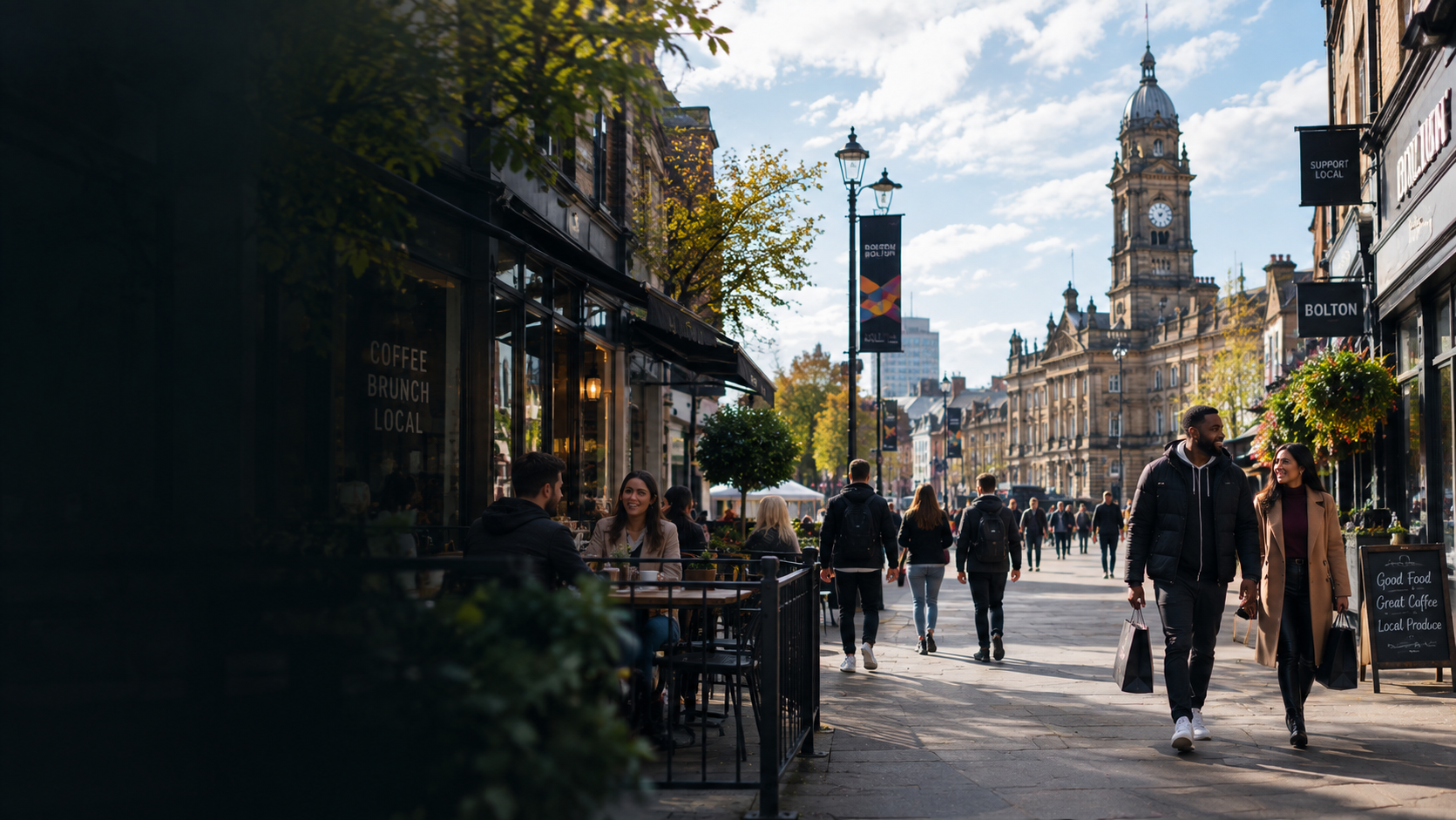
Realistic UK town-centre atmosphere
This is where place marketing can become difficult.
“People think we're cooler now” isn't exactly a robust KPI.
But perception can be tracked through a mixture of signals.
You might look at:
visitor numbers
event attendance
engagement with destination content
video views and completion rates
website traffic
tourism enquiries
business enquiries
social comments and sentiment
media coverage
stakeholder feedback
external recognition
No single metric tells the entire story.
But together, they can help establish whether your content is reaching people and whether the wider perception is beginning to move.
The Greater Manchester Town of Culture recognition provides one tangible external marker within Bolton's wider cultural story.
How long does a reputation reset take?
Not three weeks.
Probably not one campaign.
A reputation is a collection of memories, conversations, experiences and assumptions built over time.
Changing it therefore requires patience.
You may see visible shifts within 12–18 months, while establishing a genuinely different baseline can take considerably longer.
Think of content as the rudder rather than the teleporter.
It can change the direction.
It just can't instantly move the ship across the ocean.
That's why consistency matters so much.
Every new piece of content is another opportunity to reinforce the new reality.
What if the budget is small?
You don't necessarily need a huge cinematic campaign.
In fact, consistency may be more valuable than trying to make every piece look like a national tourism advert.
One well-produced video every month can create a stronger ongoing narrative than one spectacular film followed by silence.
The important thing is to build a system.
Identify the events worth covering.
Build relationships with venues and businesses.
Create a repeatable filming process.
Capture residents and local voices.
Plan seasonal content.
Repurpose footage.
Create short-form versions.
Publish consistently.
Then keep going.
Because the objective isn't to make one brilliant video.
It's to create enough evidence that the old story stops making sense.
The biggest place-branding mistake? Making everywhere look the same
You can spot generic destination marketing from a mile away.
Drone shot.
Town square.
Happy people walking.
Coffee.
Sunset.
Voiceover.
“Vibrant.”
“Welcoming.”
“Connected.”
“Full of opportunity.”
Replace the town name and you've basically got another campaign.
That's not place branding.
That's wallpaper.
Specificity is the competitive advantage.
This venue.
This restaurant.
This festival.
These people.
This street.
This story.
This weekend.
This moment.
Make the place impossible to confuse with somewhere else.
Your town doesn't need a better slogan. It may need better evidence.
That might be the biggest lesson from the Visit Bolton approach.
If people have an outdated perception of your town, organisation or brand, arguing with them isn't necessarily going to help.
Show them what has changed.
Show them what's happening.
Show them the people behind it.
Then show them again.
And again.
And again.
Because eventually, something interesting happens.
The audience doesn't necessarily think:
“Ah, the marketing campaign has successfully changed my perception.”
They simply start thinking:
“I didn't realise there was this much going on.”
That's the moment you're looking for.
The old story doesn't need to be defeated.
It simply needs to become outdated.
Frequently Asked Questions
How long does it take to change the perception of a town?
There is no fixed timeline because reputation depends on the starting perception, the scale of the place, the consistency of activity and the audiences you're trying to reach.
Visible shifts can begin within 12–18 months, but establishing a genuinely new perception can take several years.
The key is consistency rather than expecting one campaign to do all the work.
What type of video works best for place branding?
There isn't one universal format.
A strong place-marketing strategy can combine event films, short-form social content, venue features, resident stories, business profiles, seasonal videos and larger destination films.
The common factor is authenticity.
The content should show the actual place and the people who make it interesting.
Do councils need expensive cinematic films?
Not necessarily.
Production quality matters, but consistency and relevance matter too.
A highly polished flagship film can have a role, but regular, well-produced event and community content can keep the story moving throughout the year.
For many places, a content system is more useful than putting the entire budget into one film.
Can place-branding content work for small towns?
Absolutely.
In some cases, smaller places have an advantage because their stories can be more specific and personal.
You don't need hundreds of attractions.
You need compelling reasons for people to care.
A local business owner, a brilliant independent venue, a unique event or a resident with an interesting story can all become part of a much bigger narrative.
What if people already have a negative perception of our town?
Don't spend all your content telling people that their perception is wrong.
Show them something different.
If the perception is “nothing happens here”, show something happening.
If it's “there's nowhere to eat”, show the businesses and food scene.
If it's “the town is stuck in the past”, show what's new without pretending the history doesn't exist.
Evidence gives people something new to form an opinion around.
Can the same approach work for businesses?
Yes.
If your business has changed but your reputation hasn't, you're facing essentially the same problem.
Film the new facilities.
Show the technology.
Introduce the people.
Document the work.
Show customers.
Capture the new scale of the operation.
Don't simply announce that you've changed.
Make the change visible.
Reputation stuck in the past?
Maybe you don't need another campaign telling people how great your town, organisation or brand is.
Maybe you need to give them enough evidence to discover it for themselves.
At Title Productions, we create story-led video and photography designed to show places, organisations and brands as they actually are — from destination and event content to campaigns, documentaries and social media assets.
Explore our work to see how we've helped organisations turn real people, places and stories into content worth watching.
Or, if your reputation is lagging behind your reality, talk to our production team.
Because sometimes the best way to retire an old story is simply to stop telling it — and start showing people the new one.