
What Investors Actually Want to See in a Pitch Video (It’s Not Drone Shots)
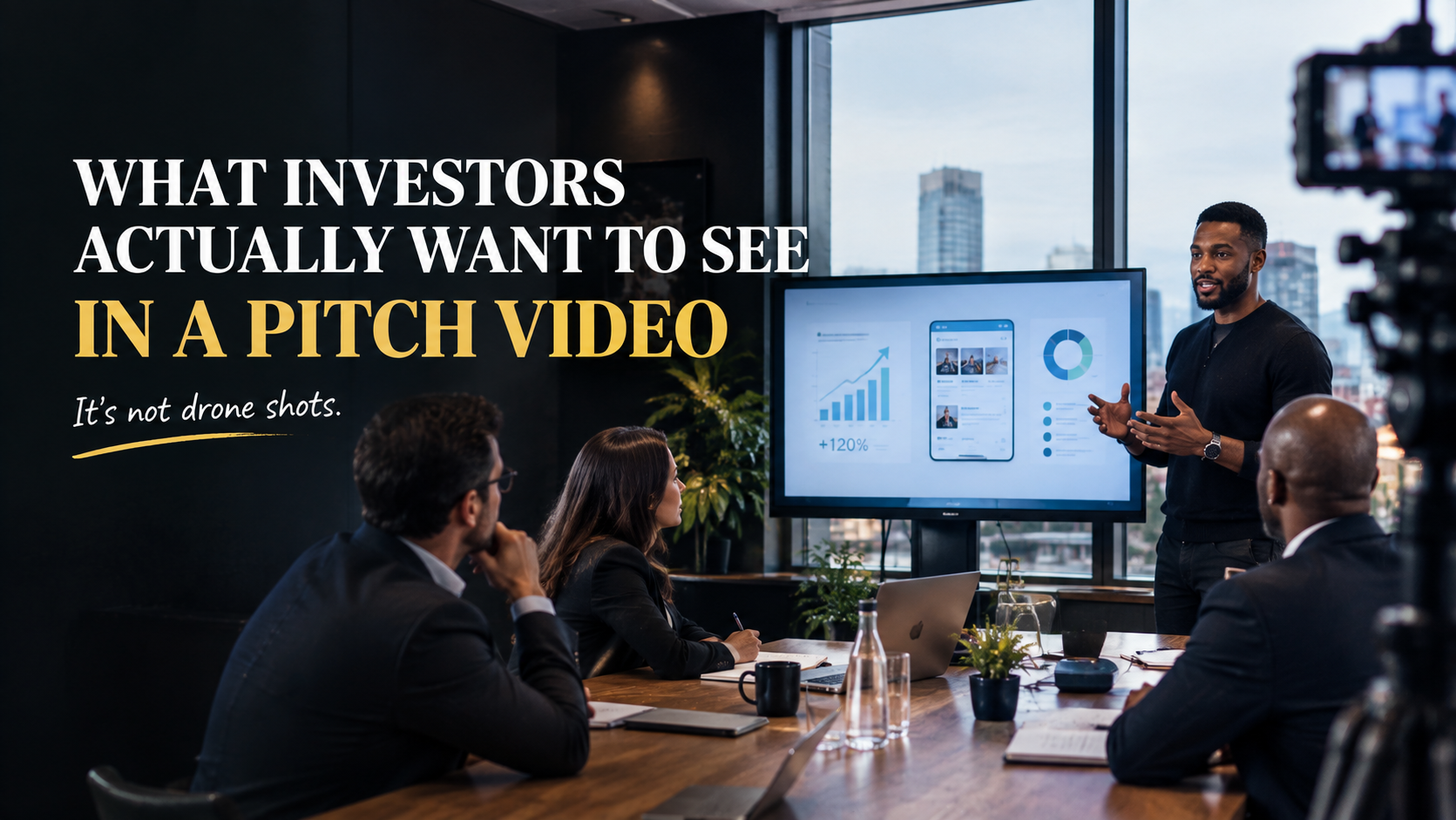
how to make a pitch video for investors
There is a particular type of investor pitch video that seems to follow the same recipe every time.
A drone shot of the building. A founder walking through a glass office. A few slow-motion handshakes. Dramatic music. A voiceover talking about "disrupting the industry".
It looks expensive.
But after two minutes, the investor still might not know whether the business actually works.
And that's the problem.
An investor pitch video shouldn't exist simply to make a company look impressive. Its job is to make the business believable.
A pitch deck can explain your market, business model, financial projections and growth strategy. A video can show something much harder to communicate on a slide: the reality behind the business.
The operation is real.
The founders know their business.
The product works.
Customers exist.
People are actually doing the work.
That is the material investors can investigate further.
So yes, use the drone if you've got a genuinely impressive building.
Just don't mistake the drone shot for evidence.
Investors don't need another advert
There is a big difference between an advert and an investor pitch video.
An advert is trying to make someone want something.
An investor video has a different job. It needs to help someone understand whether there is a credible business behind the pitch.
That changes what you should film.
Instead of spending most of the production showing polished offices and cinematic shots of people staring thoughtfully at laptops, ask a much more useful question:
What would an investor want to see if they could visit the business tomorrow?
That's what belongs in the film.
If you manufacture products, show the production process.
If you operate warehouses, show the operation.
If you've built software, show it being used.
If your business depends on people, show those people doing the work.
If customers are central to the story, let customers explain what they actually get from you.
The best investor videos often feel less like advertisements and more like a site visit the investor didn't have to travel for.
What should an investor pitch video actually include?
Every business is different, so there isn't a universal checklist.
A software startup won't have the same evidence as a manufacturing company. A pre-revenue business won't have the same customer story as an established company.
But most strong investor films are trying to answer three fundamental questions.
Is the business real?
A deck can say you have an operational business.
The camera can show it.
That's a significant difference.
Show the warehouse actually operating. Show the product being made. Show the technology being used. Show the team carrying out the processes that make the business work.
Don't manufacture a bigger-looking business for the camera.
If you're operating from a small premises, show the small premises.
If you have a modest team, show the team.
If you've built something impressive from very limited resources, that can be part of the story.
The purpose of production isn't to hide reality.
It's to make reality interesting and understandable.
Are the founders credible?
Investors aren't just investing in a product or market.
They're investing in the people expected to build the company.
That's why the founder's presence matters.
Not because they need to deliver a perfectly scripted corporate speech, but because an investor can learn something from hearing the founder explain the business in their own words.
Why does the problem exist?
Why did they build this solution?
What have they learned?
What has worked?
What hasn't?
What happens next?
Those answers can reveal far more about the business than another paragraph of corporate copy.
The founder shouldn't sound like they're reading the website.
They should sound like someone who actually understands what they're building.
Do customers genuinely exist?
This is where the film can become particularly powerful.
A deck can tell an investor that customers love the product.
Video can show the product being used.
A customer can explain why they bought it.
A business can demonstrate how its service fits into a customer's real operation.
The evidence will vary depending on the company's stage. For some businesses it might be paying customers. For others it could be product usage, pilots, repeat business, partnerships or early commercial traction.
The important thing is not to exaggerate.
Show the evidence you actually have.
A genuine early-stage business is much more interesting than a fake version of a larger one.
Your pitch deck makes claims. Your video can make them tangible.
This is where video earns its place in the fundraising process.
Consider the difference.
Your deck says:
"We have an experienced operational team."
The video shows the team actually running the operation.
Your deck says:
"Our technology is already being used."
The video shows the technology working in a real environment.
Your deck says:
"We have strong customer relationships."
The video introduces a real customer.
Your deck says:
"We operate across multiple locations."
The video takes the viewer inside those locations.
The deck and video aren't competing with each other.
They're doing different jobs.
The deck gives investors structured information.
The film gives them context.
And when those two things reinforce each other, the business becomes much easier to understand.
The best pitch videos feel like a site visit
Imagine an investor has read your deck but has never visited the business.
What would you want them to see?
The reception area?
The expensive meeting room?
The company logo on a wall?
Probably not.
You'd want them to see what actually makes the company work.
The people.
The product.
The operation.
The customers.
The technology.
The process.
That's what the camera should be looking for.
A good investor video can compress that experience into a few minutes.
It doesn't replace due diligence. It doesn't replace financial information. It doesn't replace meeting the founders.
But it can give an investor a much clearer sense of what exists behind the presentation.
This is how production should be planned
This is also why an investor video shouldn't necessarily be treated as a completely separate piece of content.
Take BlueBear, the London self-storage business.
The production wasn't simply about making one glossy investor film.
Across two production days, we captured investor content alongside brand awareness material and paid campaign assets.
That's a much smarter way to approach a production.
The founder is already there.
The locations are already prepared.
The team is already working.
The cameras are already rolling.
Why capture one piece of content when the same production can create a wider library of useful material?
The investor film might focus on credibility and evidence.
The brand content can tell the wider company story.
The paid assets can be cut into shorter, more direct pieces.
The fundraising campaign eventually ends.
The footage doesn't have to.
You can explore more examples of professional production through the Title Productions work portfolio.
Video also scales the founder
There's another reason investor video can be useful that has nothing to do with cinematography.
It can travel.
The founder might have one investor meeting.
That investor can then share the film with colleagues.
A partner who wasn't in the original meeting can watch it.
A potential business partner can see the company.
Someone in another country can understand the story without requiring the founder to repeat the entire presentation.
EMPharma is a good example of this broader use.
Its film was created to communicate the business to investors, partners and consumers across different markets.
That's where the return on an investment film becomes more interesting.
The film isn't just something shown during one meeting.
It becomes a reusable communication asset.
One piece of production can continue doing credibility work long after the original shoot.
How long should an investor pitch video be?
Two to three minutes is a sensible starting point for many investor films.
But don't turn that into a rule.
There is no prize for making a video exactly three minutes long.
If the story is complete in 90 seconds, leave it at 90 seconds.
If the business genuinely needs longer to explain something important, take the time.
The real question is:
Does every second earn its place?
A useful investor film might move through something like this:
Start with the problem
Make the viewer understand what is wrong or missing.
Don't spend the first 30 seconds showing the building.
Give them a reason to care.
Show the solution
Now demonstrate what the business actually does.
Don't just explain it.
Show it wherever possible.
Introduce the founder
Let the founder explain the opportunity, the business and what has been achieved.
Keep the language natural.
Show the evidence
Bring in the operation, customers, product, technology, team or other evidence that supports the story.
Finish with the opportunity
Where is the company going?
What happens next?
What is the investment helping make possible?
The detailed numbers can remain in the deck and financial model.
The video should leave the viewer with a clear understanding of the business and a reason to continue the conversation.
The red flags investors can spot quickly
A pitch video can accidentally create questions instead of answering them.
When production value overwhelms business substance
There's nothing wrong with making a beautiful film.
The problem comes when the film looks considerably more impressive than the business it is supposed to represent.
If you have an impressive facility, show it.
If your product deserves cinematic treatment, give it cinematic treatment.
But don't spend most of the budget making the building look spectacular while giving investors almost nothing to understand about the company.
Founders who sound scripted
Preparation is good.
A script isn't automatically bad either.
But if the founder sounds like they've memorised every sentence, something gets lost.
The strongest founder interviews usually feel conversational.
A good production team can guide the conversation, ask the right questions, remove repetition and shape the strongest answers in the edit.
The result should feel polished without feeling rehearsed.
Stock footage pretending to be evidence
If you're making a claim about your operation, show your operation.
Stock footage of someone else's warehouse doesn't prove your warehouse works.
Stock footage of somebody typing on a laptop doesn't prove your software has customers.
If something matters to the investment case, film the real thing.
Empty offices
An expensive office is not traction.
If the office matters because your team builds the product there, show them building it.
If the warehouse matters because orders are fulfilled there, show the operation.
Make the environment useful to the story.
Vague claims
"Significant traction."
"Industry-leading."
"Rapidly growing."
"Revolutionising the sector."
These phrases sound impressive until someone asks:
"What does that actually mean?"
The more important the claim, the more useful it is to show something that supports it.
What if you're a seed-stage company with no impressive premises?
Show the truth.
A garage operation with a working product can be far more compelling than a rented office dressed up to look like a multinational headquarters.
Early investors understand that early-stage businesses are early-stage businesses.
Your evidence might be:
a working prototype
early customers
product testing
customer conversations
a functioning team
early revenue
genuine product usage
a demonstrable problem
evidence of demand
You don't need to manufacture scale.
You need to demonstrate progress.
The production should reflect where the company actually is.
Can one shoot cover investor content and marketing?
Absolutely.
In fact, where appropriate, it should.
The key is planning the shoot around the full content requirement, rather than deciding afterwards that you wish you'd captured something else.
A properly planned production could capture:
the main investor film
founder interviews
customer testimonials
product footage
brand film material
LinkedIn content
social media clips
paid advertising assets
photography
website content
That means one production can continue creating value well beyond the fundraising campaign.
It's also why choosing a production partner isn't simply about who can make the prettiest film.
The bigger question is whether they understand what the footage needs to achieve.
For businesses looking beyond one investor film, exploring the wider range of Title Productions services can help when planning a production around multiple content requirements.
Should you update the video for every funding round?
Usually, the story should evolve with the company.
A business raising its first round may have a very different story from that same business 18 months later.
You may have:
new customers
new products
new locations
new revenue
a larger team
new partnerships
stronger market evidence
a different growth strategy
That doesn't necessarily mean starting from zero.
A well-planned production can capture enough material to make future updates easier.
The principle is simple:
Plan for the next stage while you're filming the current one.
The golden rule: everything you show should survive a site visit

effective investment pitch video
This is the rule I'd put above every investor pitch video.
If you show the operation, be prepared for someone to ask to visit it.
If you show customers, make sure they're genuine.
If you show the product, make sure it works.
If you talk about traction, make sure the underlying evidence exists.
If the founder makes a claim, make sure they can explain it when the camera is switched off.
Because if the video works, the next step isn't necessarily another compliment about the cinematography.
It might be:
"Can we come and see it?"
That's exactly what you want.
So, should you use drone footage?
Yes.
If it adds something.
If you've got a huge facility, an impressive location or an operation where scale matters, an aerial shot can establish that beautifully.
Use it.
Just don't build the entire investor film around it.
A drone shot can show the building.
It can't prove traction.
Beautiful music can create emotion.
It can't prove customer demand.
A cinematic founder interview can look fantastic.
It can't make an unsupported claim true.
Production quality should support the evidence.
It shouldn't become the evidence.
The real return on an investor pitch video
The best investor videos don't leave someone thinking:
"That was an expensive video."
They leave them thinking:
"I understand this business."
They've seen the operation.
They've met the founders.
They understand the problem.
They've seen the product.
They've heard from customers.
They have a clearer sense of what's real, what's working and where the business is going.
That's the real job of the film.
Not to replace the pitch deck.
Not to replace due diligence.
Not to turn a startup into something it isn't.
Simply to make the business visible.
And that's why the best investor pitch videos don't necessarily have the biggest budgets, the fanciest offices or the most spectacular drone shots.
They have the strongest evidence.
Show the business. Don't just sell the story.
If you're preparing for a fundraise and want to build a film around the evidence that actually matters, get in touch with Title Productions.