
Turning Your Knowledge Into an Online Course: What Production Actually Involves
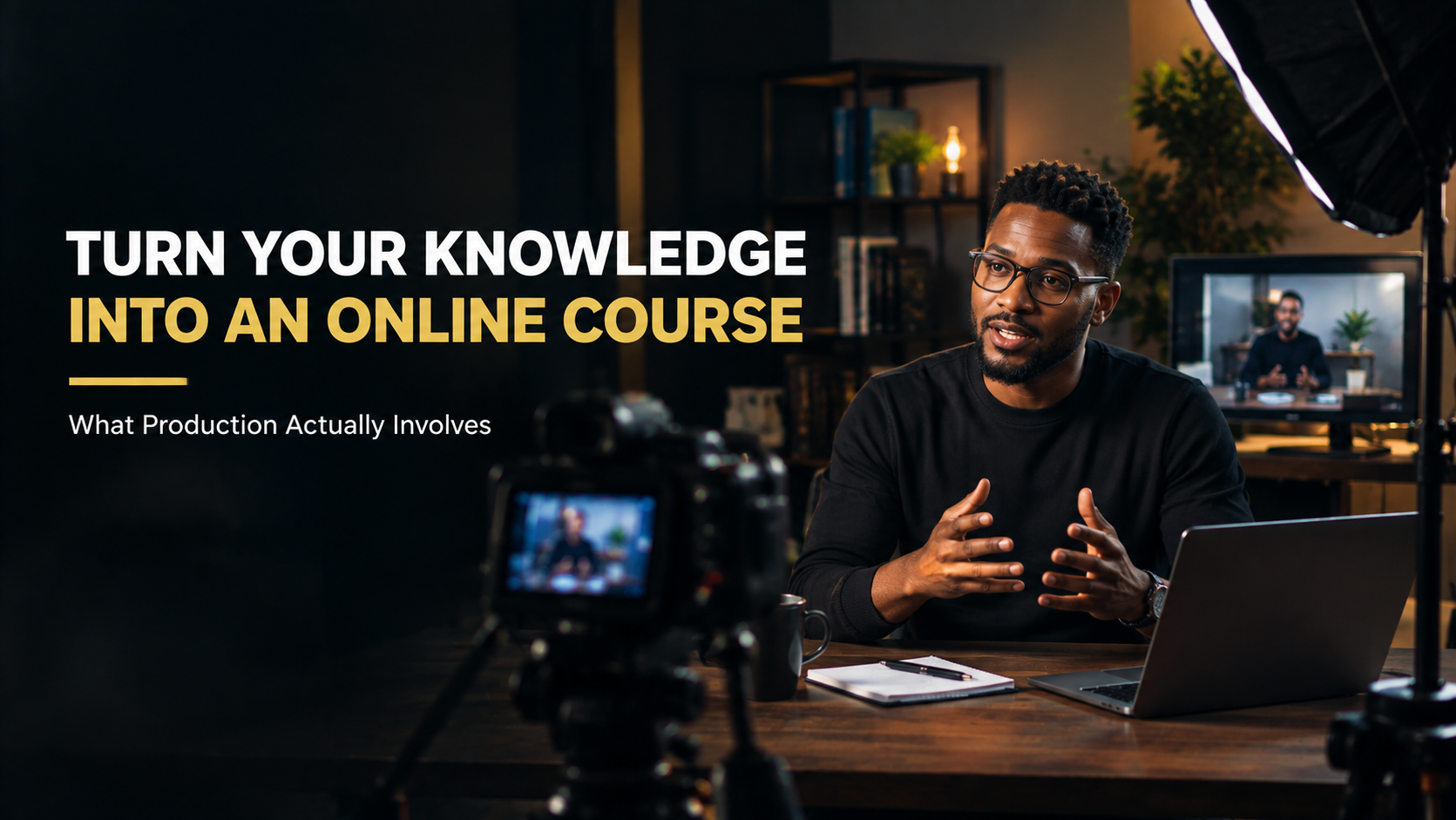
e-learning content production
Everyone with useful expertise has had the thought:
“I should turn this into an online course.”
And then one of two things usually happens.
Nothing.
Or someone records 14 hours of lessons on a webcam, uploads them to a course platform and wonders why the refund requests are arriving faster than the reviews.
The gap between having knowledge and having a course people are willing to pay for is bigger than pressing record.
You need a curriculum.
You need a production plan.
You need content that is easy to follow.
And you need the whole thing to feel credible enough that someone is happy to spend money on it.
That is where course production comes in.
What does online course production actually involve?
There are three main stages:
Curriculum design. Deciding what the learner actually needs to know, how the lessons fit together and, importantly, what does not need to be included.
Batch filming. Planning the production so multiple lessons can be recorded efficiently across a small number of filming days.
Post-production. Editing the lessons, adding graphics, captions, supporting visuals and the finishing touches needed to make the course ready for its platform.
Filming is the part everyone sees.
Curriculum design is often where the course is won or lost.
A knowledgeable expert can explain a subject for two hours.
A good course can teach the essential point in twenty minutes.
That is not about knowing less.
It is about structuring knowledge better.
Start with the learning journey, not the camera
Before choosing a camera angle, work out what the learner needs to achieve.
What should they know by the end?
What should they be able to do?
What do they need to understand first?
What can wait until later?
And which information sounds impressive but does not actually help them achieve the outcome?
That last question is surprisingly difficult for experts.
When you know a subject deeply, everything feels relevant.
For a beginner, it can quickly become information overload.
A strong course breaks the subject into logical steps and gives every lesson a job.
That makes filming easier too.
Instead of walking into a studio and trying to remember everything you want to say, the presenter has a clear teaching plan to work from.
Why batch filming changes the economics
Twenty lessons can sound like an enormous production.
It does not have to be.
With proper planning, several lessons can be recorded during a single production day.
The presenter is already prepared.
The lighting is already set.
The cameras are already running.
The audio is already checked.
The production team is already there.
That means you can move efficiently from one lesson to the next rather than treating every episode as a separate shoot.
We produced a 20-episode e-learning series for GBS UK, with the content built directly into its paid curriculum.
The important part was not simply recording twenty videos.
The series was planned as twenty distinct teaching units, allowing the production to be organised around the actual curriculum.
That is the advantage of batch production.
You stop thinking about “making twenty videos” and start thinking about building one complete learning product.
Should online courses be made up of short lessons?
Generally, focused lessons are easier to consume than a handful of enormous modules.
A learner might have twenty minutes between meetings.
They might watch one lesson during a commute.
They might return to a specific topic several weeks later.
Shorter episodes make those situations much easier to accommodate.
Instead of a two-hour module covering ten different concepts, you might have a sequence of focused lessons, each dealing with one clear idea.
That gives the learner a sense of progress too.
Lesson 7 of 20 feels achievable.
“Module 2: 94 minutes” feels like homework.
The right length ultimately depends on the subject. A complex practical demonstration may need more time than a simple explanation.
The principle is more important than a fixed duration:
Give each lesson enough time to teach its idea properly, but no more.
Does production quality really matter for a paid course?
Yes, but perhaps not for the reason people think.
Production quality does not replace good teaching.
A beautiful course with poor information is still a poor course.
But when someone is paying for your expertise, the production quality becomes part of their first impression.
Before they have judged your teaching, they have already judged the experience.
Is the audio clear?
Can they see what the presenter is demonstrating?
Is the lesson easy to follow?
Does the course feel organised?
Does it look like the creator has invested in the learner's experience?
Those things influence perceived credibility.
And audio deserves particular attention.
Viewers can tolerate an average-looking shot.
They are much less forgiving of distracting echo, inconsistent volume or difficult-to-understand speech.
Good course production removes those distractions so the learner can concentrate on the teaching.
Production should support learning, not decorate it
Graphics can make a course look more professional.
But the best graphics are not there simply to make the screen busy.
They clarify.
A diagram can explain a process.
An animation can demonstrate something difficult to film.
On-screen text can reinforce an important definition.
Captions can make a lesson easier to follow.
Screen recordings can show software or digital workflows directly.
The question should always be:
Does this help the learner understand the point?
If not, it probably does not need to be there.
Film the marketing content while the cameras are already rolling
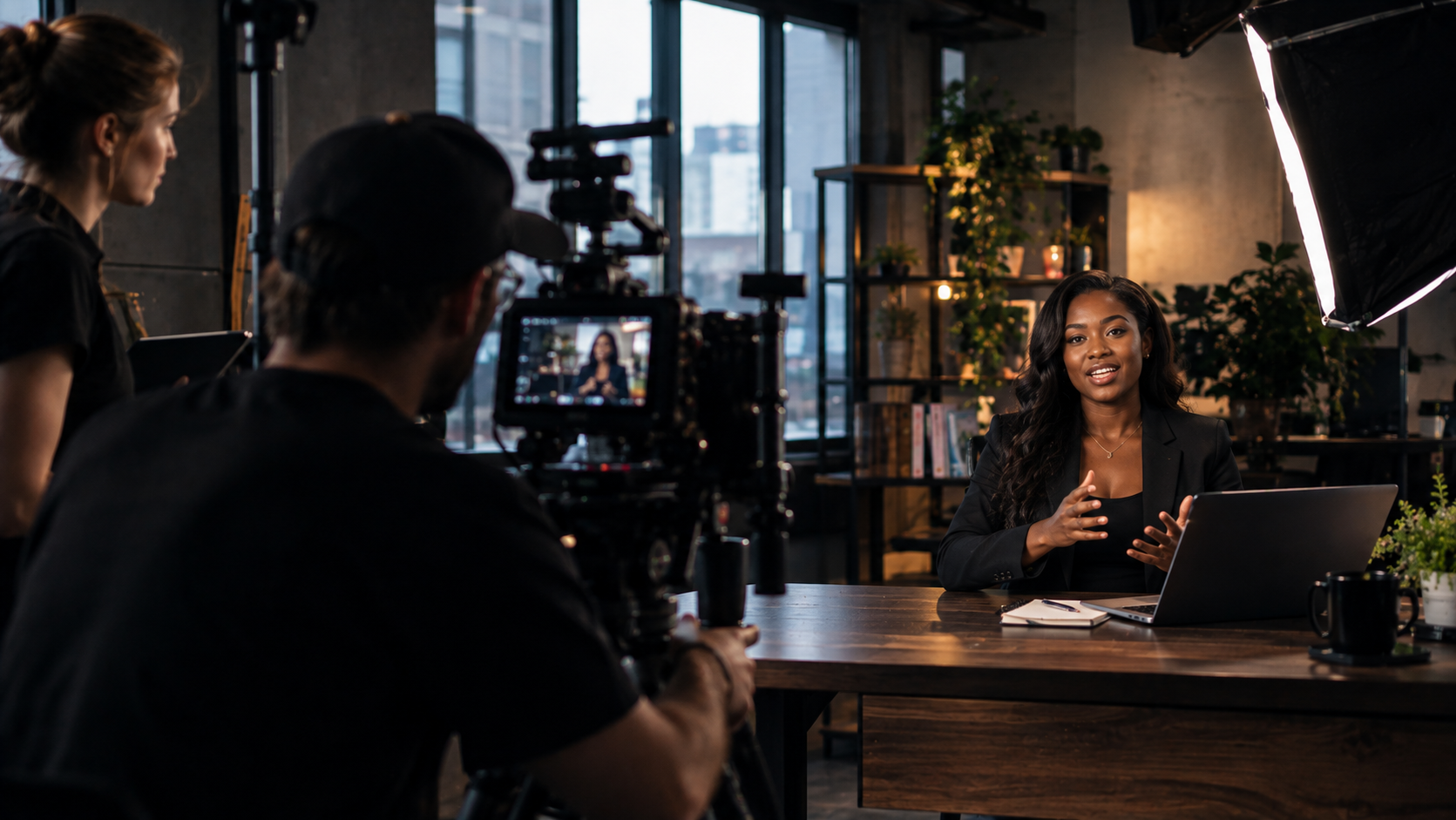
educational video production
There is another opportunity that course creators often miss.
If you are already bringing the presenter, crew, lighting and cameras together, create the promotional content at the same time.
Film a course trailer.
Capture short clips for social media.
Record preview lessons.
Get a few direct-to-camera pieces explaining who the course is for.
Create short extracts that can be used on the sales page.
These assets are far cheaper to capture while the production is already set up than organising another shoot later.
The course is the product.
The promotional content helps people discover it.
You need both.
What does course production cost?
There is no single price because production depends on the course.
The number of episodes matters.
So does the format.
A presenter-led course requires a different setup from a practical demonstration, software tutorial or multi-location training programme.
Graphics and animation can also change the scope considerably.
But batch production can make the economics much more sensible.
Filming twenty lessons across planned production days is generally more efficient than organising twenty separate filming sessions.
You can also build the production around the course from the beginning, rather than paying to fix structural problems during editing.
The important calculation is therefore not simply:
“How much will the filming cost?”
It is:
“What will it cost to create the course properly, and how many times can that asset deliver value?”
An online course can become a long-term business asset
Once the production is finished, the lessons do not stop working.
The course can teach while you are working with clients.
It can support a training business.
It can become part of an organisation's paid curriculum.
It can be sold repeatedly without requiring the expert to deliver the same explanation every time.
That is where the economics become interesting.
You make the production investment once, then use the resulting content repeatedly.
For an individual expert, that can turn knowledge into a product.
For a training provider, it can become part of the organisation's core learning infrastructure.
For a business, it can create a repeatable way to deliver specialist knowledge without relying entirely on someone's diary.
The real production is turning expertise into a product
An online course is not simply a collection of videos.
It is a learning experience.
That means the production needs to begin before the camera comes out.
Work out what the learner needs.
Build the curriculum.
Break it into useful lessons.
Plan the filming days.
Record efficiently.
Edit for clarity.
Add graphics where they genuinely help.
Create the promotional content while the production is running.
Then package the whole thing for the platform where people will actually use it.
The camera is only one part of the process.
The real job is taking what you know and turning it into something another person can learn from without needing you in the room.
If you have the expertise but need help turning it into a professional online course, explore Title Productions' work, our production services, or contact the team to discuss your course production.