
Staff Training Videos: Cheaper Than Repeating Yourself 400 Times
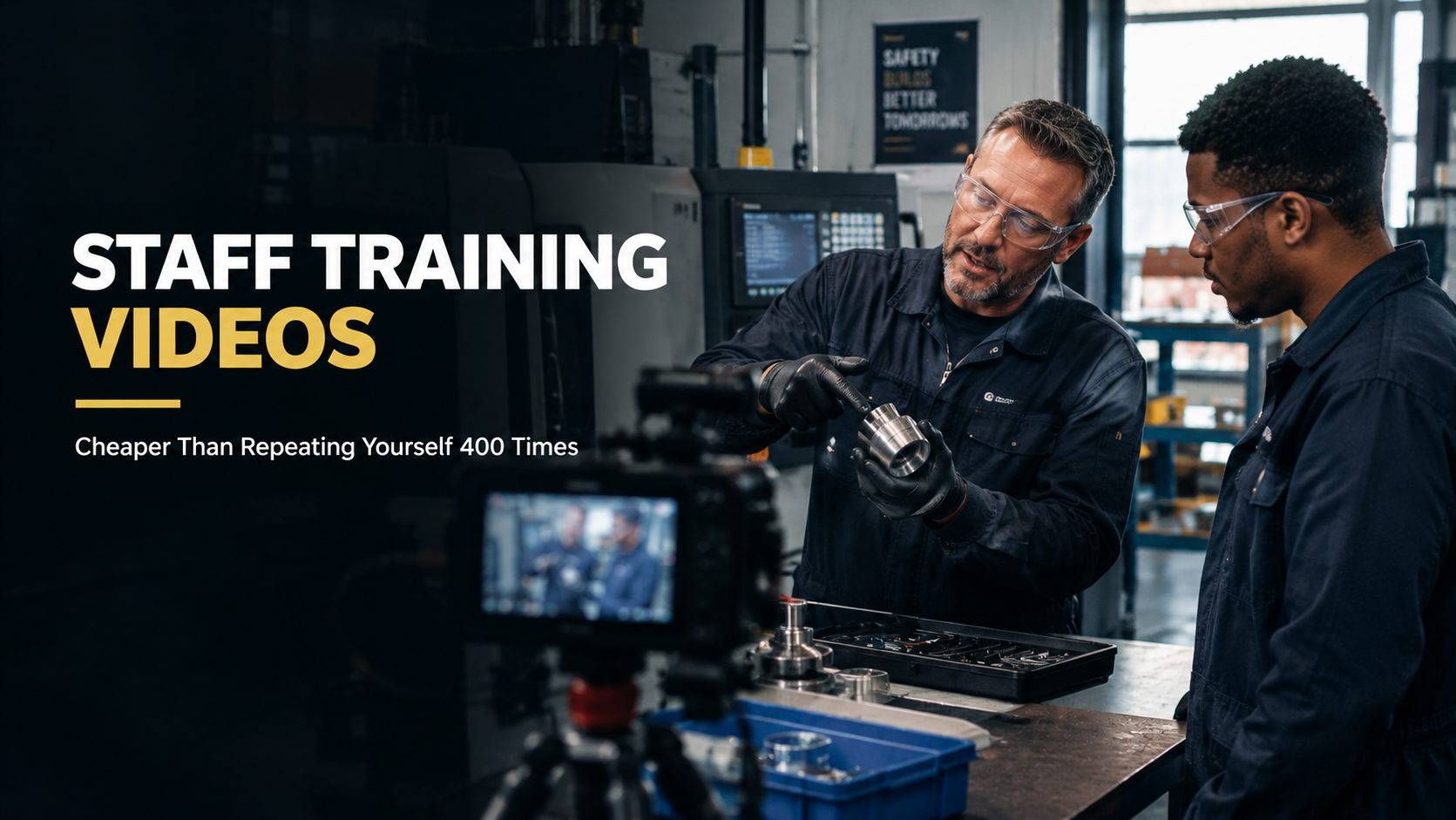
staff training video production
Every business has one.
The person who trains every new starter.
They know the job inside out. They can explain the process without looking at a manual. They have answered the same questions so many times they could probably do the induction in their sleep.
They are brilliant.
But there is a problem.
Every hour they spend explaining the basics to another new employee is an hour of an experienced member of staff being taken away from the work only they can do.
And when that person eventually leaves?
A lot of the knowledge they have built up over the years can leave with them.
That is where staff training videos become more than just another piece of company content.
They turn valuable knowledge into something the business can keep using.
Why make training videos instead of training everyone in person?
Because repeating the same explanation does not scale particularly well.
In-person training is useful. New employees need opportunities to ask questions, practise tasks and make decisions with someone experienced nearby.
But do they really need a senior employee to explain the same basic process for the 401st time?
Probably not.
A training video can capture the best explanation of a task once and make it available to every future starter.
Someone joining at 7am can watch it.
Someone working the night shift can watch it.
Someone who needs to revisit the process three weeks later can watch it again.
The experienced employee can then spend their time on the parts of training where human judgement actually matters.
That is a much better use of everyone's time.
Training videos create consistency
There is another problem with relying entirely on verbal training.
Information changes as it gets passed from person to person.
One trainer explains every step.
The next person shortens the explanation.
Someone else adds a shortcut.
Eventually, the shortcut becomes “the way we do it”.
That can create inconsistencies, particularly when a process involves safety, quality control, machinery, compliance or customer service.
A properly produced training video gives everyone the same reference point.
The correct process is demonstrated once, clearly and consistently.
And if the process changes later, you can update the relevant video rather than relying on everyone to remember the new version.
Don't make one massive training film
This is where businesses can get it wrong.
The instinct is often to create one enormous training video containing everything a new employee needs to know.
Forty-five minutes later, you've produced a corporate epic.
The new starter has watched it.
They remember approximately twelve seconds of it.
A better approach is to break training into short, task-specific videos.
One process.
One machine.
One procedure.
One question.
One video.
That makes the content easier to watch, easier to find and much easier to update.
If someone forgets how to complete one particular task, they do not need to sit through the entire training programme again.
They find the relevant video and get the answer.
Film the real job, not a pretend version of it
Training content works best when it reflects the environment employees actually work in.
That means showing the real equipment.
The real workspace.
The real process.
And, where appropriate, the real people who understand it.
We produced an eight-video staff training series for CQR, a UK manufacturer of CCTV cable.
Rather than creating one long film, the training was broken into eight focused videos covering specific parts of the job.
The videos were filmed on the actual production floor, using the actual equipment and processes.
That matters.
Someone starting on the production floor can watch the training and immediately recognise what they are seeing.
There is no need to translate a polished studio demonstration into the real world.
The real world is already on screen.
What should you film first?
Don't start with the easiest process.
Start with the bottleneck.
Look at the questions new starters ask most often.
Look at the tasks where people make the most mistakes during their first month.
Look at the processes that only one or two people fully understand.
That last category deserves particular attention.
If only two people know how an important process works, you have a knowledge risk.
If one of them leaves tomorrow, what happens?
This is the kind of expertise that needs to be captured before it disappears.
Or, as we might put it:
Film the tribal knowledge before it retires to Spain.
A simple way to identify your first training videos is to make a list of every question a new starter asks during their first month.
That list is effectively your training series outline.
It tells you what people actually need to know rather than what management assumes they need to know.
Short videos are easier to build into onboarding
Training videos become even more useful when they are part of a structured onboarding process.
Instead of giving a new starter a giant folder of documents and saying “have a read”, you can create a sequence.
Watch this.
Complete this task.
Watch the next video.
Try the process.
Ask questions.
Move on.
That creates a more manageable learning experience.
It also gives managers a clearer picture of what someone has already been introduced to before they start asking questions on the floor.
And because each video has a specific purpose, the library becomes useful beyond the first week.
Someone who has been with the company for two years can still search for the video when they forget a particular procedure.
That is one of the biggest advantages of task-level training.
It becomes a reference library rather than a one-time induction.
What makes a good staff training video?
It does not need Hollywood production value.
It needs clarity.
The best training videos are usually:
Specific — one task or process at a time.
Practical — showing people what they actually need to do.
Easy to follow — clear explanations without unnecessary corporate language.
Real — filmed around the actual workplace wherever possible.
Reusable — useful to multiple employees over time.
Easy to update — structured so individual processes can be changed without rebuilding the entire programme.
Good production still matters, of course.
Poor audio, confusing visuals or badly demonstrated processes can make training harder rather than easier.
But the purpose comes first.
A training video is not supposed to win an award for cinematography.
It is supposed to help someone do their job correctly.
What is the return on training videos?

The calculation is fairly straightforward.
Start with three things.
Senior staff time
How many hours are experienced employees currently spending repeating training?
Multiply that by the real cost of their time.
Time to competence
How long does it currently take a new starter to become confident and productive?
A structured video library can make the early learning process more consistent and easier to revisit.
Errors and rework
What happens when people receive different explanations or forget important steps?
If inconsistent training leads to mistakes, delays, wasted materials or additional supervision, there is a cost attached to that too.
Now compare those costs with producing a training library that can be used repeatedly.
The initial production is a one-off investment.
The training can then keep working every time another person joins the business.
For a company that regularly hires, that difference can add up quickly.
Training videos also protect institutional knowledge
This is perhaps the part businesses underestimate.
Training videos are not only about onboarding.
They are a form of knowledge management.
Your experienced employees know things that may never have been written down.
Why a particular machine behaves differently in certain circumstances.
How to spot a problem before it becomes expensive.
Which part of a process tends to cause mistakes.
How something is actually done rather than how it is described in a manual.
That knowledge has value.
If it only exists in someone's head, the business is vulnerable to staff turnover.
Recording it gives the organisation a reference point that can survive changes in personnel.
It does not replace experienced employees.
It makes their knowledge easier to pass on.
Build a training library, not just a training video
The biggest opportunity is to stop thinking about “a training video” as a single production.
Think in terms of a training library.
Start with the processes causing the biggest problems.
Film those.
Add the questions new starters repeatedly ask.
Then keep building.
Over time, you can have a searchable collection covering everything from basic onboarding to specialist procedures.
And because the videos are modular, you do not have to remake everything whenever something changes.
One process changes?
Update one video.
A new machine arrives?
Add a new video.
A common mistake keeps appearing?
Create a short video explaining it.
That is far more practical than producing another giant training film every few years.
Your best trainer cannot be everywhere
There will always be a role for people in training.
Some things need demonstration.
Some require judgement.
Some require someone standing beside a new employee saying, “Yes, that's right. Now try it yourself.”
But your most experienced people should not have to spend their working lives repeating information that could have been captured once.
A good training video gives them backup.
It captures their knowledge when they can give the clearest explanation.
Then it keeps working after the camera is packed away.
For the new starter, it is an accessible reference.
For the manager, it is a more consistent onboarding tool.
For the business, it is a way of keeping valuable knowledge inside the organisation.
And for the person who has explained the same process 400 times?
Well, they might finally get to explain something new.
If your business is building an onboarding or internal training programme, explore Title Productions' work, our production services, or contact the team to discuss creating a practical training video library for your organisation.