
Stop Describing Your Process. Show It. (Why “Our Unique Methodology” Is White Noise)
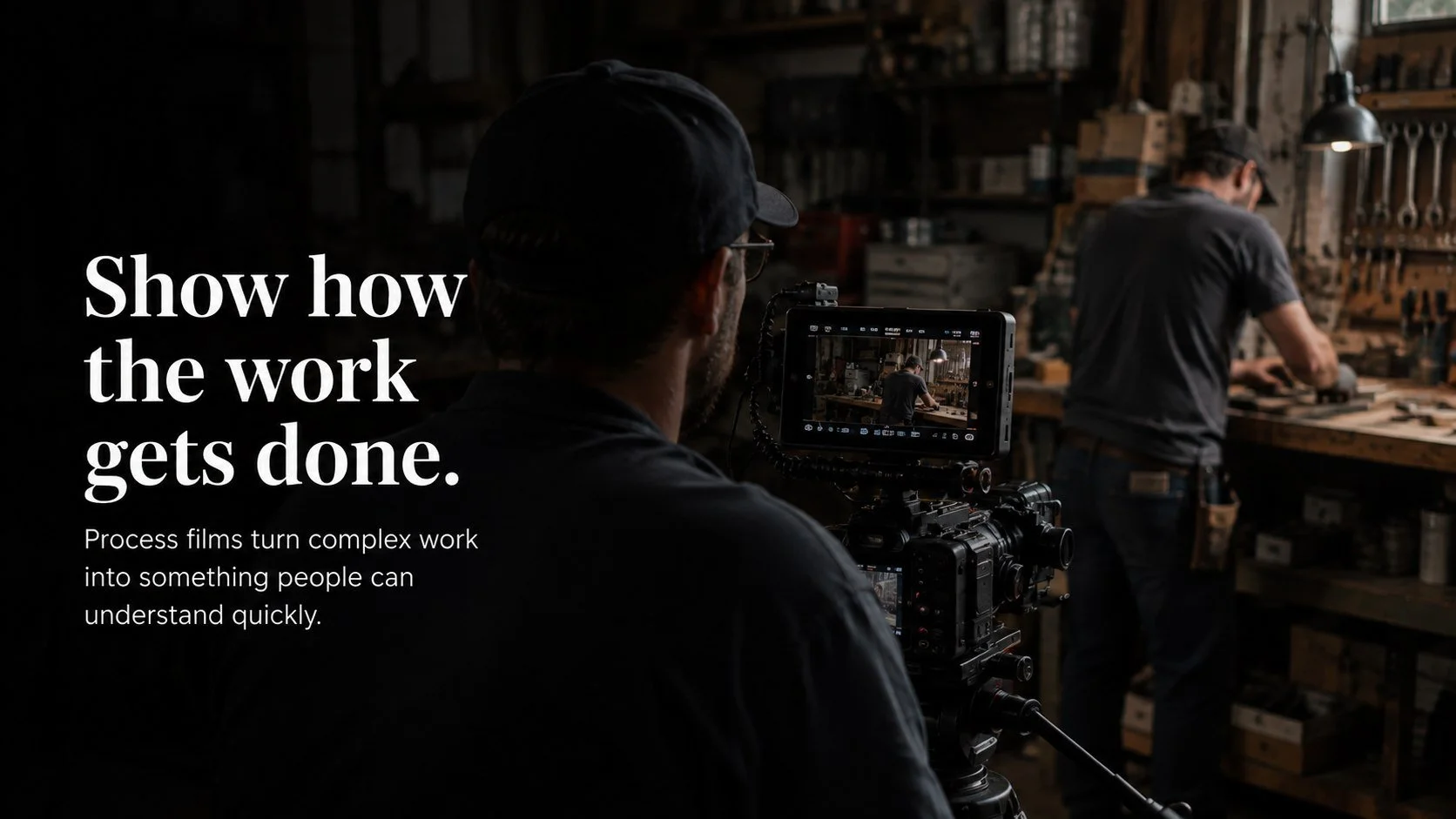
Show Your Process
“Our proven five-step methodology delivers results through a collaborative, client-focused approach.”
Sounds impressive, doesn’t it?
Now open the website of three "bespoke," "collaborative," "strategic," "innovative," "results-driven," "client-focused," and "competitor" competitors.
There’s a very good chance you’ll find almost exactly the same sentence.
Maybe theirs says “bespoke” instead of "proven." Maybe they call it a “strategic framework” rather than a "methodology." Perhaps they have six steps instead of five.
But essentially?
Same message. Same language. Same promise.
And that creates a problem.
When every business describes its process using the same polished words, the process stops being a reason to choose you.
The prospect skims it, nods politely, and moves on to the one thing they can easily compare.
The price.
That is how genuinely good businesses end up losing work to cheaper competitors.
The solution isn't to write a better process page.
It is to stop describing the process and start showing it.
Your process page probably sounds like everyone else's.
Here is a quick test.
Imagine you are looking for a professional service. You land on two websites.
One says:
“We take a collaborative, client-focused approach tailored to your unique requirements.”
The other says:
“You’ll meet the team responsible for your project before anything is produced. We’ll show you what we recommend, explain why, and give you the opportunity to challenge it before we move forward.”
Which one tells you more?
The second one.
Not because the writing is particularly clever. It isn't.
It simply gives you something you can picture.
That distinction matters.
Words such as bespoke, collaborative, strategic, innovative, results-driven, client-focused," and "proven" aren't necessarily bad words. The problem is that service businesses have used them so frequently that they have lost much of their ability to differentiate.
Everyone is collaborative.
Everyone is strategic.
Everyone says they tailor their approach.
Everyone has a “proven methodology."
And, apparently, everyone's clients are delighted.
The prospect has heard it all before.
So when your website tells them that your process is "unique," they don't necessarily believe you.
They just keep scrolling.
Why prospects ignore written process descriptions
A written process has one major weakness:
It asks the prospect to trust your description of what happens.
You say your discovery process is thorough.
You say your team gets involved early.
You say your quality control is rigorous.
You say you communicate throughout the project.
Fine.
But what does that actually look like?
That is the question your process page often fails to answer.
A prospect can't see the workshop.
They can't see the review meeting.
They can't see the designer challenging an idea.
They can't see the production team solving a problem.
They can't see the quality-control checks.
They can't see what happens when something doesn't go according to plan.
All they can see is a sentence telling them that you do all of those things.
And your competitor has a sentence saying the same thing.
Written processes therefore create competitive parity.
Everyone has one.
A filmed process can create something much more valuable:
competitive proof.
Your process isn't your five steps. It's what happens inside them.
Most businesses think their process is the five or six headings sitting on their website.
Discovery.
Strategy.
Production.
Review.
Delivery.
Job done.
But that isn't really your process.
Those are just the chapter titles.
The interesting part is everything that happens underneath them.
What does discovery actually look like?
Who is involved?
What questions do you ask?
What happens when the client says something you disagree with?
How do you turn a vague idea into something practical?
How does your team check the work before it reaches the client?
How do you respond when something needs changing?
How do you make sure the final result is actually fit for purpose?
That's your process.
And that's precisely the stuff worth filming.
So, what is the alternative to describing your process?
Film it.
Not an animated timeline where five colourful icons float across the screen.
Not generic stock footage of someone typing on a laptop.
Not a voiceover saying, “At XYZ Solutions, our people are at the heart of everything we do.”
Actually film the work.
Film your team running the discovery session.
Film the whiteboard covered in ideas.
Film the designer making changes.
Film the engineer inspecting the work.
Film the strategist presenting recommendations.
Film the production team reviewing footage.
Film the client asking questions.
Film the moment someone spots a problem and fixes it.
Film the handover.
Film the finished result.
In other words, show the evidence.
A process film doesn't have to make your business look glamorous.
It has to make your business look real.
There is a psychological advantage to letting prospects watch you work.
Something interesting happens when someone watches another person doing a job.
They begin to understand what it would feel like to work with them.
A prospect who watches your team running a genuine client workshop isn't simply learning that you “offer collaborative consultations."
They're seeing the consultation.
They're hearing the questions.
They're watching the interaction.
They're getting a small preview of what it might be like to sit on the other side of the table.
That is powerful because buying a professional service involves uncertainty.
The prospect isn't only asking:
“Can they do the job?”
They're also asking:
“Will they understand us?”
“Will they communicate properly?”
“Will they make this complicated?”
“Will I have to chase them?”
“Will the work actually be good?”
“Will they disappear after I sign?”
A written methodology can claim to answer those questions.
A well-made process film can demonstrate them.
And a demonstration is much harder to dismiss than a sentence on a webpage.
This is why real footage beats polished corporate language.
There is a temptation to make a process film look incredibly polished.
Of course, production quality matters.
But don't polish the life out of it.
If your team spends three hours arguing over the best approach to a problem, don't pretend every project is magically effortless.
If your creative director challenges an idea, show it.
If your quality-control process involves checking something five times, show that.
If your team has a proper conversation before deciding what to recommend, capture that.
The imperfections are often the most persuasive part.
Because your competitors can copy your words.
They can copy "client-first."
They can copy "bespoke."
They can copy "strategic."
They can copy your five-step graphic.
They can't copy your people doing your work.
That's the difference.
The work you think is boring is probably the most interesting thing on your website.
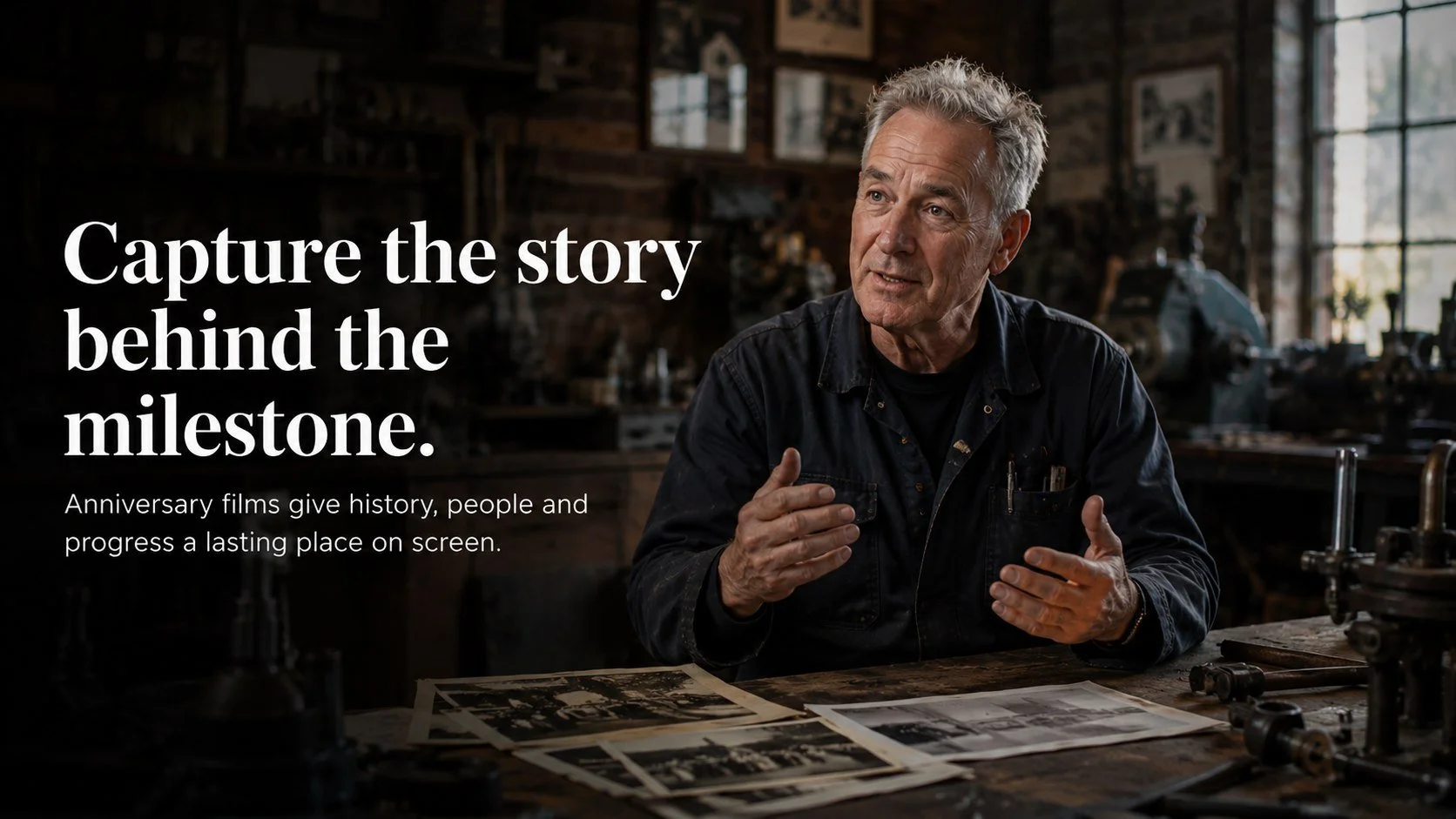
Stop Explaining Your Process
This is one of the biggest mistakes businesses make when planning corporate video.
Someone from the company looks at their ordinary working day and thinks:
“There's nothing interesting here.”
Of course you think that.
You see it every Tuesday.
Your prospect doesn't.
Imagine you're a manufacturer.
You might think a quality-control inspection is completely ordinary.
To a potential customer considering spending £50,000 with you, it could be one of the most reassuring pieces of content on your website.
You might run a consultancy and think your strategy workshop is boring.
A potential client might be desperate to know how you actually reach your recommendations.
You might run an agency and think your internal review meeting isn't worth filming.
A prospect might want to see exactly how much thought goes into the work before it reaches them.
The things you consider mundane are often the things a PDF can't prove.
That's where the value is.
The Bangin Spice Mix lesson: show the real thing
This principle isn't limited to service businesses.
We saw a similar effect when working on the Bangin Spice Mix campaign.
Rather than simply telling the audience that the product was authentic and well made, the production showed the product itself being made.
The camera could capture something a sentence couldn't.
The ingredients.
The preparation.
The process.
The people.
The finished product.
That same principle applies to professional services.
Don't tell people your process is good.
Give them something they can actually see.
Where should a process film sit in the sales journey?
The obvious answer is your website.
But stopping there would waste most of its value.
A good process film can become a sales asset that follows the prospect throughout their decision-making journey.
Put it on your homepage.
Your homepage usually has a difficult job.
It has to explain what you do, establish credibility, and give visitors a reason to continue—often within seconds.
A short process film can help answer one of the most important questions early:
“What is it actually like to buy from these people?”
That's much more useful than another paragraph telling visitors you're “passionate about delivering exceptional solutions."
Put it inside proposals.
This is where the format becomes particularly useful.
Your proposal might explain your methodology beautifully.
Your competitor's proposal might explain theirs beautifully too.
Now imagine your prospect opens yours and sees a short film showing your team actually working.
Suddenly the proposal isn't just making claims.
It is showing evidence.
The film keeps working even when you're not in the room presenting it.
Use it in follow-up emails.
After an initial sales call, prospects often start comparing suppliers.
You know what happens next.
Open proposal one.
Open proposal two.
Open proposal three.
Compare price.
Compare services.
Try to work out who feels safest.
A process film gives you another opportunity to influence that comparison.
Instead of saying:
“Just wanted to follow up and explain our approach…”
You can point them towards something that actually demonstrates it.
That's a much stronger sales conversation.
What if your process isn't visually exciting?
Good.
It doesn't need to be.
You're not making a Hollywood blockbuster.
You're making a piece of commercial proof.
A process film doesn't need explosions, drones flying through sunsets, or dramatic slow motion of somebody walking into a boardroom.
If anything, overproducing it can weaken the message.
The prospect doesn't need cinematic spectacle.
They need confidence.
Show the consultant running the workshop.
Show the manufacturing process.
Show the team checking the work.
Show the designer making revisions.
Show the people who will actually be responsible for the project.
The goal isn't:
“Look how impressive our office is.”
The goal is:
“Look how we work.”
That's a completely different message.
A process film can also become a content engine.
Here's another reason filming the process makes sense.
You don't necessarily need one film.
You can build an entire content system from the same production.
Start with the flagship two-to-four-minute process film.
Then cut it into shorter pieces.
One clip about discovery.
Another about quality control.
Another about how projects are reviewed.
Another about what happens before delivery.
Another featuring a member of the team explaining one stage.
Now your sales asset becomes social content.
It can live across LinkedIn, Instagram, YouTube, and other relevant channels while continually reinforcing the same message:
This is how we work.
And unlike generic “five reasons to choose us” posts, every piece has a genuine source.
The work itself.
How long should a process film be?
For a flagship process film, around two to four minutes is a sensible starting point.
That's enough time to explain the journey without turning it into a corporate documentary nobody finishes.
But don't obsess over the exact runtime.
The important thing is whether every section earns its place.
You can then create shorter versions for specific stages of the buying journey.
A 30-second clip might explain your discovery process.
A 45-second version might focus on quality control.
A one-minute version might show what happens after the initial brief.
That gives you content for different levels of buyer interest without repeatedly filming the same thing.
What if our process changes?
It will.
Businesses evolve.
Teams change.
Technology changes.
The way you deliver projects changes.
That doesn't mean a process film becomes useless.
The trick is to focus the main film on the fundamentals that define how you work, rather than documenting every tiny operational detail.
Then review the film periodically.
A refresh every 12–18 months may make sense for many businesses, particularly if the process or team has changed significantly.
And let's be honest: if your process page hasn't been updated since 2019, the film isn't necessarily the thing you should be worried about.
Will filming disrupt our actual client work?
It shouldn't if the production is planned properly.
In fact, the best process films often involve very little staging.
The objective isn't to make your team pretend to work.
It's to capture them working.
That means planning around real activity, identifying the moments that matter and keeping the production team from getting in the way.
Depending on the business and scope, the filming itself might take a day or two.
The more authentic the process, the less you need to manufacture.
And that is exactly what makes the final film believable.
Your process is probably your biggest untapped sales asset
Think about how much effort goes into developing a good process.
You hire experienced people.
You create systems.
You develop quality checks.
You learn from previous projects.
You refine how you communicate with clients.
You build expertise.
Then your website reduces all of that to:
Step 1: Discovery.
Step 2: Strategy.
Step 3: Delivery.
That's like spending years building a brilliant restaurant and describing it as:
“Food. Served professionally.”
Technically accurate.
Completely unhelpful.
Your process contains evidence of your expertise.
So why hide it behind corporate language?
The real competitive advantage isn't having a process.
Your competitors have a process.
They probably have a project management system.
They probably have meetings.
They probably have quality checks.
They probably have a strategy phase.
They probably have a delivery stage.
None of those things are particularly unique.
What can differentiate you is how you actually do those things.
And more importantly, whether you are willing to let prospective clients see them.
That is why filming your process can be so powerful.
You move the conversation away from:
“Who says they can do the best job?”
towards:
“Who has actually shown me how they work?”
That's a much more useful comparison.
Stop making prospects take your word for it.
If your website says you're collaborative, show the collaboration.
If you say you're meticulous, show the checking.
If you say you're strategic, show the thinking.
If you say you're hands-on, show the people doing the work.
If you say your clients are involved throughout the process, show what that involvement looks like.
Because the strongest sales message isn't always another claim.
Sometimes it's simply
“Here. Have a look.”
At Title Productions, we use that same story-first approach across documentary, case study, and commercial production. You can see examples of the work we've produced in our portfolio of projects or explore how we approach projects from brief through to delivery through our production services.
Because ultimately, your prospects don't need another beautifully written methodology.
They need a reason to believe you.
And your process might already be sitting right in front of them.
You just need to show it.
Frequently Asked Questions
How much does a process film cost?
The cost depends on the number of filming locations, production days, people involved, complexity, and how much content you want to create from the shoot.
A simple process film might require a single location and a focused shoot. A larger organisation may need multiple departments, locations, and interviews.
The important question isn't simply how much the film costs.
It's what the asset will do for you afterwards.
If the same production becomes your website hero film, proposal asset, sales follow-up, LinkedIn content and social cutdowns for the next year, its value extends well beyond the original video.
Can a process film replace our written process page?
Not necessarily.
The strongest approach is usually to use both.
Your written process is useful for visitors who want to scan specific information, understand the stages, or find answers quickly.
The film provides something the written page cannot:
visual evidence.
Think of the text as the explanation and the film as the demonstration.
Can we use the process film on social media?
Absolutely.
In fact, this is one of the biggest advantages of filming the process properly.
The main film can be cut into smaller pieces covering individual stages, people, questions, problems, and outcomes.
Those clips can become useful social content rather than another round of generic promotional posts.
How disruptive is filming to our team?
A well-planned production should work around your business rather than forcing the business to work around the camera.
The best footage often comes from real activity, so there's usually no benefit in turning your workplace into a film set for several days.
The production team can identify the important moments beforehand and capture them with minimal disruption.
How often should we update a process film?
There's no universal schedule, but reviewing it every 12–18 months is sensible for many businesses.
If your team, technology, process, or proposition changes significantly, update it sooner.
The important thing is to avoid letting your film become a historical record of how your business used to work.
Losing deals at the proposal stage to cheaper competitors?
Maybe the problem isn't your price.
Maybe the prospect simply doesn't understand why your price is justified.
Your website can tell them you're experienced.
Your proposal can tell them your process is proven.
Or you can show them.
Let's film the thing your PDF can't prove.
Get in touch with Title Productions and let's talk about what your process actually looks like on camera.