
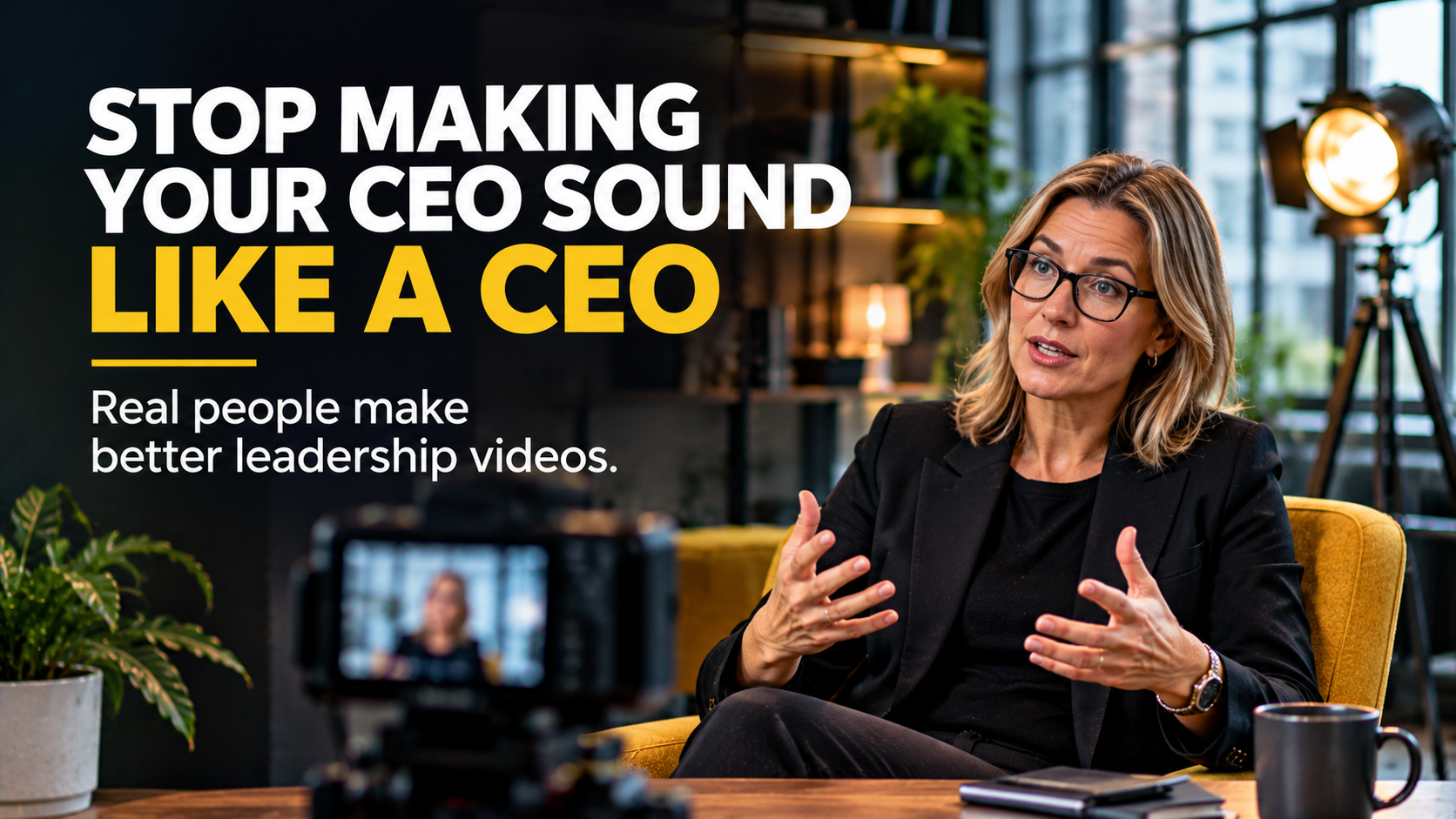
Stop Making CEOs Sound Corporate.
Put a camera in front of most CEOs and something strange happens.
The person who is sharp, funny and direct in every meeting suddenly starts speaking like they've swallowed a corporate communications handbook.
"We're passionate about delivering excellence for our valued stakeholders."
"We strive to create innovative solutions that drive meaningful impact."
"Our people are at the heart of everything we do."
Nobody talks like that in a normal conversation. Which is precisely why audiences struggle to believe it when they hear it on camera.
The problem isn't that business leaders lack things worth saying. Most have years of experience, valuable insights and stories that customers would genuinely find interesting.
The problem is what happens when someone tries to turn those thoughts into a polished corporate performance.
The result is often a video that looks professional but feels strangely disconnected from the person speaking.
And when you're trying to build trust, that disconnect matters.
The best CEO videos don't make leaders sound more corporate. They make them sound more like themselves.
The Corporate Voice Is a Trust Killer
Think about the last time you watched a business leader speak on camera.
Did you remember what they said? Did you believe them? Did you feel you understood the person behind the company?
Or did it sound like another carefully approved corporate announcement?
Audiences don't just listen to the words in a CEO video. They pay attention to how those words are delivered.
They notice whether the speaker sounds comfortable, whether their answers feel considered and whether the message appears to come from personal experience.
A perfectly delivered script can still feel unconvincing if the language sounds unnatural.
That's because professional communication and corporate language aren't the same thing.
A CEO can communicate authority without using complicated phrases. They can demonstrate expertise without sounding rehearsed. They can discuss company values without repeating the wording from the About Us page.
In fact, straightforward language often makes a leader more credible.
Compare these two statements:
Corporate version:
"We are committed to delivering innovative solutions that empower our clients to achieve sustainable business growth."
Human version:
"We want to help businesses solve problems that are holding them back. That's what our team comes to work to do."
The second statement is easier to understand because it sounds like something a person might actually say.
It also gives the audience a clearer idea of what the business does.
The objective isn't to make a CEO less professional. It's to remove the unnecessary performance that gets between the speaker and the message.
Why CEOs Suddenly Sound Different on Camera
It's easy to assume that an executive who struggles on camera simply isn't comfortable being filmed.
Sometimes that's true.
But often, the production process itself creates the problem.
There are three common reasons why confident business leaders become unusually formal when recording a video.
The Script: When Someone Else Writes Your Personality
A communications team receives a brief.
They need a CEO introduction, a company announcement or a message about the organisation's latest achievements.
They write a script, send it for approval and eventually place it in front of the person who needs to deliver it.
The problem?
The language may be perfectly acceptable on paper but completely unfamiliar to the person reading it.
A naturally direct leader is suddenly expected to deliver sentences filled with formal expressions, carefully constructed phrases and corporate terminology.
They're no longer explaining something they understand. They're trying to remember someone else's words.
That creates a translation exercise in front of the camera.
The speaker concentrates on getting the sentence right rather than communicating the meaning behind it.
A better approach is to establish the message first, then allow the CEO to explain it in their own language.
The production team can shape the final narrative during editing without forcing the speaker to memorise every sentence.
The Autocue: Reading Is Not the Same as Talking
Autocues have their place.
They can be useful for formal announcements, broadcast-style presentations and situations where exact wording is essential.
But they're not always the best tool for leadership videos.
When someone reads directly from a screen, their attention shifts towards delivering the written words.
Their eyes may move differently. Their expression can become less natural, and their delivery may lose the rhythm of an ordinary conversation.
Even when the speaker gets every word right, the result can feel distant.
For many CEO interviews, a better option is to use an off-camera interviewer and a series of well-prepared questions.
The leader listens, thinks and responds.
The production team then selects the strongest answers and builds the final video around them.
This approach often produces more natural material because the speaker is responding to an idea rather than reciting a paragraph.
The Pressure: Everyone Thinks This Is a Big Performance
A CEO video can feel like a significant moment.
The board might approve it. The marketing team might have spent weeks organising it. The final video may be intended for customers, investors, employees or the wider public.
The speaker knows the recording matters.
Unfortunately, that pressure can make them overthink every sentence.
They start trying to sound authoritative, avoid mistakes and deliver something that feels suitably important.
The result is often the opposite of what the business needs.
A simple explanation becomes a formal address. A genuine opinion turns into a carefully managed statement.
The solution is to change the atmosphere of the recording.
Instead of presenting the shoot as a major speech, treat it as a conversation with someone who genuinely wants to understand the business.
That small change in expectation can make a considerable difference.
How to Film Leaders People Actually Want to Listen To
Good CEO videos don't happen by accident.
They require preparation, thoughtful questions and a production environment that allows the speaker to relax.
At Title Productions, we believe the strongest leadership content often comes from interviewing executives rather than asking them to perform a script.
Here's how that approach works.
Interview, Don't Ask Them to Recite
Instead of handing a CEO a finished script, start with the subjects the video needs to cover.
Prepare a series of questions that encourage them to explain their experiences, opinions and decisions.
For example, a company introduction might explore:
What problem did the business originally set out to solve?
What has changed in the industry since the company started?
What do customers commonly misunderstand about the service?
What has the business learned from its biggest challenges?
What makes the team approach its work differently?
These questions give the speaker room to think.
The interviewer can ask follow-up questions, explore interesting answers and encourage the CEO to explain points in greater detail.
The final edit can then be structured around the most useful material.
The result is a video that still has a clear narrative without sounding like a speech.
Ask Questions That Produce Stories, Not Statements
Some interview questions almost guarantee predictable answers.
"Tell us about your commitment to quality."
"What makes your company innovative?"
"How important are your employees?"
A CEO can answer those questions without revealing anything particularly interesting.
Try asking questions that invite specific experiences instead.
"What was the biggest mistake you made when starting the business?"
"Can you remember a customer problem that changed how you work?"
"What is something about your industry that you think people misunderstand?"
"What decision looked risky at the time but turned out to be right?"
These questions are more likely to produce stories, opinions and examples.
A specific experience is often more memorable than a general statement about company values.
If a CEO explains how the business struggled with a particular challenge and what they learned from it, the audience gains something useful.
They also get a better sense of the person making the statement.
Give the Camera Time to Become Normal
The first few minutes of an interview aren't always the most useful.
The speaker may be adjusting to the environment, thinking about the camera or worrying about how they sound.
That's normal.
Rather than rushing through the questions, allow time for the conversation to develop.
Start with straightforward subjects. Let the CEO become familiar with the interviewer and recording setup before moving into the more important questions.
Some of the strongest answers often arrive after the initial warm-up.
The speaker begins to relax, stops monitoring every word and focuses more on the conversation.
A production team should recognise that this is part of the process, not wasted filming time.
Don't Edit Out Every Human Moment
There is a difference between an unclear answer and a natural human moment.
A pause while someone thinks can make an answer feel considered.
A brief laugh can make a serious subject more approachable.
A speaker correcting themselves can make the conversation feel genuine.
Of course, editing still matters.
Unnecessary repetition, distracting mistakes and sections that make the message difficult to follow should be removed.
But removing every pause, expression and spontaneous moment can create a video that feels artificially polished.
The objective is clarity, not perfection.
A CEO who sounds like a real person is often more engaging than one who delivers every sentence without hesitation.
The Questions That Make Better CEO Videos
The quality of a leadership video often depends on the questions asked before and during filming.
A useful question should encourage the speaker to explain something they know, remember or genuinely believe.
Here are some examples worth building into a CEO interview.
For company introductions
What problem did you originally want to solve?
What do you wish more people understood about your business?
What has changed most since the company began?
For leadership and company culture
What do you look for when building a team?
What's one lesson you've learned from managing people?
What does good leadership look like in practice?
For customers and business development
What do customers usually come to you struggling with?
What makes a successful client relationship?
Can you describe a project that changed the way you approach your work?
For industry expertise
What is one industry trend you think businesses are getting wrong?
What should companies be paying more attention to?
What advice would you give someone making this decision for the first time?
These aren't questions that need rehearsed answers.
They're starting points for conversations that reveal the speaker's experience and perspective.
A skilled interviewer should also be prepared to follow an interesting answer rather than immediately moving to the next question.
Sometimes the best material comes from asking, "Can you give me an example?"
The One Sentence That Changes the Shoot
Before recording, give the CEO one simple instruction:
"You're not making an announcement. You're explaining this to one intelligent person over a coffee."
It sounds straightforward, but it changes the way many people approach the camera.
They stop trying to deliver a speech.
They focus on explaining their point clearly.
Their sentences become shorter. Their vocabulary becomes more natural, and they are less concerned with sounding impressive.
The person their colleagues recognise in everyday meetings starts to appear on screen.
That's the person the audience needs to meet.
A leadership video doesn't need to sound like a parliamentary address to communicate authority.
In fact, a CEO who can explain a complicated business decision in simple language may demonstrate more confidence and expertise than one who relies on corporate terminology.
Where CEO Videos Fit Into Your Wider Marketing Strategy
A CEO interview shouldn't necessarily be created as a standalone video and then forgotten.
A single well-planned recording session can produce content for several business purposes.
For example, a longer leadership interview could be edited into:
A company introduction: A structured film explaining the organisation's purpose, expertise and direction.
LinkedIn leadership clips: Short extracts featuring the CEO's opinions, industry insights and experiences.
Customer education: Answers to common questions that help prospects understand the company's services.
Recruitment content: Conversations about leadership, company culture and what the organisation looks for in its people.
Website content: Short videos supporting service pages, About pages and relevant landing pages.
Sales support: Specific answers that help the sales team address questions or concerns during conversations with potential customers.
The exact content depends on the interview and the audience.
Not every answer will become a separate video, and not every clip needs to be published.
The important thing is to plan for multiple uses before filming rather than discovering afterwards that the footage only works as one long corporate film.
This is also where a consistent video production and content strategy can help businesses make better use of leadership expertise.
What About CEOs Who Really Don't Like Being Filmed?
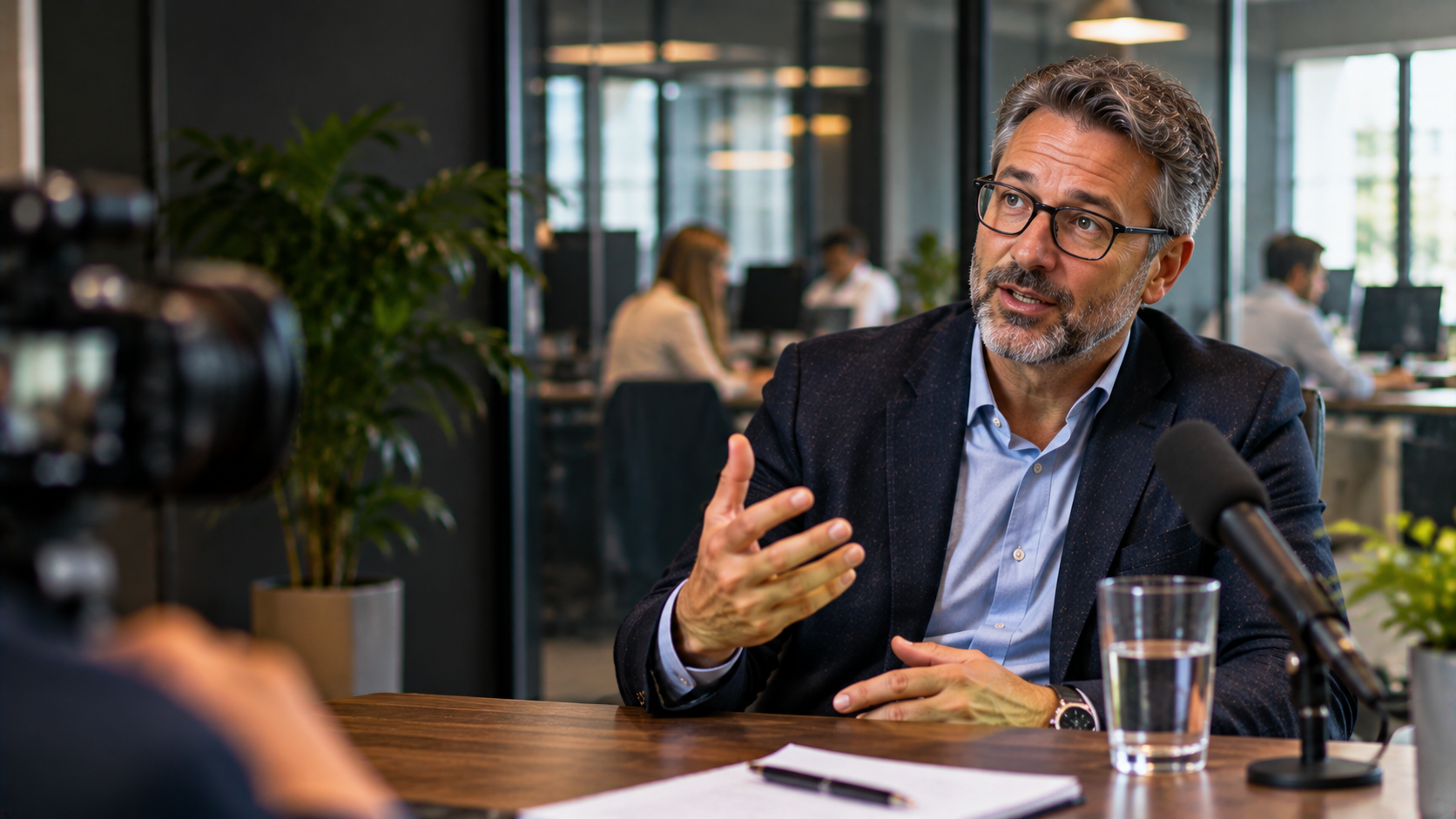
Corporate Interview in a Modern Office
Not every business leader is naturally comfortable on camera.
Some are confident speakers but dislike being recorded. Others need time to organise their thoughts or feel uncomfortable discussing themselves.
That doesn't mean they shouldn't appear in video content.
It means the production approach needs to suit the individual.
Start with a conversation before filming.
Explain the purpose of the video, who will watch it and what subjects will be covered.
Avoid giving the CEO a long script to memorise.
Use an interviewer who can make the conversation feel natural, and choose a filming environment where the speaker feels comfortable.
For particularly nervous contributors, begin with shorter questions and less formal material.
It's also useful to explain that the final video will be edited. They don't need to deliver every answer perfectly in one take.
If the subject is sensitive or the message requires careful wording, the communications team can still review the content before publication.
Authenticity doesn't mean abandoning preparation or editorial control.
It means creating the conditions for a leader to communicate naturally while keeping the message accurate and appropriate.
Stop Directing a Performance. Start Capturing a Person.
Your CEO probably doesn't speak in corporate slogans during a normal conversation.
They explain problems, tell stories, make decisions and share opinions.
Those are the qualities that make them interesting to listen to.
Yet too many leadership videos remove those qualities in an attempt to make the speaker sound more professional.
The result is a polished corporate performance that could have come from almost any organisation.
A better approach starts with the person, not the script.
Ask better questions. Create a relaxed interview environment. Give the speaker time to find their rhythm. Keep the moments that make the conversation feel real.
At Title Productions, we produce corporate video, leadership interviews and branded content designed to communicate business expertise in a clear and engaging way.
Our approach focuses on capturing genuine insight and shaping it into content that works across websites, social platforms and wider marketing campaigns.
You can explore examples of our previous production work to see how different stories and messages can be brought to life.
If your leadership videos feel overly scripted or your executives struggle to communicate naturally on camera, talk to our team about your next production.
Your CEO doesn't need to sound more like a CEO. They need to sound like the person people already trust.