
When Beautiful Brand Films Fail
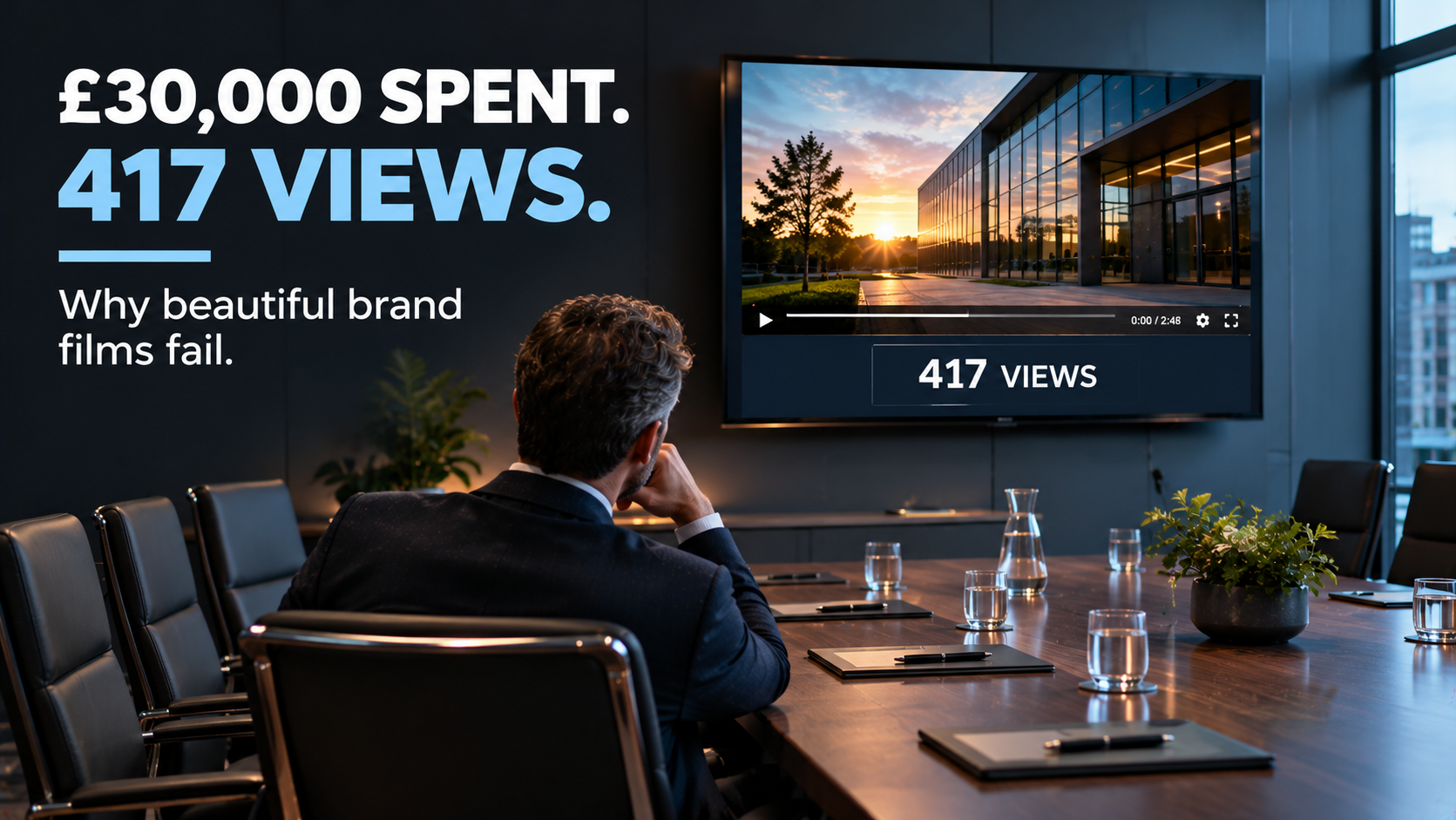
Somewhere in the UK, a marketing director is presenting a beautifully produced £30,000 brand film to the board.
The cinematography is excellent. The music is emotional. The colour grading looks like something from a major television campaign. Everyone agrees the company has never looked better.
Then somebody opens YouTube.
417 views.
Nobody mentions the number. The marketing director moves quickly to the next slide.
The frustrating part? The film probably isn't bad.
It may be an exceptional piece of creative work. The production company may have delivered everything promised, and the business might genuinely be proud of the result.
But six weeks after launch, the film is sitting quietly on YouTube, attracting little attention beyond employees, existing customers and a handful of people who already know the brand.
The number 417 is illustrative, but the situation is familiar.
Businesses invest heavily in flagship films, expecting them to create awareness, strengthen their reputation and generate commercial interest. Yet the results sometimes fall far short of expectations.
The problem usually starts long before filming.
Poor brand film ROI is rarely just a production problem. More often, it's a strategy, distribution and audience problem.
And until businesses recognise that distinction, expensive films will continue to disappear into the internet.
A Beautiful Brand Film Is Not a Marketing Strategy
Let's establish something important.
There's nothing inherently wrong with spending £30,000 on a brand film.
For some businesses, that level of investment is entirely justified.
A major rebrand, international campaign, investor presentation or significant company milestone may require sophisticated creative development, multiple filming locations, specialist equipment and extensive post-production.
A well-made film can become a valuable asset for years.
The mistake is assuming that production quality automatically creates an audience.
It doesn't.
A film can be beautifully shot, professionally edited and emotionally compelling without reaching the people it was created to influence.
Production determines what the audience experiences when they watch.
Distribution determines whether the intended audience gets an opportunity to watch in the first place.
Those are separate responsibilities, and both need a budget.
Too often, businesses invest heavily in the first and treat the second as an afterthought.
That's how a £30,000 production becomes a £30,000 video sitting on a company YouTube channel.
Reason One: The Entire Budget Went Into Production
This is one of the most common mistakes in expensive brand film projects.
The business approves a £30,000 marketing budget.
The production company presents a creative concept, and the team gets excited about what the finished film could look like.
The budget covers creative development, filming, locations, crew, equipment, editing, colour grading, sound design and final delivery.
Every pound is accounted for.
Except the money needed to put the film in front of people.
The launch plan becomes something like this:
Upload the film to YouTube. Share it on LinkedIn. Ask employees to repost it. Add it to the homepage. Send it to a few customers.
Then wait.
But why would a business expect thousands of relevant strangers to discover a film simply because it has been uploaded?
Your existing followers may see the announcement. Some employees might share it. A few customers may watch.
But those people already have a relationship with your business.
If the objective is to reach new audiences, you need a strategy for reaching people who haven't heard of you.
That could involve paid social advertising, YouTube campaigns, industry publications, targeted email activity, partnerships or integration into a broader marketing campaign.
The right channels depend on who you're trying to reach.
What a Better £30,000 Budget Might Look Like
Instead of spending the entire amount on production, consider reserving a portion for distribution.
For example:
£27,000 for creative development and production.
£3,000 for targeted distribution and promotion.
That's a 90/10 split.
It isn't a universal formula, and £3,000 won't guarantee a successful campaign. In some cases, a larger distribution allocation may be appropriate.
But even this adjustment forces an important conversation before production begins.
Who needs to see the film? Where can we reach them? What action do we want them to take? How will we measure the result?
Those questions are just as important as the creative treatment.
A film with a smaller production budget and a credible distribution plan may deliver greater commercial value than a more expensive film that nobody sees.
A great film deserves an audience. That audience needs to be planned for, not hoped for.
Reason Two: The Film Was Made for the Boardroom, Not the Viewer
There's a particular type of corporate brand film that almost everyone in the creative industry will recognise.
It opens with a sweeping drone shot of an office building.
A piano begins playing.
A voiceover talks about innovation, excellence, passion and commitment.
Employees appear in slow motion. Someone walks through a corridor. Another person smiles during a meeting.
The company logo appears.
The film looks expensive.
But what has the viewer actually learned?
Sometimes, very little.
This happens because brand films often pass through several layers of internal approval.
The marketing team wants the film to feel modern. Senior leadership wants it to communicate the company's values. Department heads want their teams represented. Someone wants to mention the company's history, and another person insists on including every service.
By the time everyone has contributed, the film may have become a polished summary of how the business wants to describe itself.
Unfortunately, that's not always what the audience wants to watch.
The Boardroom Question vs the Audience Question
Inside the business, the main question is often:
"Does this film represent us properly?"
That's a reasonable concern. Brand accuracy matters.
But the audience is asking something different:
"Why should I spend my time watching this?"
Those two questions need to be answered together.
A potential customer may care about how you solve a problem, what makes your approach credible or whether you've delivered results for businesses like theirs.
A prospective employee may want to understand what working for your organisation actually feels like.
An investor may be interested in the strength of your operations, leadership and commercial opportunity.
None of those audiences automatically cares about an abstract statement describing your passion for excellence.
The strongest brand films connect what the business wants to communicate with something the audience genuinely values.
That might be a compelling customer story, a distinctive point of view, a demonstration of expertise or a clear explanation of why the company exists.
The creative should begin with the viewer's interests, not simply the organisation's preferred description of itself.
Reason Three: You Produced One Asset for One Moment
Imagine spending £30,000 on a four-minute brand film.
It launches on a Tuesday.
The marketing team shares it across the company's channels. Employees engage with the announcement, and the film receives a burst of attention.
By the following week, activity slows.
A month later, the business is back to posting occasional photographs and written updates because there's no new video content ready.
The film hasn't necessarily failed as a brand asset.
But as a sustained visibility strategy, it was always limited.
You invested in one piece of content and one major launch moment.
There were no shorter edits, no platform-specific versions, no supporting interviews and no plan to continue the conversation.
That's a missed opportunity.
One Filming Project Should Create More Than One Publishing Opportunity
A flagship brand film can be the centre of a much wider content campaign.
Depending on what is captured during production, the same project could support:
A main brand film for the website and presentations.
Shorter edits for LinkedIn and paid advertising.
Vertical clips for social media.
Individual employee or leadership stories.
Customer-focused versions highlighting specific benefits.
Behind-the-scenes content.
Supporting photography and campaign visuals.
These assets shouldn't simply be random extracts from the main film.
They should be planned around different audiences, messages and distribution channels.
For example, the main film might introduce the company's broader story, while a shorter edit explains one service benefit to a specific customer group.
Another clip might focus on the people behind the business.
Each piece creates another relevant opportunity to reach someone.
That doesn't mean every £30,000 project should automatically produce a hundred videos. The number of usable assets depends on the creative concept, filming plan and editing scope.
The principle is to plan for reuse before production begins.
If the business needs a sustained presence, a single finished film is rarely the most efficient use of all its available content budget.
Reason Four: Nobody Defined What Success Actually Meant
The title of this article focuses on 417 views.
But views alone don't determine whether a brand film has delivered a return.
A film with 417 views from highly relevant decision-makers could be more valuable than one with 40,000 views from people who will never become customers.
Imagine a specialist engineering company produces a film to support a major tender.
The video is watched by a relatively small group of procurement professionals, helps explain the company's capabilities and becomes part of a successful sales process.
Its public view count may be modest, but the commercial contribution could be substantial.
Now imagine another company spends the same amount on a film intended to reach thousands of potential customers.
It attracts only a few hundred views, generates no meaningful enquiries and receives little engagement from the intended audience.
That is a very different outcome.
Brand Film ROI Depends on the Objective
Before production begins, businesses should agree on what the film is expected to achieve.
If the objective is brand awareness, relevant reach, audience engagement and brand recall may be useful indicators.
If the film supports sales, consider how often the sales team uses it, whether prospects engage with it and how it contributes to commercial conversations.
For recruitment, the measures might include relevant careers-page visits, candidate engagement or the quality of applications.
For investor communications, success may be linked to how effectively the film communicates the business opportunity and supports discussions with potential investors.
Not every benefit can be reduced to a direct financial return.
Brand perception, trust and familiarity can be difficult to attribute to a single asset.
But that doesn't mean measurement should be ignored.
The mistake is approving an expensive film without agreeing on its purpose, then deciding whether it worked based on whichever metric is easiest to find afterwards.
A view count tells you something about distribution. It doesn't tell you the entire story of value.
Reason Five: The Film Had No Life After Launch
Some businesses treat the publication date as the finish line.
The film is delivered, approved and uploaded.
Everyone celebrates.
Then attention moves to the next project.
But a brand film shouldn't automatically become irrelevant after its launch week.
Depending on the subject, it may continue supporting the business for months or years.
It could feature on important website pages, appear in sales presentations, support recruitment activity, introduce the company at events or provide material for future advertising.
The key is to plan those uses in advance.
If the film is intended for several purposes, the production process should account for them.
A website version may need a different opening from a conference presentation. A paid social advertisement may require a shorter edit with a more immediate message.
A recruitment-focused version may benefit from employee interviews that aren't central to the main brand story.
Without that planning, businesses can end up with an impressive film that is difficult to adapt.
They then face additional editing costs or discover that the footage needed for a different version was never captured.
A stronger approach treats the brand film as the beginning of a content library, not the end of a production project.
So, Whose Fault Is It When a Brand Film Underperforms?
The easy answer is to blame the marketing team.
They commissioned the film, approved the budget and managed the launch.
But that ignores an important part of the production company's responsibility.
A production partner shouldn't simply ask what the client wants to film.
They should also ask why the film is being made, who needs to see it and what the business expects to happen after delivery.
Those questions can change the entire project.
If a client has £30,000 available and needs to generate ongoing awareness, a single expensive brand film may not be the most appropriate recommendation.
A more useful solution might be a smaller flagship production supported by regular content and a distribution budget.
That recommendation could reduce the amount spent on the main film.
But it may produce a better result for the client.
Production companies shouldn't promise marketing outcomes they don't control. Audience targeting, media buying, campaign management and conversion performance may sit outside their contracted responsibilities.
However, a good production partner should recognise when the proposed deliverables don't match the stated objective.
If the client needs ongoing visibility, delivering one video without discussing how it will be used is a missed opportunity.
Equally, the business has responsibilities.
The marketing team needs to provide clear objectives, identify the audience, allocate an appropriate budget and ensure the content is actually distributed.
Successful brand film ROI depends on the production company and the client making the right decisions before the first filming day.
What Should You Do With a £30,000 Video Budget Instead?
The answer depends on what the business needs.
There are situations where spending most of the budget on one exceptional film makes sense.
There are others where that approach creates an impressive asset but leaves the business without enough content to maintain a regular presence.
The important thing is to choose the production model based on the objective.
Option One: Invest in a Flagship Brand Film
A major film may be appropriate when your business is launching a new identity, entering a significant market, presenting to investors or communicating an important milestone.
In these circumstances, the film may need a distinctive creative concept, carefully planned production and a high level of technical execution.
The investment can be justified when the finished asset has a clear purpose and an appropriate distribution plan.
But even then, consider how the footage can support shorter edits and additional uses.
Option Two: Split the Budget Between a Hero Film and Ongoing Content
For businesses that need both a strong brand introduction and regular marketing material, a mixed approach may be more useful.
An illustrative £30,000 allocation could be:
£10,000 for a focused hero film.
£14,000 for recurring video production and short-form content.
£6,000 for distribution and promotion.
These figures are examples, not fixed package prices. The appropriate allocation depends on production complexity, campaign duration and the channels being used.
This approach provides a flagship asset while creating opportunities to maintain visibility over several months.
The business can introduce its brand through the main film, then reinforce relevant messages through expert interviews, customer stories, demonstrations and shorter social videos.
The content becomes connected rather than appearing as isolated campaigns.
Option Three: Build a Recurring Content Production System
If the main objective is to remain visible, educate potential customers and support an ongoing sales pipeline, a recurring production arrangement may be the stronger option.
Instead of concentrating the budget on one major filming project, the business schedules regular content capture sessions.
Each session can produce a planned selection of videos and supporting assets.
Over time, this creates a growing library of material that can be distributed through LinkedIn, YouTube, email, website pages and sales communications.
It also gives the marketing team more opportunities to learn from performance.
If a particular topic generates useful engagement, future filming sessions can explore it further.
If a format isn't working, the team can adjust the approach without waiting for another major campaign.
This is where a video production retainer or another structured production arrangement may be worth considering.
The objective isn't simply to produce more content.
It's to create a repeatable process that keeps the business visible and gives each filming investment more opportunities to deliver value.
How to Prevent Your Next Brand Film From Flopping

Worried Creative in a Modern Studio
Before approving another substantial video budget, make sure the project answers a few essential questions.
Who is the film for?
Define the audience clearly. A film intended for investors will need a different message from one designed to attract new customers or employees.
What should the viewer understand or do afterwards?
Decide whether the objective is awareness, trust, enquiries, recruitment, sales support or something else.
How will people discover it?
Identify the distribution channels before filming begins. Consider whether paid promotion, email marketing, partnerships or website placement will be required.
What additional content can be captured?
Plan short-form edits, interviews, alternative openings and supporting footage while the production is being organised.
How long should the film remain useful?
Consider whether the content is tied to a specific launch or whether it needs to support the business over a longer period.
How will success be measured?
Agree on meaningful indicators before the campaign begins.
These questions don't restrict creativity.
They give the creative team a clearer purpose and help ensure the finished work has a practical role in the wider marketing strategy.
The Problem Isn't the £30,000 Film. It's What Happens Around It.
A beautifully produced brand film can be a powerful asset.
It can explain a company's purpose, introduce its people, demonstrate its capabilities and create an emotional connection with the audience.
But even exceptional creative work needs a plan.
Without distribution, the right people may never encounter it.
Without a clear audience, the message may become too generic to resonate.
Without additional content, the film may create one brief moment of attention before the business returns to silence.
And without agreed objectives, nobody can confidently explain whether the investment delivered value.
At Title Productions, we believe video production should begin with an understanding of what the content needs to achieve.
As a media production company working across corporate video, branded content, social media production and creative campaigns, our focus is on developing content that serves a clear purpose beyond the filming day.
You can explore our previous projects to see the different types of content we produce.
If you're planning a brand film or reviewing how your business invests in video, get in touch with our team to discuss a production approach that fits your audience, objectives and budget.
Because the problem with a £30,000 brand film isn't that it costs £30,000.
It's spending £30,000 to be visible for one week when your business needs to be remembered all year.