
Why Your Facebook Ads Die After a Week (And How to Shoot 40 Variants in a Day)
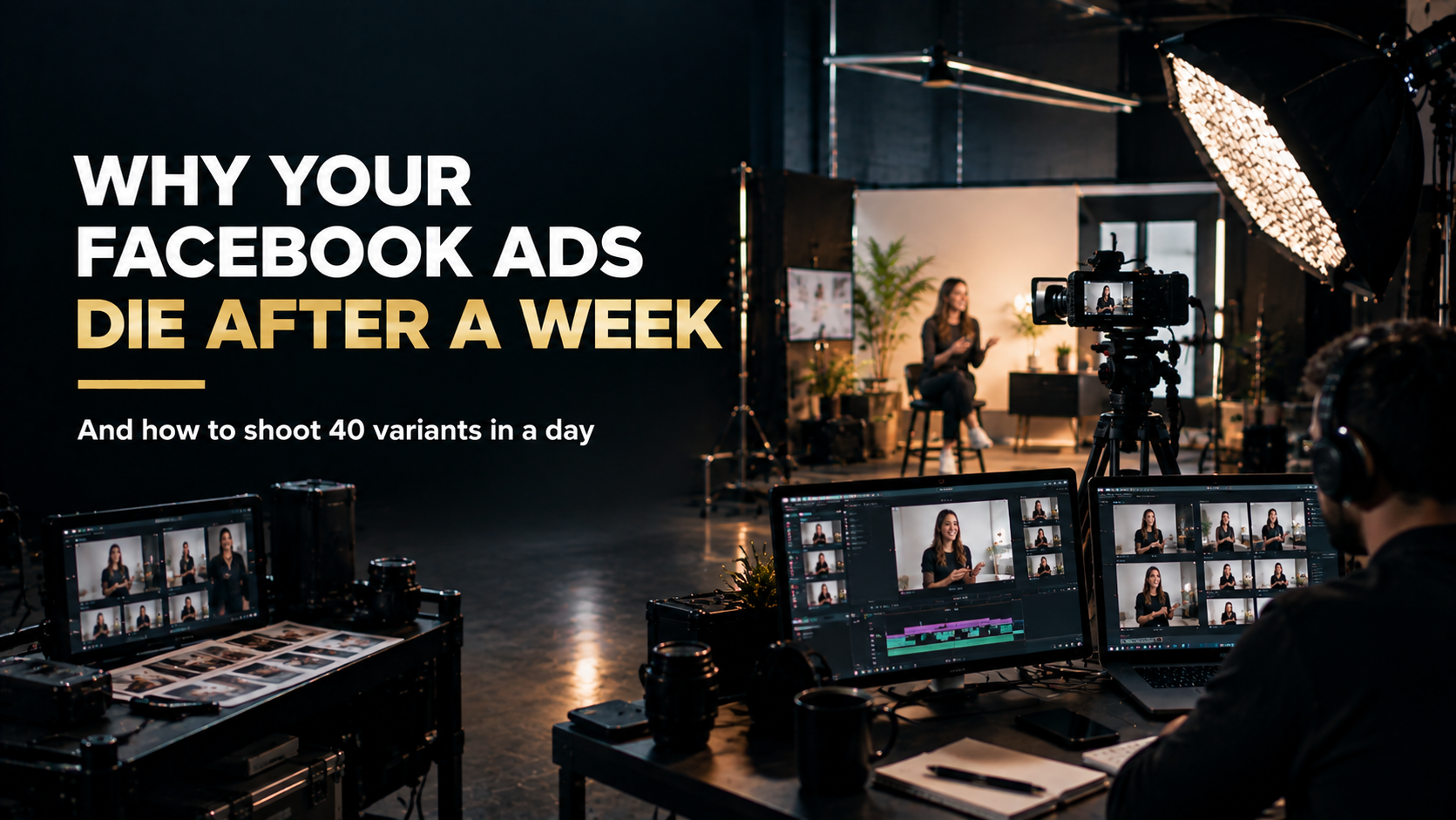
social media content production
You know the pattern.
New ad launches. Results are great. You celebrate. Maybe even buy the good biscuits.
Then, somewhere between day five and day fifteen, the cost per result starts climbing. Engagement drops. The once-brilliant ad suddenly looks rather ordinary.
By week three, your winning ad is a losing ad.
The ad did not necessarily break.
It wore out.
This is creative fatigue: people see the same advertising repeatedly, become less responsive to it, and performance can decline as a result.
The usual response is to change the targeting, increase the budget or start fiddling with the campaign settings.
Sometimes those things matter.
But if the audience has simply seen the same creative too many times, none of them solves the underlying problem.
You need more creative.
And that does not have to mean producing 40 completely different ads from 40 completely different shoots.
The smarter approach is to build the production around variety from the beginning.
Why Facebook and Instagram ads stop working
Paid social platforms are built to find people who are likely to respond to an advert.
Once your campaign is running, the same creative can be shown repeatedly to people within your target audience. As frequency increases, the creative can lose its ability to grab attention.
That matters because social advertising is consumed at speed.
People are scrolling through Reels, Stories and feeds surrounded by hundreds of competing pieces of content. An advert that looked fresh two weeks ago can become instantly recognisable.
And once someone knows what is coming, they have less reason to stop.
This is why creative is such an important part of modern paid social.
Your targeting might be excellent.
Your landing page might be excellent.
Your offer might be excellent.
But if the creative no longer makes someone stop scrolling, the rest of the campaign has a harder job.
The problem is that creative has a shelf life.
Which creates an uncomfortable question:
How do you keep producing enough fresh advertising without constantly paying for another full production?
Stop shooting ads. Start shooting a creative system.
This is where modular production changes the economics.
Instead of planning one shoot around one finished advert, you plan the shoot around interchangeable creative components.
Think:
Different opening hooks
Product demonstrations
Talking-to-camera sections
Customer problems
Product benefits
Testimonials
Close-up product shots
Lifestyle footage
Calls to action
Different endings
Different messaging angles
Each component can then be combined with others during editing.
You are no longer producing one advert.
You are building a library of ingredients that can become many adverts.
That distinction is important.
Because the expensive part of advertising creative is often not editing another six-second version.
It is organising another shoot.
Another location.
Another crew.
Another setup.
Another round of planning.
Another day on set.
A properly planned production day can capture the raw material for dozens of pieces of creative in one coordinated push.
How one production day can create 40 ad variants
The maths is surprisingly simple.
Imagine you shoot:
5 different hooks
× 4 creative formats
× 2 lengths
= 40 potential combinations
The exact number will depend on the campaign, product and footage available, but the principle is powerful.
One production does not have to equal one advert.
It can equal a creative library.
For example, the same product could be introduced through:
A problem-led opening
A surprising fact
A direct product demonstration
A customer statement
A strong benefit
Those openings can then be edited into different formats and lengths.
Suddenly, the production team has created multiple opportunities for the media-buying team to test.
And that is the point.
You do not know beforehand which combination will win.
Nobody does.
The hook is where your production day earns its money
On social media, the opening seconds have an enormous job.
Someone is scrolling.
You have a tiny window to give them a reason to stay.
So instead of filming one perfect introduction and moving on, film several.
The same product can begin with:
A problem
“You're probably wasting money on…”
A result
“Here’s what happened when we changed…”
A demonstration
“Watch what happens when…”
A direct statement
“If you’re still doing this, stop.”
A question
“Why does this keep happening?”
The rest of the advert can remain largely the same.
That means one production setup can generate several creative directions without requiring an entirely new shoot.
And once you start thinking this way, the shoot itself becomes more efficient.
Variety does not mean making random adverts
There is a trap here.
Some brands hear “more creative” and respond by producing a mountain of slightly different videos that all say exactly the same thing.
That is not really variety.
Useful variation changes something meaningful.
Change the format
Try different ways of delivering the same message:
Talking to camera
Product demonstration
Voiceover
Text-led video
UGC-style creative
Customer testimonial
Lifestyle footage
Change the length
A six-second version may work differently from a 15-second version.
A 30-second explanation may suit a more complicated proposition.
The point is not to assume which one will win.
It is to give the campaign something worth testing.
Change the message angle
The same product might be positioned around:
Price
Quality
Convenience
A specific problem
A particular occasion
A product benefit
A customer objection
Again, you are creating meaningful alternatives rather than cosmetic changes.
Bangin Spice Mix: turning one production into 40+ variants
We used this approach with Bangin Spice Mix for the launch of a new product line.
Rather than treating the campaign as a series of individual adverts, the production was planned around modular creative.
The shoot captured interchangeable components that could be combined and edited into more than 40 ad variants.
That approach produced a much larger testing library from a single coordinated production push.
For that campaign, the production approach was associated with a 60% reduction in production costs compared with producing the ads piecemeal, alongside a 28% reduction in customer acquisition cost.
The creative also recorded 32% three-second retention.
Those are results from that specific campaign, not a promise that every modular production will produce the same numbers.
But the bigger lesson is more useful than any individual percentage:
The campaign had enough creative variety to find out what actually worked.
That is the advantage of volume.
You cannot predict the winner before you test
This is one of the hardest things for creative teams to accept.
The advert everyone loves in the edit suite might perform terribly.
The simple version that nobody expected much from might become the strongest performer.
The polished product demonstration might lose to someone talking directly to camera.
The 30-second explanation might lose to a six-second clip.
You can make informed creative decisions.
You can use audience research.
You can study previous campaign performance.
But you still have to test.
That is why producing one “perfect” advert can be a surprisingly risky strategy.
You have invested the production budget into one hypothesis.
A modular shoot gives you multiple hypotheses.
What should you actually capture during the shoot?
The trick is to plan the production before the cameras start rolling.
A useful creative production plan might divide the day into blocks.
Block 1: Hooks
Capture multiple openings for the same core message.
Do not stop after getting one that sounds good.
Get several.
Block 2: Core message
Film the main explanation, demonstration or story.
Capture different takes and delivery styles where useful.
Block 3: Product footage
Get the close-ups, demonstrations, details and movement needed to make the edits visually interesting.
Block 4: Human moments
Capture reactions, interactions, testimonials and natural footage.
These can often become completely different creative assets from the same production.
Block 5: Endings and calls to action
Film multiple ways to finish.
Different CTAs can change the purpose of an otherwise identical piece of content.
Once these blocks are captured, the editor has options.
And options are what turn one shoot into a creative testing system.
The best production day is planned around the edit
This is where production strategy matters.
You should not simply ask:
“What advert are we filming?”
Ask:
“What assets will the campaign need over the next several weeks?”
That changes the way you plan the shoot.
The shot list becomes more deliberate.
The script becomes modular.
The talent requirements become clearer.
The production team knows which elements need multiple versions.
The editor knows what combinations are possible.
And the paid media team gets a library rather than a single asset.
This is where a production company can become much more than the people who turn up with cameras.
The creative strategy, production and post-production need to work together from the beginning.
How often should you refresh Facebook ad creative?
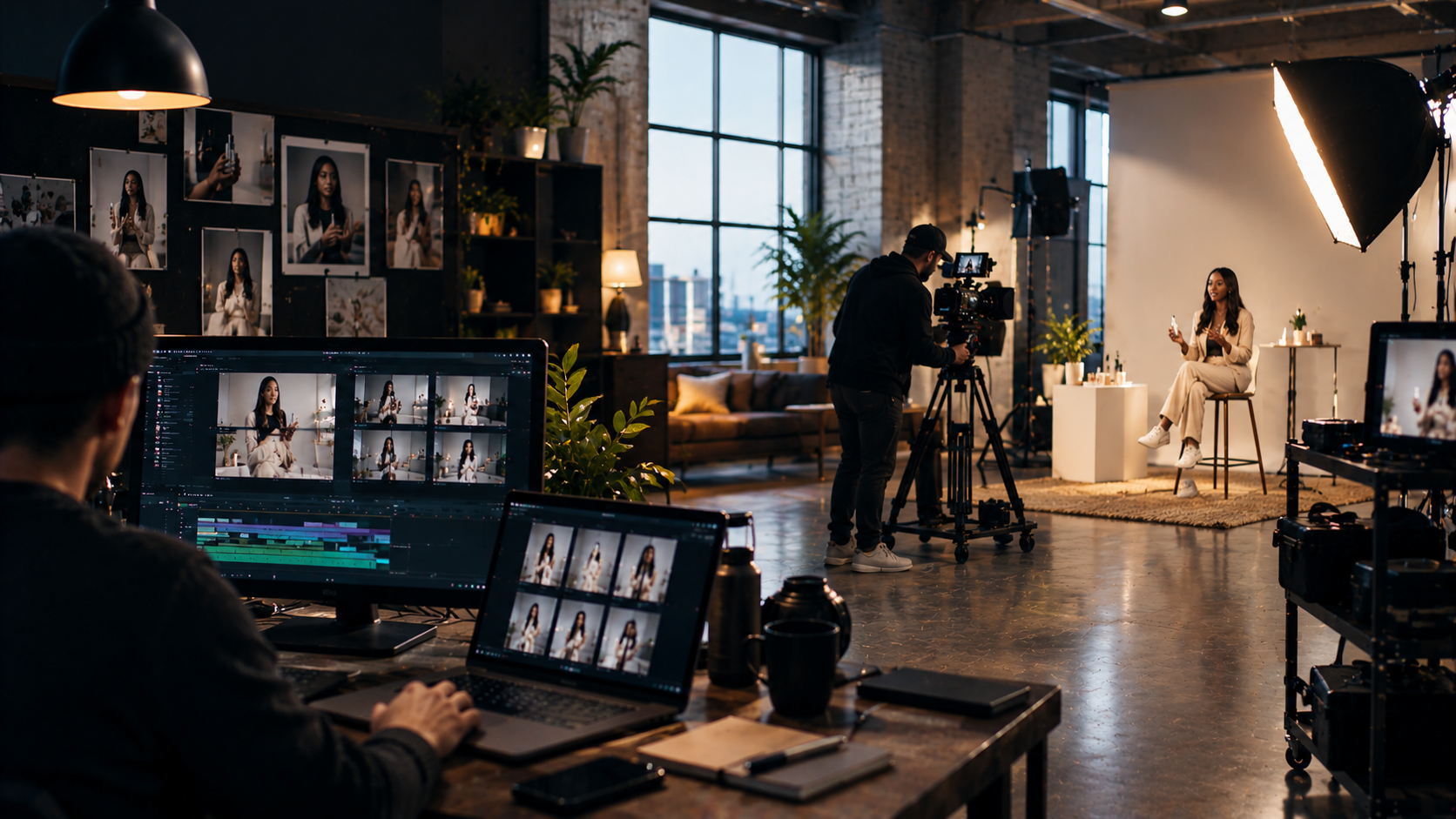
modular video production
There is no universal seven-day expiry date for an advert.
Some creative can run longer. Some deteriorates much faster.
The important thing is to watch the campaign rather than blindly follow a calendar.
Look for changes in metrics such as:
Frequency
Cost per result
Click-through rate
Conversion rate
Engagement
Video retention
If performance is deteriorating while the same creative is being repeatedly served, creative fatigue should be one of the things you investigate.
And this is where having a creative library becomes particularly useful.
A refresh does not necessarily mean:
“We need another shoot next Tuesday.”
It can mean:
“Let's rotate in three unused hooks, two alternative edits and a different product demonstration.”
The production work has already been done.
Turn creative emergencies into a production calendar
This is the real advantage of modular content production.
Without a system, the cycle looks like this:
Ad performance drops → panic → new brief → new shoot → new edit → new campaign
With a creative library, it can look more like this:
Performance drops → review creative → rotate alternatives → test new combinations → plan the next production batch
That is a much healthier way to run paid social.
Your production schedule becomes proactive rather than reactive.
You are not constantly trying to rescue an exhausted advert.
You already have the next batch waiting.
One shoot should create more than one campaign
There is another reason to think beyond individual adverts.
The footage captured for paid social can often support other parts of your marketing.
Short-form ads.
Organic social content.
Product pages.
Website videos.
Email campaigns.
Launch content.
Sales presentations.
Behind-the-scenes material.
The more deliberately you plan the production, the more useful the footage becomes after the original campaign has finished.
That is where a good content production strategy starts to pay for itself.
You are not simply buying a day of filming.
You are building a bank of usable marketing assets.
The creative treadmill is not going away
Paid social will continue to demand fresh creative because audiences change, platforms change and attention moves quickly.
Trying to solve that with one brilliant advert is the wrong production model.
The better question is:
How efficiently can we produce enough genuinely different creative to keep testing?
That is the shift from making ads to building a creative system.
At Title Productions, we approach production with the wider content requirement in mind, from the initial creative concept through to filming and post-production. You can see examples of our video production work or explore our wider production services.
Because when the campaign needs 40 variations, the answer probably isn't 40 shoots.
It is one very well-planned one.