
A/B Testing Video Ads: The Boring Secret Behind Ads That Convert
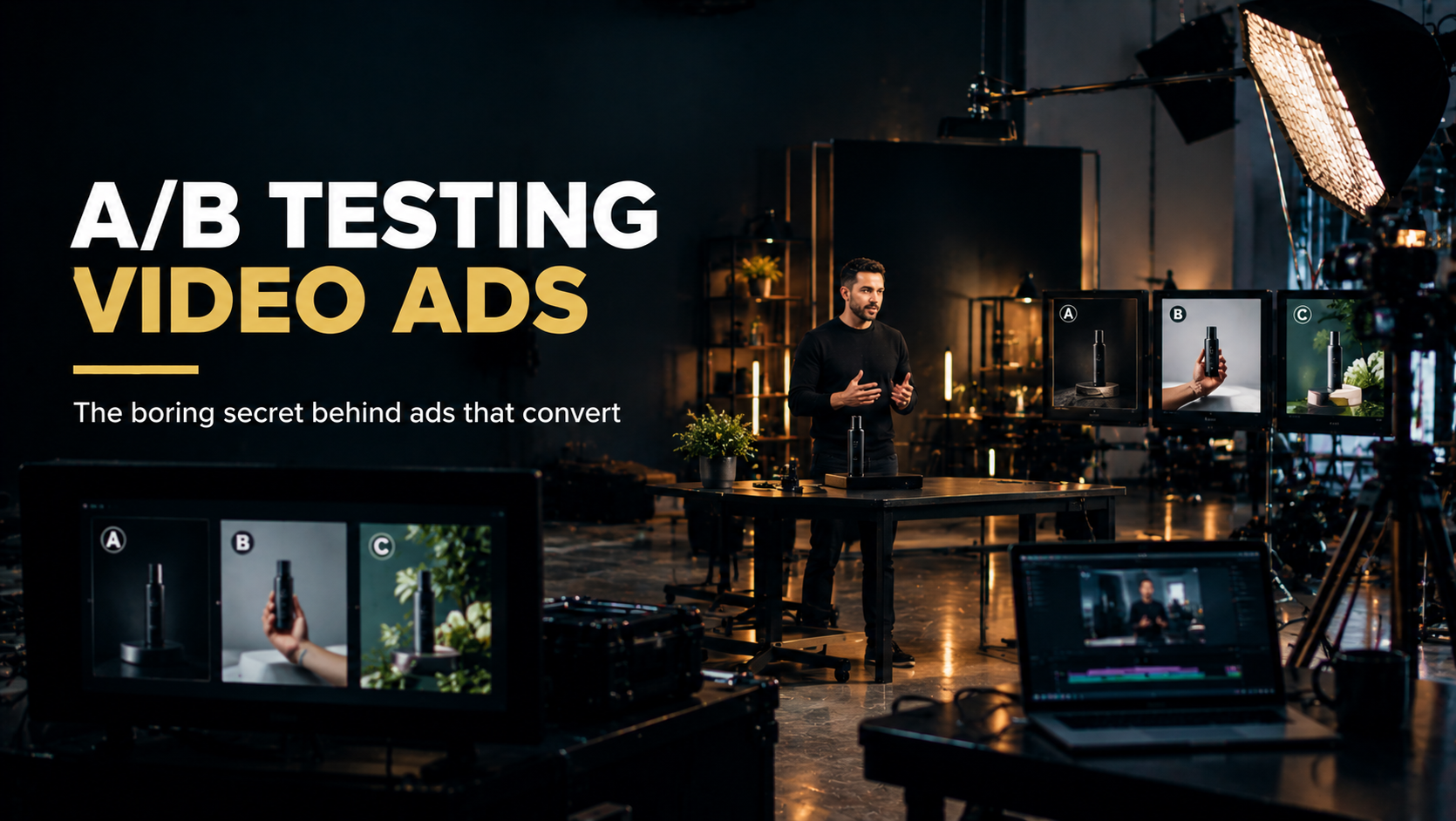
Secret behind ads that convert
There are two ways to decide which video ad to run.
Option one: everyone watches the edits, someone senior says, “I like the second one,” and that becomes the campaign.
Option two: you put the variations in front of the audience and let the data decide.
Option one makes for a much more enjoyable meeting.
Option two gives you something much more useful: evidence.
That is the slightly boring secret behind effective video ad testing.
The best-performing advert is not necessarily the one the creative team prefers, the one with the most expensive production or the one the managing director likes.
It is the one that produces the strongest response from the audience under a properly structured test.
And good A/B testing starts long before you open Meta Ads Manager.
It starts when you plan the shoot.
What is A/B testing for video ads?
A/B testing means comparing different versions of an advert to understand which performs better against a defined objective.
With video advertising, that could mean testing:
Two different hooks
Two offers
Two messaging angles
Different video formats
Different lengths
Different audiences
The important word is different.
A useful test changes a defined variable while keeping the other important elements consistent.
If you change the opening, the offer, the presenter and the audience simultaneously, you may get a winner.
But you will not necessarily know why it won.
That makes the result much less useful for the next campaign.
Change one thing at a time
This is where A/B testing gets boring.
And that is exactly why it works.
Imagine you have two versions of the same video.
Version A opens with:
“Struggling to keep up with your repayments?”
Version B opens with:
“There may be another way to deal with your debts.”
Everything else stays broadly consistent.
Now you have a meaningful hook test.
If one version produces a stronger result, you have learned something about the opening.
But imagine Version B also changes the offer, the presenter, the music and the ending.
Now you have several variables moving at once.
Even if Version B wins, you cannot confidently say what caused the difference.
The lesson is simple:
A test should teach you something, not just give you a winner.
Testing beats taste
Creative judgement still matters.
You need people who understand storytelling, audiences, messaging and production.
But creative judgement should generate the hypotheses.
The audience should test them.
That distinction prevents a common problem in advertising: confusing what feels good with what works.
A polished advert can lose to a simpler one.
A funny opening can lose to a direct one.
A beautifully scripted introduction can lose to a straightforward product demonstration.
And the version everyone expected to win can end up sitting at the bottom of the results.
That is not a failure of creativity.
It is useful information.
The mistake: treating A/B testing as a media-buying problem
A lot of businesses think testing starts once the videos have been delivered.
It doesn't.
If you need to commission a new video every time you want to test a different hook, testing becomes slow and expensive.
By the time the new creative is ready, the campaign may have already moved on.
This is why video production for paid social should be designed around the testing strategy.
Before the shoot, decide what you want to learn.
Then build the production around those questions.
Instead of:
One campaign → one advert
Think:
One campaign → multiple controlled creative variables → multiple testable versions
That changes the entire production process.
A/B testing should influence the way you shoot
Suppose you want to test five different hooks.
Don't film one hook and hope it works.
Film all five.
Want to test two different offers?
Capture both.
Want to compare a talking-head version with a product demonstration?
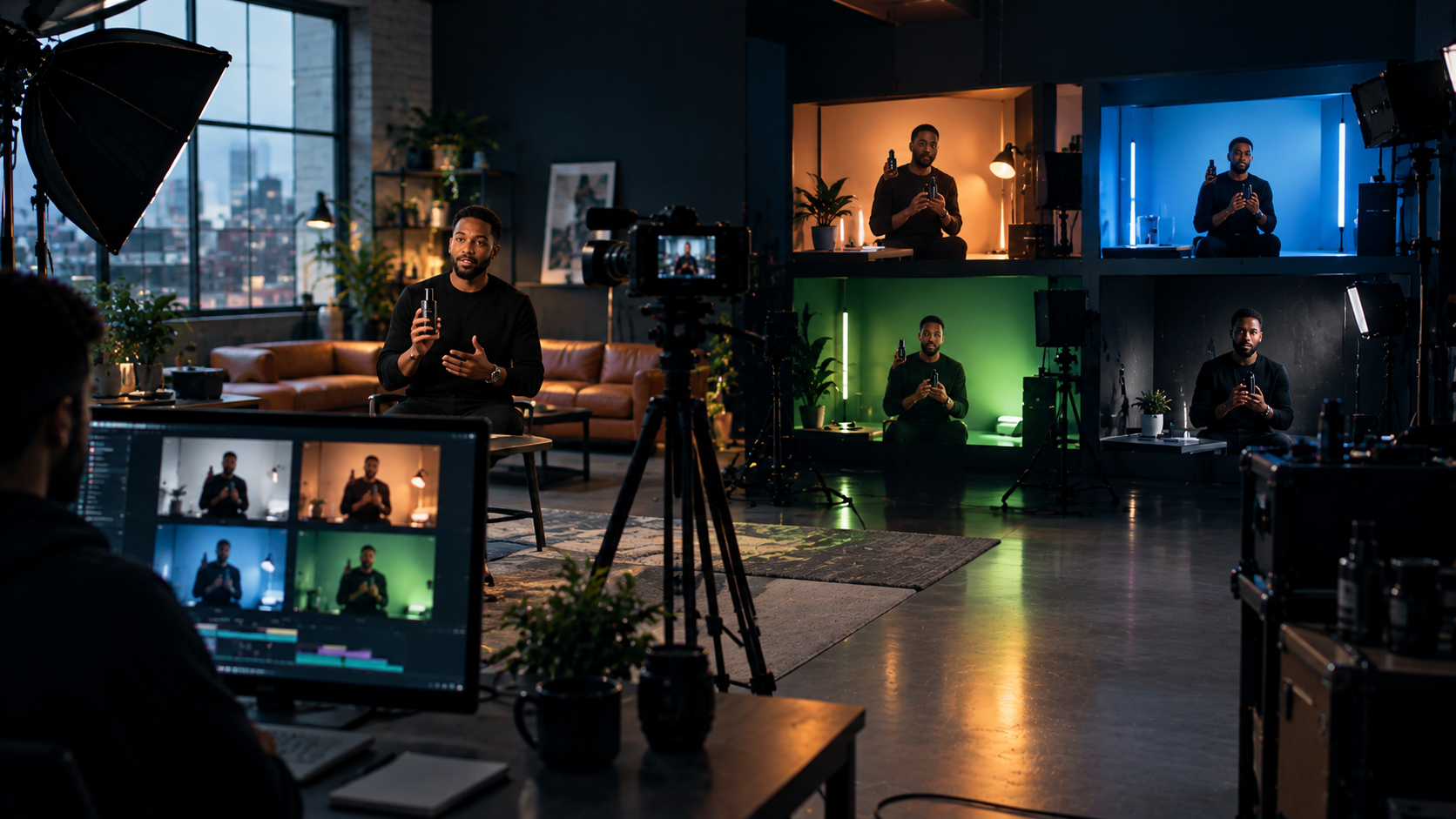
Shoot both formats while the set, talent and crew are already there.
This is where modular production becomes particularly useful.
One production session can capture the components required for an entire creative testing matrix.
The editor then creates the variants.
The media team tests them.
The audience provides the evidence.
And the winners inform the next round.
JT Maxwell: building testing into the production
Our work with JT Maxwell demonstrates what this can look like in practice.
JT Maxwell is a licensed insolvency practice regulated by the IPA, so accuracy and compliance matter when communicating its services.
For its “End-of-Month Wipeout” campaign, we produced 12 videos as a structured set designed for paid social and A/B testing.
The videos explored different hooks and different framings of the same compliant core message.
The important part was not simply producing 12 videos.
It was producing them as a testing system.
The variations were ready from the beginning, meaning the campaign did not have to wait for new production every time another creative hypothesis needed testing.
That is the production lesson:
If you know you want to test it, shoot it before you need it.
The same principle works for completely different products
The method does not depend on the industry.
We used a similar approach with Bangin Spice Mix, but in a completely different category.
For its new product line launch, the production was block-shot to create more than 40 creative variants.
Different hooks, formats and messaging combinations could then be tested and iterated.
Debt services and food products obviously require completely different creative treatment.
The production logic is the same.
Shoot the matrix. Test the variants. Keep the winners. Build from what you learn.
What should you test first?
Not every variable deserves equal attention at the beginning.
A sensible testing sequence starts with the elements most likely to change the audience's response.
1. Test the hook
Start with the opening.
If the first few seconds do not earn attention, the rest of the advert does not get much of a chance.
Try different approaches:
Problem-led
Benefit-led
Curiosity-led
Demonstration-led
Direct statement
Question-led
You are looking for the opening that gives people the strongest reason to keep watching.
2. Test the message angle
Once you have a stronger understanding of the hook, test how the proposition is framed.
The same service can be communicated in very different ways.
For example, a financial service might be positioned around:
Relief
Structure
A specific problem
A practical next step
The underlying service has not changed.
The way it is presented has.
3. Test the format
Now explore how the message is delivered.
A talking-head video might outperform a product demonstration.
A voiceover might outperform direct-to-camera.
A UGC-style treatment might outperform something more traditionally produced.
Again, let the audience decide.
4. Test the audience
Once the creative has been properly tested, audience differences can become much easier to interpret.
A creative that works for one audience segment may not perform the same way for another.
That is valuable information.
Over time, your testing history starts becoming a creative playbook rather than a collection of disconnected campaigns.
Give the test enough time to teach you something
This is another part nobody particularly enjoys.
A winner on day two is not necessarily a winner.
Small amounts of data can produce misleading early results, particularly when spend is limited.
That is why testing should have a defined threshold before the campaign starts.
Decide what you need to see before drawing conclusions.
That might involve a predetermined level of spend, impressions, clicks or conversions depending on the campaign objective.
The exact threshold will vary by account and objective.
The important thing is to establish the rules before you see the results.
Otherwise, it becomes very easy to move the goalposts.
Kill your favourites
This may be the hardest part.
You've spent days making the advert.
The cinematography looks brilliant.
The edit is sharp.
Everyone in the production meeting loved it.
Then the data says another version is performing better.
Switch it off.
That is what testing is for.
A/B testing only works if you are willing to accept an answer you did not expect.
Otherwise, you are not really testing.
You are looking for data to confirm your opinion.
Build a library of what you've learned
The biggest value of A/B testing does not necessarily come from one winning advert.
It comes from what happens after six months of testing.
Imagine your team has recorded:
Which hooks consistently attract attention
Which messaging angles generate action
Which formats perform for different audiences
Which offers work for different segments
Which video lengths are useful for particular objectives
Which creative approaches repeatedly underperform
You now have something much more valuable than a folder full of adverts.
You have a creative playbook.
The next production is no longer starting from a blank page.
You have evidence.
Your production team should know what is being tested
The boring secret behind ads that convert
This is one of the easiest improvements to make.
Do not hand the production team a brief that simply says:
“We need three Facebook ads.”
Tell them what the campaign needs to learn.
For example:
Hook test: five openings
Message test: two positioning angles
Format test: talking-to-camera and demonstration
Length test: 15 and 30 seconds
Now the shoot can be organised around those variables.
The crew knows what needs to be captured.
The talent knows which lines need alternatives.
The editor knows which footage needs to remain interchangeable.
And the paid media team receives assets designed for testing rather than a collection of unrelated videos.
That is much more efficient than discovering the testing requirements after filming has finished.
The goal isn't to find one perfect advert
This is perhaps the most important point.
A/B testing is not about discovering the one advert that will work forever.
It is about creating a process for learning.
Creative changes.
Audiences change.
Offers change.
Platforms change.
What works this month may need another approach later.
The brands that build testing into their content production strategy are better equipped to respond because they are constantly collecting information about what their audience responds to.
The process becomes:
Create → test → learn → iterate → produce → test again.
Not:
Create → launch → hope.
The boring system is the competitive advantage
There is nothing particularly glamorous about changing one variable at a time.
It will not make an exciting presentation slide.
It probably will not impress anyone at the next creative meeting.
But it gives your advertising something far more useful than applause.
It gives you evidence.
And when A/B testing is considered during the production process, you can create enough variations to test properly without commissioning a completely new shoot every time an idea comes along.
At Title Productions, we build productions around the wider content requirement, from creative development and filming through to video production and post-production.
You can also explore our video production work to see how different production approaches can be built around different communication goals.
Because the best question after producing an advert is not:
“Do we like it?”
It is:
“What can we learn from it?”