
Written Testimonials vs Filmed Testimonials: One of These Gets Read
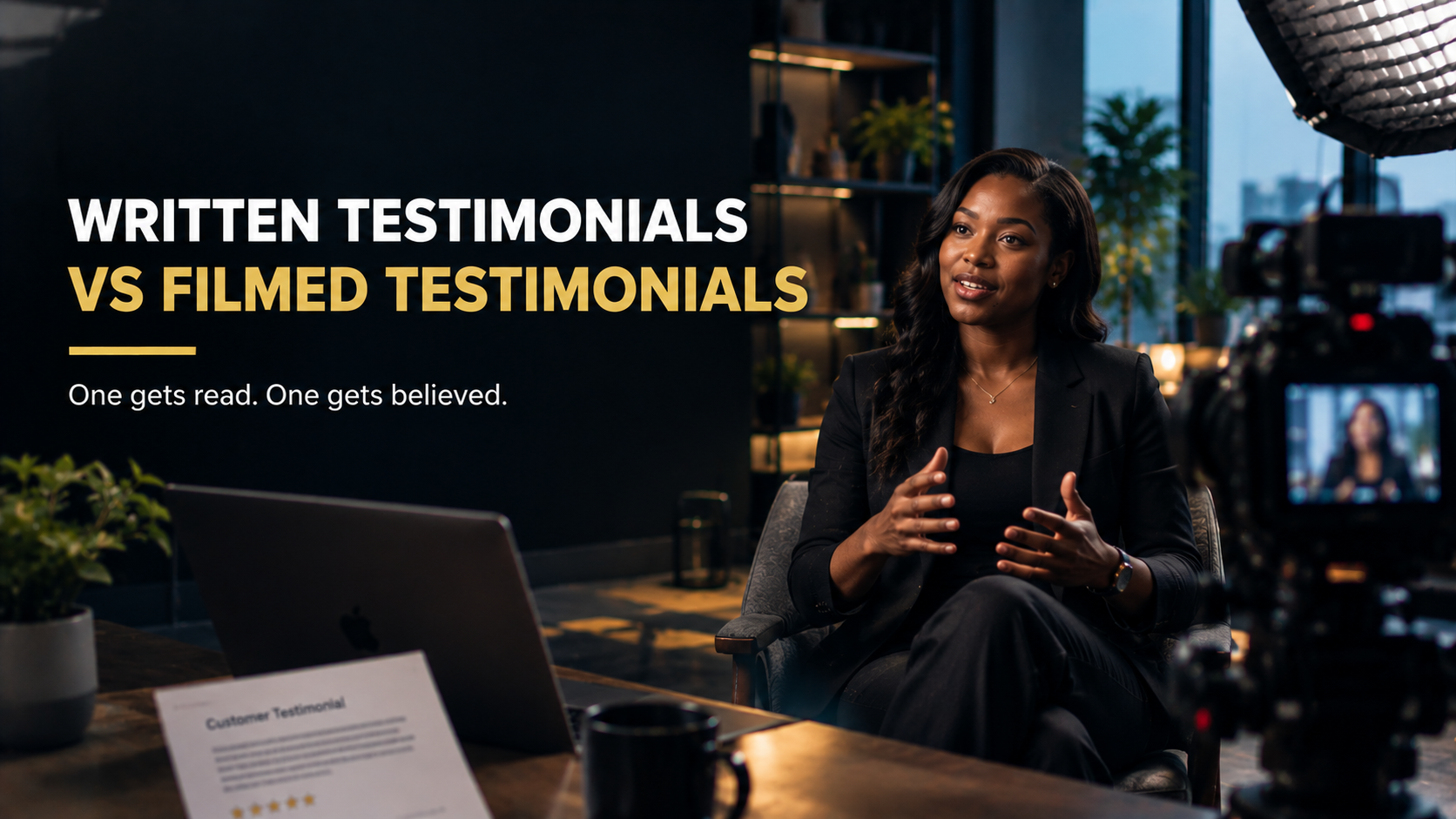
WRITTEN TESTIMONIALS VS FILMED TESTIMONIALS
Quick answer: filmed testimonials tend to carry more credibility because the customer is visible, identifiable and speaking in their own words.
A written testimonial says your business did a good job.
A filmed testimonial lets someone see the person saying it.
That difference matters.
Because let’s be honest about written testimonials.
“Great service, would definitely recommend! – John S.”
You have probably seen hundreds of them.
They sit underneath the hero section, between service descriptions and above the footer. Most people barely register them. Not necessarily because they are untrue, but because there is very little for the reader to judge.
Who is John?
What did you actually do for him?
What problem did you solve?
And, perhaps most importantly, why should a stranger believe him?
Now put John in front of a camera.
Give him a name, a company, a face and the freedom to explain what actually happened.
Suddenly, the testimonial becomes more than a quote.
It becomes evidence.
A Written Testimonial Makes a Claim. A Filmed Testimonial Shows the Person Making It.
This is the fundamental difference.
A written review gives you the customer's words, but removes almost everything around them.
You cannot hear their voice. You cannot see their expression. You cannot watch them pause while trying to explain what changed. You cannot get a sense of whether they are genuinely enthusiastic or simply repeating something polite.
Video brings that context back.
A prospect watching a real customer talk about their experience can make their own judgement about the person on screen.
Do they sound genuine?
Do they understand the problem?
Are they specific about what happened?
Can they explain what changed?
Those little signals add context that a block of text cannot provide.
It is the difference between reading “the restaurant is brilliant” and watching someone you trust describe exactly what they ordered, why they liked it and whether they would go back.
The second gives you something to evaluate.
The Best Testimonial Films Don't Feel Like Testimonials
This is where businesses often get it wrong.
They put a customer in a chair, point a camera at them and ask:
“So, what did you think of our service?”
The customer looks at the camera.
“Yeah, they were really good. Very professional. I'd definitely recommend them.”
Cut.
Technically, that is a testimonial.
It is also incredibly forgettable.
A strong testimonial film feels more like a conversation.
The customer explains:
what their situation looked like before
what problem they needed to solve
why they chose the business
what the experience was actually like
what changed afterwards
what result they saw
The interviewer can guide that conversation without appearing in the finished film.
There is no need to hand the customer a script.
In fact, scripting them too heavily can make the whole thing less believable.
People do not naturally speak in polished marketing copy.
They hesitate. They rephrase things. They remember details halfway through a sentence. They laugh.
Those imperfections are often what make the finished testimonial feel real.
Specifics Are Where the Value Is
“We had a great experience” is nice.
It is not particularly useful.
“We had a great experience and our onboarding time dropped from three weeks to five days” is something a prospect can actually think about.
Specificity gives a testimonial weight.
Ask customers about the problem they had, rather than simply asking whether they liked the service.
What was happening before?
What were they struggling with?
What changed?
What surprised them?
What result did they see?
What would they tell another company considering the same service?
The answers create a story.
And stories are considerably harder to dismiss than generic praise.
Your Customers Don't Need to Sound Like Actors
This is another reason filmed testimonials can work so well.
The customer isn't there to perform.
They're there because they actually used your product or service.
That means the production should support them rather than turn them into a presenter.
Good lighting helps.
Good sound helps even more.
A comfortable environment helps.
An interviewer who knows how to draw out useful answers helps enormously.
But the customer should still sound like themselves.
At Title Productions, our own client testimonial films are built around that principle. We have filmed customers across very different industries and relationships, from EDU Lettings, including Nick discussing a three-year working relationship, through to work for Alan Day Group, where Volkswagen content featured Coldplay's Will Champion.
They are very different stories.
And that is precisely the point.
A testimonial does not need to follow one visual formula to be persuasive. It needs to contain a real person with something credible to say.
You can see more examples in our work.
One Customer Doesn't Have to Represent Everyone
There is another advantage to filmed testimonials that is easy to overlook.
Range.
Your prospects are looking for themselves.
A property company might want to hear from another property company.
A training provider might want evidence from another organisation with similar challenges.
A growing business might want to see what the experience was like for another growing business.
One testimonial can prove that someone was happy.
Several well-chosen testimonials can demonstrate that your business works across different situations.
Think about your testimonial library almost like a portfolio.
Different industries.
Different company sizes.
Different problems.
Different outcomes.
Different personalities.
The wider the range, the easier it becomes for a new prospect to find someone they recognise.
How Do You Get Customers to Agree to Be Filmed?
Most businesses assume customers will say no.
Often, they simply have not asked.
The timing makes a huge difference.
Ask when the customer has just experienced a positive outcome. A project has been delivered. A campaign has launched. A problem has been solved. A measurable result has landed.
The experience is still fresh.
Then remove as much friction as possible.
Tell them what to expect.
Give them the questions beforehand.
Keep the interview focused.
Take the crew to them where possible.
And make it clear how the footage will be used.
The customer shouldn't have to become a production manager just because you want a testimonial.
A well-organised shoot can take surprisingly little of their time while giving you an asset that can keep working for years.
Give Customers Some Control Over the Final Film
There is also a simple way to make people more comfortable with the idea of being on camera:
Explain the approval process.
People are much more likely to agree when they understand that they will not suddenly discover their words being used out of context.
Agree what they are comfortable with.
Be clear about where the footage may appear.
And, where appropriate, give them an opportunity to review the final edit before publication.
There is some paperwork involved when names, faces, brands or endorsement footage are being used commercially, particularly where public figures or third-party rights are involved.
It is not the exciting part of testimonial production.
It is still part of doing it properly.
Don't Put Your Best Testimonial on a Page Nobody Visits
A great testimonial hidden on a dedicated “Reviews” page is doing very little work.
Put it where doubt exists.
That could be:
Your homepage
When someone is deciding whether to trust the business at all.
Service pages
When someone is deciding whether you can solve their particular problem.
Proposals
When the prospect is comparing suppliers.
Follow-up emails
When interest exists but the decision has stalled.
Paid advertising
When you need to establish credibility quickly.
The same customer conversation can be edited into different formats for each environment.
A 60–90 second version can sit on your website.
A 15-second section can become a social clip.
A particularly strong sentence can become a short paid ad.
The transcript can provide written pull quotes.
One conversation can therefore become a small library of proof.
Written Testimonials Still Have a Job

customer testimonial video
This is not an argument for deleting every written review from your website.
Written testimonials are quick to scan.
They work well alongside service information.
They can be useful for search visibility and can give visitors immediate reassurance without asking them to press play.
The problem is relying on them alone.
If your website contains twenty written reviews but not one customer willing to put their face behind what they are saying, you are missing an opportunity.
The strongest approach is usually a mixture.
Written reviews for speed.
Filmed testimonials for depth.
Specific case studies for evidence.
Together, they create a much stronger picture of what it is actually like to work with you.
Your Happiest Customers Are Already Part of Your Marketing
You don't necessarily need another campaign.
You may already have the raw material.
Think about the customers who have been with you for years.
The ones who send referrals.
The ones who were genuinely excited when a project launched.
The ones who tell you, “You made that so much easier.”
Those are the people worth asking.
A testimonial is not simply another piece of content.
It is a customer telling the next customer what you were like to work with.
And because it comes from outside your business, it can do something your own marketing can never completely replicate.
It lets someone else make the case for you.
That is why a filmed testimonial can be worth considerably more than another paragraph of five-star reviews.
Not because video magically makes people buy.
Because a real person, speaking openly about a real experience, gives the prospect something they can actually judge for themselves.
And sometimes, that is the difference between “they look good” and “I trust them.”
If you are building a library of customer stories rather than producing one-off videos, our video production services can support the filming, editing and content versions needed to make each testimonial work across your marketing.
The Best Testimonial Is the One Your Customer Actually Believes
Forget asking customers to memorise five-star sentences.
Don't tell them what to say.
Don't turn them into actors.
Give them a comfortable environment, good questions and enough space to tell the story properly.
Then let the prospect decide.
Because the most persuasive part of a testimonial isn't the production.
It is the person standing in front of the camera saying:
“This is what happened when we worked with them.”