
Growing Fast? Congrats. Here’s How to Not Look Like a Faceless Corporation
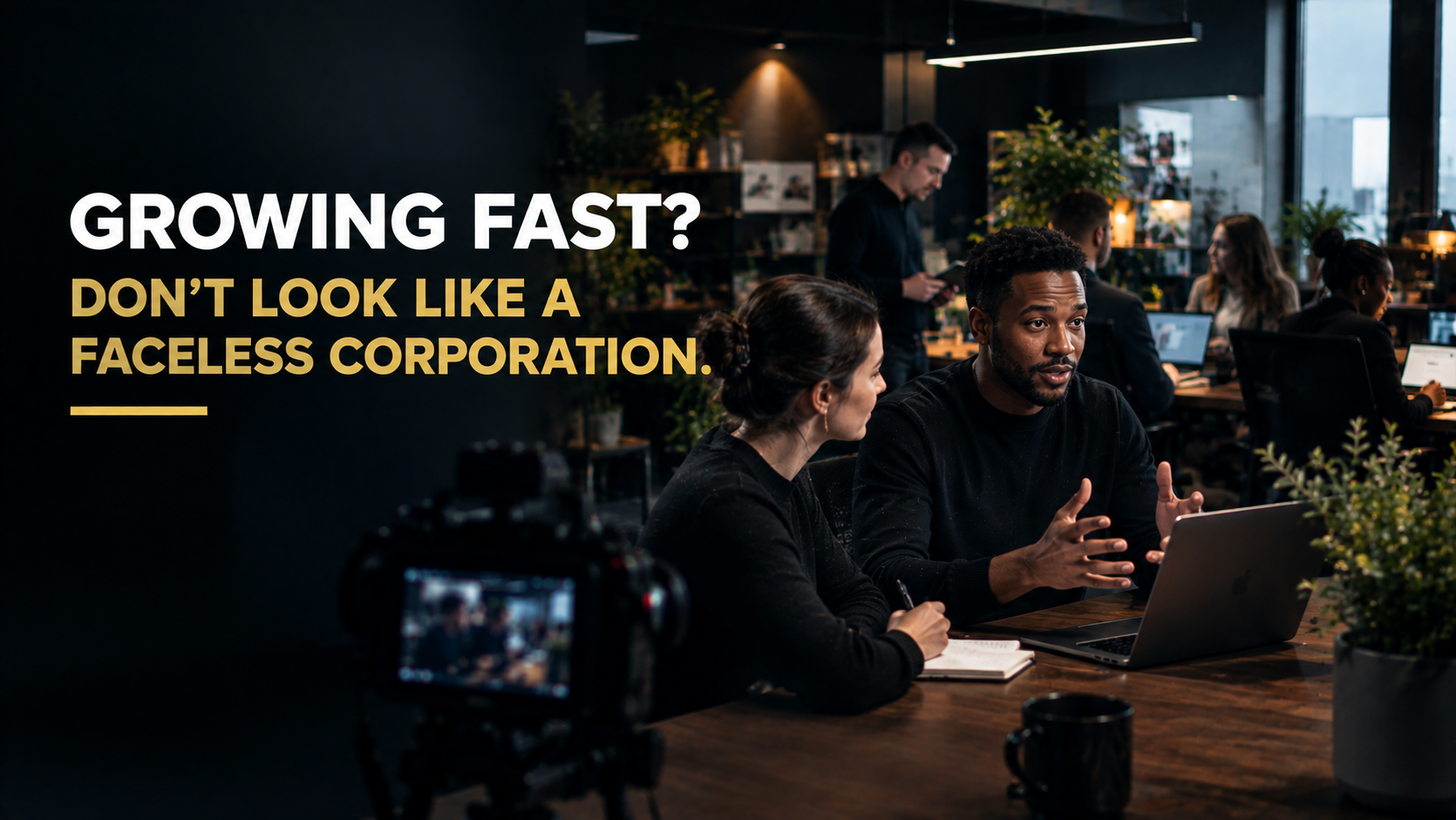
Here’s How to Not Look Like a Faceless Corporation
Nobody warns you about this part of growth.
You grow.
More staff. More customers. More systems. Bigger premises. More departments. More meetings about the meetings.
Which is exactly what you wanted.
Then one day, a longtime customer says:
“You’ve got quite big now, haven’t you?”
And somehow, it doesn't sound entirely like a compliment.
What they are really saying is that the thing that made them trust you in the first place has become harder to see.
The people.
The personality.
The care.
The feeling that there was an actual human being on the other end of the phone.
It probably still exists.
But invisible trust is difficult to maintain.
As businesses scale, the personal experience that built the brand often gets replaced by processes. Processes are useful. Customers just don't necessarily see them.
They see the invoice.
The automated email.
The corporate LinkedIn post.
The generic “we're delighted to announce” update.
And suddenly, the company that once felt like a group of people has started to feel like a company.
Why does growth make a business feel less personal?
Early-stage businesses have an advantage they rarely recognise.
Everyone is visible.
The founder might answer the phone.
The sales person knows the customer by name.
The person doing the work might be the person sending the update.
Customers know who they are dealing with.
As the business grows, that naturally changes.
Departments appear.
Responsibilities are distributed.
Communication becomes more structured.
The founder is no longer involved in every conversation.
None of that is necessarily a problem.
The problem is what happens when the human side of the business disappears from the brand altogether.
Your customers may still be dealing with brilliant people.
They just cannot see them.
And if a competitor is showing its team, its work and its customers every week, that business can start to feel more familiar.
Not because it is necessarily better.
Because it is visible.
Your business has not become less human. Your marketing has.
This is an important distinction.
You do not need to manufacture personality.
You already have it.
Your employees have stories.
Your customers have experiences.
Your projects have challenges.
Your workplace has character.
Your growth has a story.
Your expertise has a human face.
The problem is that most of these things never make it into the marketing.
Instead, businesses often communicate growth through announcements.
“We are delighted to announce our new office.”
“We are pleased to welcome our latest team member.”
“We have expanded our services.”
All technically correct.
All remarkably easy to scroll past.
The better question is:
What does this change mean for the people who already trust us?
That is where the story becomes interesting.
Trust needs to stay visible as you scale
Think about the difference between these two messages.
“We've moved into a larger premises.”
That can sound like:
The company is getting bigger. Things might be getting more expensive.
Now tell the same story differently.
“Three years ago, we were working from a much smaller space. Today, we've got room for a bigger team, more equipment and more capacity for our customers.”
Same fact.
Different meaning.
The second version makes existing customers part of the journey.
It says:
You helped us get here.
That is powerful because growth should not feel like something that happened to your customers.
It should feel like something they have been part of.
This is where an ongoing content programme matters
A single brand film can introduce a company brilliantly.
But it cannot keep the company feeling current forever.
People change.
Teams grow.
Projects finish.
Customers arrive.
Products launch.
Premises change.
Milestones happen.
New stories appear every month.
So rather than treating video as an occasional campaign, businesses can build an ongoing content production programme around the things that are already happening.
The goal is simple:
Keep the business visible.
Not polished beyond recognition.
Not artificially “humanised”.
Just visible.
What should an ongoing content programme actually include?
It does not need to mean filming every Tuesday.
A practical programme might work monthly or quarterly, depending on the business, and combine several types of content.
People content
Show the humans behind the company.
That could include:
New team members
Employee profiles
Founder stories
Day-in-the-life content
Expertise-led videos
Behind-the-scenes moments
Team culture
Customers do not need to meet every employee.
But seeing real people repeatedly makes a growing business easier to understand.
Work content
Show what customers are actually paying for.
Film the project.
Show the process.
Explain the difficult bit.
Capture the finished result.
Let people see the expertise rather than simply being told that it exists.
This is particularly valuable for businesses selling something that is difficult to explain through static marketing.
Customer content
Your customers are part of the story too.
Testimonials are useful, but there is more to customer content than asking someone to stand against a wall and say nice things about you.
Show the relationship.
Show the problem.
Show the result.
Let customers explain what changed.
And keep refreshing those stories as the customer base grows.
Milestone content
Growth creates plenty of stories.
New premises.
New products.
New hires.
Anniversaries.
Major projects.
Expansion.
Partnerships.
Awards.
The mistake is treating these as press releases with cameras.
A milestone becomes more interesting when it has people attached to it.
Who started the business?
Who was there early on?
What has changed?
What does the next stage mean?
Who helped make it happen?
Suddenly, a corporate announcement becomes a story.
Secure24: letting the content grow with the business

Business video production
We have seen this model work through ongoing production relationships.
Secure24 started with us at an early stage, using trust-focused films to help establish the business and communicate what sat behind the brand.
As the business grew, the content requirements changed too.
The production moved into paid campaign content and a broader ongoing content programme.
That progression matters.
The business did not need the same film repeatedly.
It needed its content to evolve alongside the business.
The company grew.
The audience grew.
The production strategy grew with it.
EDU Lettings: making milestones part of the story
EDU Lettings provides another example from a completely different sector.
Property lettings is built heavily around relationships and trust, so maintaining that human connection matters.
Their ongoing content has included milestone storytelling, including their three-year celebration and Nick's testimonial.
Rather than treating the milestone as simply another company announcement, film gives the business a way to put people at the centre of the story.
That makes the growth feel tangible.
There are faces attached to it.
There is history attached to it.
And there is a reason for customers to care.
Bangin Spice Mix: keeping character through growth
Then there is Bangin Spice Mix, a D2C food brand operating in a completely different world.
Food brands live or die on character.
The product needs to look good, obviously.
But the personality surrounding it matters too.
Ongoing production helped support new product-line launches while retaining the distinctive character that attracted the original audience.
Again, the industry changes.
The principle doesn't.
Keep showing the people, the product and the story as the business develops.
Why ongoing production beats starting from scratch
There is also a practical reason to move towards a content programme.
One-off productions restart from zero.
New briefing.
New planning.
New crew conversations.
New understanding of the brand.
New production setup.
New decisions about what the business should look and sound like.
An ongoing production relationship gets easier over time.
The creative team already understands the business.
The visual language is established.
The people behind the camera become familiar with the people in front of it.
Previous content shows what has already been covered.
And each shoot adds another layer to the content library.
That creates something one-off production cannot easily provide:
continuity.
Trust is a frequency, not an event
This is perhaps the biggest shift in thinking.
A company anniversary film might be excellent.
A new brand film might be excellent.
A beautifully produced corporate video might be excellent.
But trust is not built by one excellent video sitting on your website for three years.
It is reinforced through repeated evidence.
Your customers keep seeing the people.
They see the work.
They see customers like themselves.
They see the business moving forward.
They see that the company they chose is still made up of people who care about what they do.
That is what an ongoing content production strategy can provide.
Not constant noise.
Consistency.
You do not need to manufacture personality
One of the worst ways to make a growing company feel human is to force it.
Suddenly everyone is laughing around a conference table.
Someone is throwing a paper aeroplane.
There is a suspiciously spontaneous coffee-making scene.
Nobody talks like this in real life.
You do not need any of it.
If your business is serious, let it be serious.
If your team is funny, let them be funny.
If your work is technical, explain the technical side.
If your customers care about relationships, show those relationships.
Human content does not mean pretending to be casual.
It means allowing real people, real work and real stories to remain visible.
The real value is continuity
The businesses that handle growth well do not necessarily stay small-looking.
They can look successful.
They can look established.
They can look like serious organisations.
The goal is not to hide the fact that you have grown.
It is to make sure growth does not erase the people who made the business worth trusting in the first place.
That means building content into the growth plan rather than treating it as something to remember when there is a big announcement.
People content.
Work content.
Customer stories.
Milestones.
Behind the scenes.
New products.
New chapters.
Keep capturing them.
At Title Productions, we work with businesses that need more than a one-off video, building production around the wider content requirement and the stories that continue to develop.
You can explore our video production work or see the wider production services we offer.
Because the objective is not to make a growing company look smaller.
It is to make sure that when the company gets bigger, people can still see the humans inside it.